


The Vanguard ETF Warren Buffett Endorses That Young Investors Should Buy and Hold Forever
Key Points
Buffett's often regarded as the world's greatest stock picker, but he has important advice for his estate.
He recommends his estate do something distinctly different than mirror Berkshire Hathaway's stock holdings.
Interestingly, he's not the only market veteran making this recommendation, either.
- Motley Fool Issues Rare "Total Conviction" Buy Alert ›
You likely know him best as a brilliant stock picker, and the key reason Berkshire Hathaway (NYSE: BRKA) (NYSE: BRKB) shares typically outperformed the S&P 500 during the 55 years he served as CEO of the conglomerate.
The fact of the matter is that Warren Buffett wishes you wouldn't follow in his exact footsteps. He'd much rather most people do things a little differently than he did, largely because most investors can't do exactly what Buffett did and how he did it while heading up Berkshire.
Missed Nvidia in 2009? This Rare Signal Is Flashing Again. In 2009, a "Double Down" signal flashed for a little-known chipmaker called Nvidia. For the first time in years, that same "Total Conviction" signal is flashing for a company 1/100th the size of Nvidia. Continue »
So what does he want you to do? Buy and hold the simplest of all investment options. That's the Vanguard S&P 500 ETF (NYSEMKT: VOO), which is merely meant to mirror the performance of the aforementioned S&P 500.
Buffett makes no bones about it
He's never been shy about saying it. As Buffett plainly put in writing in his 2013 letter to Berkshire shareholders, "My advice to [my estate's] trustee could not be more simple: Put 10% of the cash in short-term government bonds and 90% in a very low-cost S&P 500 index fund. (I suggest Vanguard's.)"
Of course, that's for what will eventually be his estate's money. That doesn't necessarily mean it's the best decision for you.
It's what Buffett says immediately after that, however, that hits home for everyone: "I believe the trust's long-term results from this policy will be superior to those attained by most investors -- whether pension funds, institutions or individuals -- who employ high-fee managers."
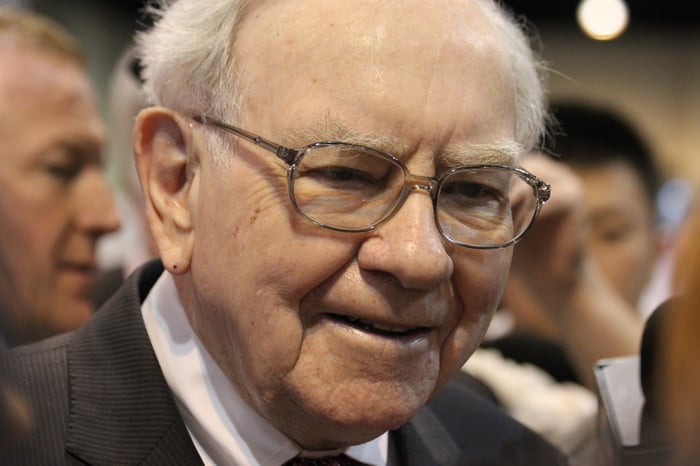
Image source: The Motley Fool.
The thing is, history says he's right.
This begs the question... why didn't Buffett follow his own advice for Berkshire Hathaway? Mostly because it didn't make sense to.
Not your typical equity portfolio
Although it's often treated as one or the other, Berkshire is neither a conventional company nor a mutual fund, even though it owns a portfolio of stocks. Buffett's made it abundantly clear that Berkshire Hathaway is first and foremost an insurer that requires reliable cash flow, some of which comes from dividends, but much of which is generated by the dozens of cash-generating businesses that Berkshire outright owns.
These include Shaw flooring, Fruit of the Loom, Dairy Queen, railroad BNSF, and Duracell, just to name a few. These companies collectively generated $44.5 billion worth of operating earnings for the $1.1 trillion behemoth last fiscal year, making it much easier for the conglomerate to remain patient with some of its stock holdings. It's not a luxury that average investors with typical portfolios have.
So who knows? If Berkshire Hathaway's idle cash and Buffett's personal wealth were not intertwined with a large collection of other cash-generating businesses, he may well have used it to buy and hold the Vanguard S&P 500 ETF, or its equivalent SPDR S&P 500 ETF Trust (NYSEMKT: SPY).
One thing's for sure either way. Buffett certainly isn't the only stock-picking genius who suggests that trying to beat the market -- by buying and selling individual stocks -- is a mistake for most people. Plenty of experts recognize that a more active approach to investing often draws you into or out of a position at the wrong time. Buffett's just trying to steer his estate around those traps that are so easy for investors to fall into without realizing it.
Should you buy stock in Vanguard S&P 500 ETF right now?
Before you buy stock in Vanguard S&P 500 ETF, consider this:
The Motley Fool Stock Advisor analyst team just identified what they believe are the 10 best stocks for investors to buy now… and Vanguard S&P 500 ETF wasn’t one of them. The 10 stocks that made the cut could produce monster returns in the coming years.
Consider when Netflix made this list on December 17, 2004... if you invested $1,000 at the time of our recommendation, you’d have $380,579!* Or when Nvidia made this list on April 15, 2005... if you invested $1,000 at the time of our recommendation, you’d have $1,359,789!*
Now, it’s worth noting Stock Advisor’s total average return is 931% — a market-crushing outperformance compared to 212% for the S&P 500. Don't miss the latest top 10 list, available with Stock Advisor, and join an investing community built by individual investors for individual investors.
See the 10 stocks »
*Stock Advisor returns as of October 15, 2026.
James Brumley has no position in any of the stocks mentioned. The Motley Fool has positions in and recommends Berkshire Hathaway and Vanguard S&P 500 ETF. The Motley Fool has a disclosure policy.
Recommended Articles


