


United States Dollar Index extends decline to near 101.80 after Fed Warsh’s remarks
- The US Dollar Index posts fresh 10-day low near 101.80 even as Fed’s Warsh stresses on price stability.
- Fed’s Warsh said that right now we are witnessing structural growth and investment surge.
- Fed’s Hammac warns that lower-income Americans are struggling with inflation.
The US Dollar (USD) delivers a negative reaction after remarks from Federal Reserve (Fed) Chair Kevin Warsh at the Fireside Chat with International Monetary Fund (IMF) Managing Director Kristalina Georgieva.
As of writing, the US Dollar Index (DXY), which tracks the Greenback’s value against six major currencies, is down 0.15% to near 101.80, the lowest level seen in 10 days.
US Dollar Price This week
The table below shows the percentage change of US Dollar (USD) against listed major currencies this week. US Dollar was the weakest against the New Zealand Dollar.
| USD | EUR | GBP | JPY | CAD | AUD | NZD | CHF | |
|---|---|---|---|---|---|---|---|---|
| USD | -0.36% | -0.52% | -0.14% | -0.69% | 0.41% | -0.70% | -0.39% | |
| EUR | 0.36% | -0.08% | 0.21% | -0.29% | 0.78% | -0.32% | 0.01% | |
| GBP | 0.52% | 0.08% | 0.25% | -0.21% | 0.86% | -0.22% | 0.07% | |
| JPY | 0.14% | -0.21% | -0.25% | -0.41% | 0.67% | -0.54% | -0.13% | |
| CAD | 0.69% | 0.29% | 0.21% | 0.41% | 1.10% | -0.12% | 0.30% | |
| AUD | -0.41% | -0.78% | -0.86% | -0.67% | -1.10% | -1.07% | -0.74% | |
| NZD | 0.70% | 0.32% | 0.22% | 0.54% | 0.12% | 1.07% | 0.29% | |
| CHF | 0.39% | -0.01% | -0.07% | 0.13% | -0.30% | 0.74% | -0.29% |
The heat map shows percentage changes of major currencies against each other. The base currency is picked from the left column, while the quote currency is picked from the top row. For example, if you pick the US Dollar from the left column and move along the horizontal line to the Japanese Yen, the percentage change displayed in the box will represent USD (base)/JPY (quote).
In the event, Fed Chair Warsh stressed on achieving price stability, adding that he will make judgements at the October and December meetings. Warsh praised government policies being key driver to rising investments in the economy.
Warsh flags investment surge and AI risks but avoids pre-committing on rates
Fed Chair Warsh’s speech scores 5.6/10 on the FXS Speechtracker, modestly below the 6.1/10 established baseline, pointing to a slightly less impactful tone despite broadly steady messaging. The admission of being “over-scarred from the global financial crisis” underscores a cautious bias toward financial stability even as Warsh highlights structural growth and an investment surge driven by “good policies,” suggesting a guarded hawkish stance rather than an aggressive one. Warsh’s focus on AI, upcoming field hearings, and task forces to build new intellectual capital reinforces a forward-looking but non-committal approach, with explicit refusal to prejudge the October and December FOMC meetings keeping Dollar traders focused on data rather than guidance.
The FXS Fed Sentiment Index was unchanged, moving 0.00 points to a level of 127.51, which keeps the overall stance firmly in hawkish territory well above the neutral 100 mark. The lack of index movement, despite the slightly softer FXS Speechtracker score, indicates that Warsh’s remarks are seen as broadly consistent with the prevailing hawkish policy framework, leaving Dollar and broader FX expectations largely intact.
Several Fed members have already stressed on containing elevated price pressures, which are hurting households.
Hammack flags inflation mindset risks as Fed tone stays firmly hawkish
Fed’s Hammack delivers a moderately hawkish message, with a 7.2/10 FXS Speechtracker score slightly softer relative to the historical average of 7.6/10 but still signaling concern over persistent price pressures. The emphasis on lower-income Americans struggling with inflation, rising input costs, and the risk of an entrenched “inflation mentality” points to openness to more aggressive policy action if inflation expectations drift higher, especially given the view that financial conditions do not yet appear restrictive and the neutral rate is uncertain.
The FXS Fed Sentiment Index slipped by 0.25 points to 127.92, indicating a modest tonal pullback but remaining well above the 100 neutral mark. This keeps the broader Fed stance in clearly hawkish territory despite the slight decline, aligning with Hammack’s caution on inflation dynamics and the potential need for firmer policy if an inflationary mindset takes hold.
US Dollar Index Technical Analysis
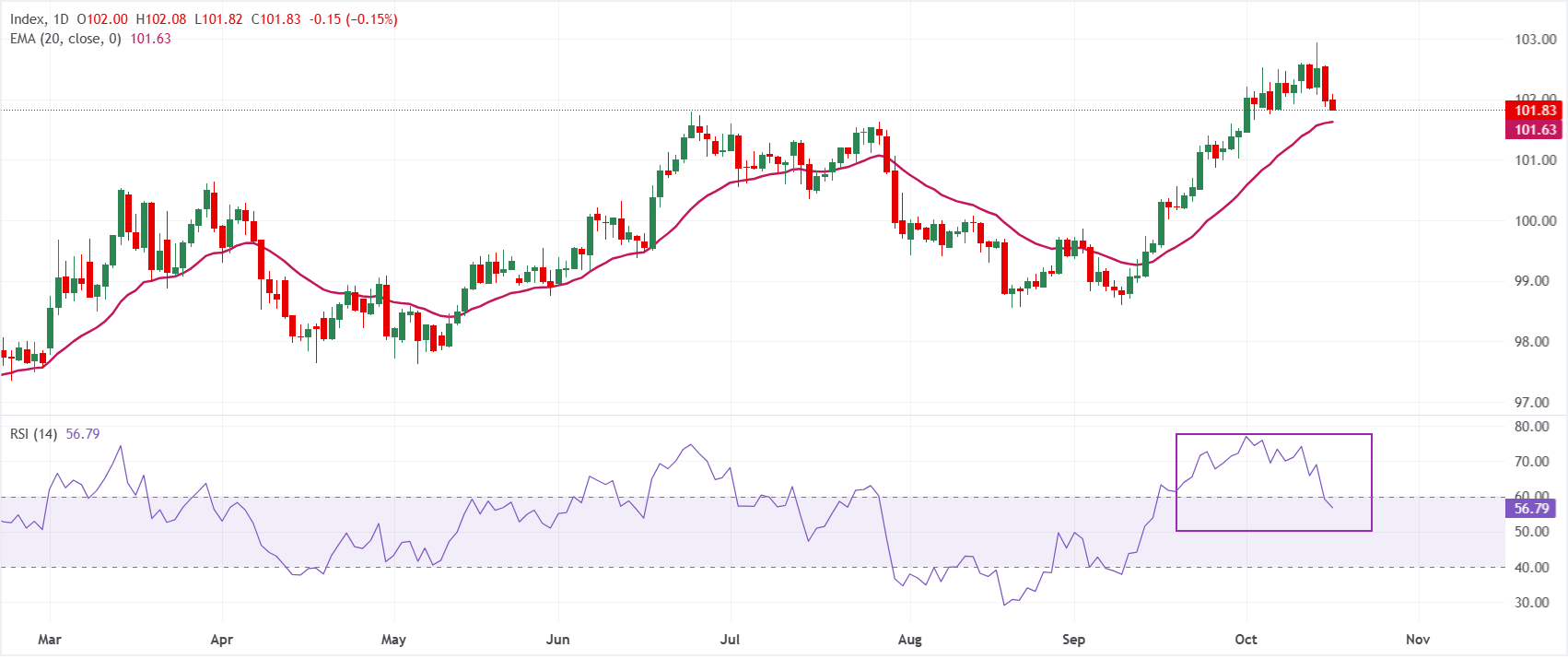
In the daily chart, Dollar Index Spot trades at 101.83. The near-term bias is mildly bullish as price holds above the 20-day exponential moving average (EMA) at 101.63, suggesting underlying demand after the recent recovery from sub-100 levels. The Relative Strength Index (14) at 56.79 stays in neutral-to-positive territory, hinting that upside momentum is moderating but not yet deteriorating.
On the downside, initial support is defined by the 20-day EMA at 101.63, which acts as the primary technical floor while the index consolidates above it. As long as this level contains pullbacks, the broader constructive tone is likely to persist, though a decisive break lower would signal that the bullish phase is losing traction.
(The technical analysis of this story was written with the help of an AI tool. Know more.)
Fed FAQs
Monetary policy in the US is shaped by the Federal Reserve (Fed). The Fed has two mandates: to achieve price stability and foster full employment. Its primary tool to achieve these goals is by adjusting interest rates. When prices are rising too quickly and inflation is above the Fed’s 2% target, it raises interest rates, increasing borrowing costs throughout the economy. This results in a stronger US Dollar (USD) as it makes the US a more attractive place for international investors to park their money. When inflation falls below 2% or the Unemployment Rate is too high, the Fed may lower interest rates to encourage borrowing, which weighs on the Greenback.
The Federal Reserve (Fed) holds eight policy meetings a year, where the Federal Open Market Committee (FOMC) assesses economic conditions and makes monetary policy decisions. The FOMC is attended by twelve Fed officials – the seven members of the Board of Governors, the president of the Federal Reserve Bank of New York, and four of the remaining eleven regional Reserve Bank presidents, who serve one-year terms on a rotating basis.
In extreme situations, the Federal Reserve may resort to a policy named Quantitative Easing (QE). QE is the process by which the Fed substantially increases the flow of credit in a stuck financial system. It is a non-standard policy measure used during crises or when inflation is extremely low. It was the Fed’s weapon of choice during the Great Financial Crisis in 2008. It involves the Fed printing more Dollars and using them to buy high grade bonds from financial institutions. QE usually weakens the US Dollar.
Quantitative tightening (QT) is the reverse process of QE, whereby the Federal Reserve stops buying bonds from financial institutions and does not reinvest the principal from the bonds it holds maturing, to purchase new bonds. It is usually positive for the value of the US Dollar.
Recommended Articles


