


Not Broadcom. Not AMD. Nvidia's Biggest Threat Continues to Be Something Near and Dear to Its Heart.
Key Points
Nvidia, Broadcom, and Advanced Micro Devices (AMD) have taken full advantage of otherworldly enterprise spending on AI-accelerating chips.
Though AMD could slowly chip away at Nvidia’s graphics processing unit (GPU) virtual monopoly, neither it nor Broadcom are a serious threat to its compute dominance.
On the other hand, some of Nvidia’s largest customers, by net sales, may upend its parabolic ascent.
- 10 stocks we like better than Nvidia ›
In the mid-to-late 1990s, the internet changed corporate America forever, giving businesses access to new selling and marketing channels. For decades, investors have been waiting, often impatiently, for Wall Street's next "internet moment." The evolution of artificial intelligence (AI) has delivered.
Empowering software and systems to make split-second, autonomous decisions is a multitrillion-dollar global opportunity, and Wall Street's largest public company, Nvidia (NASDAQ:NVDA), is at the heart of it. Nvidia, along with specialty and AI-accelerated chipmakers Broadcom (NASDAQ:AVGO) and Advanced Micro Devices (NASDAQ:AMD), better known as "AMD," are the backbone of enterprise data centers.
Missed AI’s "Act 1"? Act 2 Could Be 15x Bigger. Most investors think they missed the AI boat because they didn't buy Nvidia in 2005. But according to our analysts, we’re only at the end of "Act 1"—the R&D phase. "Act 2" is the global rollout. Continue »

Image source: Nvidia.
Broadcom and AMD aren't a threat to Nvidia's data center dominance
Some investors view Broadcom and AMD as the biggest threats to Nvidia's near-monopoly on graphics processing units (GPUs) in AI-accelerated data centers. While AMD's Instinct GPUs are less costly than Nvidia's GPUs and could, over time, (pardon the necessary pun) chip away at Nvidia's market share, AMD isn't a threat to Nvidia's compute dominance.
Likewise, Broadcom focuses on custom application-specific integrated circuits (ASICs) rather than general-purpose GPUs, which are Nvidia's domain. Both companies can coexist among hyperscalers without cannibalizing each other.
Nvidia $NVDA Q2’27 EARNINGS HIGHLIGHTS
— Wall St Engine (@wallstengine) August 26, 2026
🔹 Revenue: $96.2B (Est. $92.2B) 🟢; +106% YoY
🔹 Adj. EPS: $2.22 (Est. $2.10) 🟢; +120% YoY
🔹 Data Center: $89.0B (Est. $85.8B) 🟢; +117% YoY
🔹 Adj Gross Margin: 75.0% (Est. 75%) 🟡; +250 bps YoY
Q3 Guide:
🔹 Revenue: $108.0B +/- 2%… pic.twitter.com/zVimcTYVot
But this doesn't mean Nvidia has a clear runway to success -- even though the company's 117% year-over-year Data Center segment sales growth in the fiscal second quarter suggests it does.
While Nvidia's aggressive innovation timeline (one new AI chip per year) should keep its compute advantages secure, another threat looms large... and it's near and dear to the company's heart.

Image source: Getty Images.
Nvidia's top customers are, ironically, its biggest risk
It's no secret that many of Wall Street's most influential businesses are using Nvidia's GPUs in their AI-accelerated data centers. Industry titans such as Amazon (NASDAQ:AMZN), Microsoft (NASDAQ:MSFT), and Meta Platforms (NASDAQ:META) have spent a small fortune purchasing Nvidia's superior AI hardware.
But these companies also share a similarity beyond just being some of Nvidia's largest clients. They're also internally developing GPUs for their respective data centers:
- Amazon has developed a custom machine learning chip, Inferentia2, as well as Trainium, its AI training and inference chip.
- Earlier this year, Microsoft unveiled its Maia 200 inference chip, with the Maia 300 expected to be unveiled any day now.
- Meta's Training and Inference Accelerator program has developed four AI chips over the last two years.
Will the AI-accelerating chips developed by Nvidia's customers be superior to Nvidia's hardware? Highly unlikely.
Will Amazon, Microsoft, or Meta sell their chips externally and become serious rivals to Nvidia in general-purpose GPUs? Microsoft may sell its Maia 300 chips externally, but it's not a serious rival at this point.
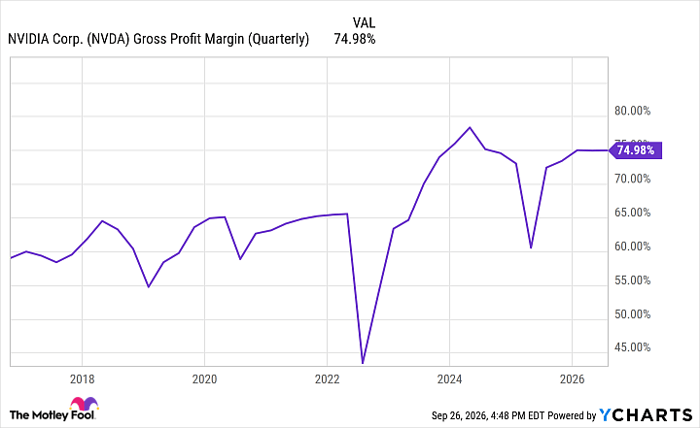
NVDA Gross Profit Margin (Quarterly) data by YCharts
But can Nvidia's top customers, by net sales, pack their data centers with in-house chips that are considerably less costly and easier to access than Nvidia's hardware? Absolutely. Nvidia's opportunity to win data center real estate shrinks as its leading customers ramp up their own AI chip programs.
Furthermore, Nvidia's pricing power has benefited immensely from persistent AI hardware shortages. With several of its top clients ramping up AI chip production, this ongoing supply shortage should wane. If GPUs become more accessible, Nvidia's pricing power, and thus its gross margin, would likely suffer.
Ironically, there's no bigger threat to Nvidia than its top customers.
Should you buy stock in Nvidia right now?
Before you buy stock in Nvidia, consider this:
The Motley Fool Stock Advisor analyst team just identified what they believe are the 10 best stocks for investors to buy now… and Nvidia wasn’t one of them. The 10 stocks that made the cut could produce monster returns in the coming years.
Consider when Netflix made this list on December 17, 2004... if you invested $1,000 at the time of our recommendation, you’d have $383,680!* Or when Nvidia made this list on April 15, 2005... if you invested $1,000 at the time of our recommendation, you’d have $1,382,954!*
Now, it’s worth noting Stock Advisor’s total average return is 937% — a market-crushing outperformance compared to 214% for the S&P 500. Don't miss the latest top 10 list, available with Stock Advisor, and join an investing community built by individual investors for individual investors.
See the 10 stocks »
*Stock Advisor returns as of September 29, 2026.
Sean Williams has positions in Amazon and Meta Platforms. The Motley Fool has positions in and recommends Advanced Micro Devices, Amazon, Broadcom, Meta Platforms, Microsoft, and Nvidia. The Motley Fool has a disclosure policy.
Recommended Articles


