


Will President Trump Crash the Stock Market? History Says This Could Come Next.
Key Points
Although the stock market has performed well in 2026, rising inflation and higher interest rates could derail the rally.
How much longer can the generative AI boom carry the market?
- These 10 stocks could mint the next wave of millionaires ›
You can use a lot of words to describe Donald Trump's administration, but boring is not one of them. Since Trump's election victory in 2024, he has embarked on a series of unorthodox economic policies that are starting to reshape the U.S. economy and its relationship with the rest of the world.
Let's dig deeper into the reasons a downturn could be on the horizon.
Missed AI’s "Act 1"? Act 2 Could Be 15x Bigger. Most investors think they missed the AI boat because they didn't buy Nvidia in 2005. But according to our analysts, we’re only at the end of "Act 1"—the R&D phase. "Act 2" is the global rollout. Continue »
First, the good news
Some will call it luck; others will call it skill. But despite his unorthodox and volatile policy decisions, Trump's time in office has tended to correlate with strong stock market performance. In fact, the S&P 500 has already risen 27.6% since his election victory in November. This may have something to do with his corporate tax breaks and looser regulatory stance on energy policy and new industries like generative artificial intelligence (AI).
Goldman Sachs expects global AI spending to exceed $1 trillion in 2026. And many on Wall Street are likely betting that the Trump administration will help create a favorable regulatory environment for U.S. tech giants to build their data centers while also protecting their legacy businesses from hostile regulation in foreign jurisdictions like the E.U. Still, although the positive sentiment has certainly helped lift stocks, the AI boom faces some fundamental challenges that could soon worsen.
Frontier AI model creators like Anthropic and OpenAI continue to go through money, the latter expecting to burn an eye-watering $280 billion by 2030. Furthermore, many hyperscalers on the infrastructure side of the opportunity could soon face negative free cash flow as they pour money into expensive hardware and equipment. Trump's radical economic policies may already be adding fuel to the fire.
The Trump honeymoon period could soon end
Despite his frequent attempts to talk down inflation, Trump's actual policies have increased it. Aggressive tariffs raise the cost of imported finished goods and components, while the war in Iran has triggered bottlenecks in the Strait of Hormuz and Bab el-Mandeb, which are key to the global oil and gas trade. The result is that Brent crude is up 70% since the start of the year, and the Federal Reserve has been forced to raise its benchmark interest rate to 3.75% to 4.00% to try to keep prices under control.
Historically, Fed tightening cycles have tended to correlate with underperformance in the stock market. And this comes at an extremely bad time for the capital-hungry AI industry because higher rates make it more expensive for tech companies to access the financing they need to build their huge data centers.
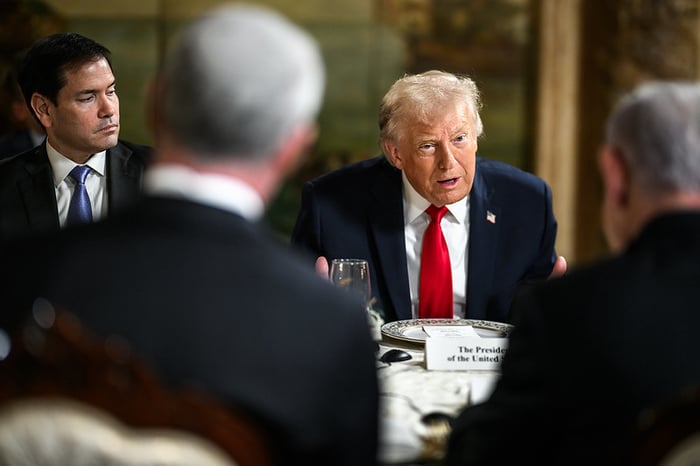
Image source: The White House.
The political uncertainty and unchecked federal deficit spending is also causing bond yields to rise (with the 10-Year Treasury hitting an alarming 5.2%) as of this writing. Government bonds represent the risk-free rate in the U.S. economy. When they start offering attractive returns, investors tend to become less willing to risk their money in more speculative and higher-risk opportunities like new technologies, putting pressure on growth stock valuations.
Meanwhile, low-cost (and often open-source) Chinese AI models continue to gain ground on their capital-intensive American rivals. This introduces the possibility of margin compression in the future and calls into question whether the huge sums U.S. tech companies are spending will actually lead to sustainable long-term returns.
What should investors do next?
The AI boom is getting long in the tooth. During the next few quarters, the fallout from Trump's unorthodox economic policies could start hurting stock valuations. Nevertheless, financial markets are notoriously difficult to time correctly, so selling everything or trying to short the S&P 500 probably isn't the best way to respond to the situation.
Instead, investors should focus on diversifying their portfolios outside of high-risk sectors like AI and betting on stable, fairly valued businesses that can thrive even in this increasingly uncertain economic climate.
Where to invest $1,000 right now
When our analyst team has a stock tip, it can pay to listen. After all, Stock Advisor’s total average return is 937%* — a market-crushing outperformance compared to 214% for the S&P 500.
They just revealed what they believe are the 10 best stocks for investors to buy right now, available when you join Stock Advisor.
See the stocks »
*Stock Advisor returns as of September 29, 2026.
Will Ebiefung has no position in any of the stocks mentioned. The Motley Fool has positions in and recommends Goldman Sachs Group. The Motley Fool has a disclosure policy.
Recommended Articles


