


Apple and Nvidia Are the Two Largest Companies in the World. Which is the Better Stock to Buy?
Key Points
Nvidia's growth rate will blow Apple away over the next year.
Apple's stock is very pricey compared to Nvidia's.
- 10 stocks we like better than Nvidia ›
Nvidia (NASDAQ: NVDA) is the world's largest company by market cap and has a valuation of about $5.4 trillion. Apple (NASDAQ: AAPL) is the second-largest at just under $5 trillion. While that may not seem like much of a gap, it's actually quite large. Mastercard (NYSE: MA) is a $500 billion company, so Apple needs to add an equivalent of a Mastercard to its business to catch up to Nvidia.
That's a huge size difference, but the world's largest company doesn't always hold on to the spot for long. So, is Apple destined to retake the title as the world's largest company and outperform Nvidia over the next few years? Let's take a look.
Missed AI’s "Act 1"? Act 2 Could Be 15x Bigger. Most investors think they missed the AI boat because they didn't buy Nvidia in 2005. But according to our analysts, we’re only at the end of "Act 1"—the R&D phase. "Act 2" is the global rollout. Continue »

Image source: Getty Images.
Nvidia has a major growth catalyst at its back
Apple's business is relatively easy to explain: It makes consumer hardware and offers a handful of services to support that hardware, creating an ecosystem that fuels its operations. Apple's largest business segment is the iPhone, which accounted for $54 billion of Apple's $109 billion revenue total in its most recent quarter. Its Services division is growing into one of the larger segments of the company. Services generated nearly $31 billion in revenue during the quarter.
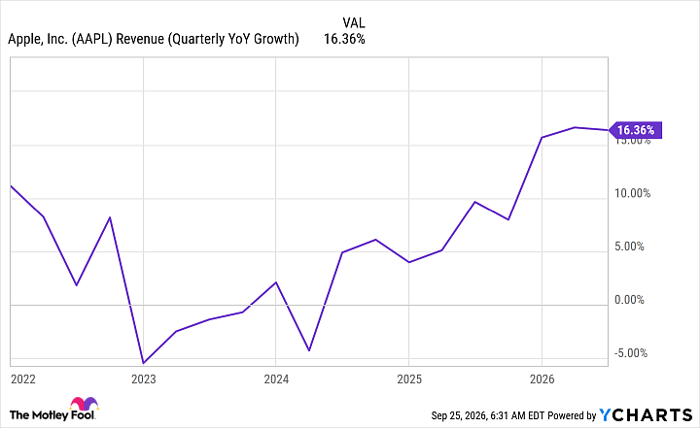
Overall, Apple's revenue grew at a 16% year-over-year pace to $109 billion -- the fastest growth rate in over four years.
Data by YCharts.
I'll be curious to see what Apple can do over the next few years to boost that growth rate, but comparing Apple's growth to Nvidia's is a moot point. Nvidia's growth is so much greater that it will be impossible for Apple to catch up.
In its fiscal Q2, Nvidia's revenue grew at a 106% year-over-year pace to $96.2 billion. Nvidia is growing far faster than Apple and is nearly as large as Apple, too. That's a bit hard to reconcile, but it shows just how impressive Nvidia's business is.
It's all centered around semiconductor GPUs, which are in high demand and short supply thanks to the artificial intelligence (AI) build-out. Nvidia projects this supply/demand situation will continue, contributing to a 70% revenue growth forecast for next year. There's no way Apple will grow anywhere near that rate, so it's very likely that Nvidia will generate more revenue per quarter than Apple by 2027. Nvidia is also growing much faster. Taken together, it's pretty clear that Nvidia is likely to outperform Apple over the next few years.
Apple is far more expensive than Nvidia
But outperformance isn't the only factor to consider when determining which stock is the better buy at the moment. There's also valuation.
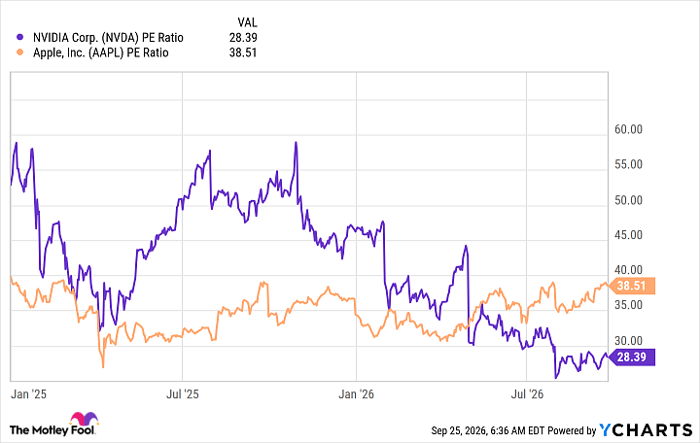
Given Nvidia's rapid growth and stock price performance, it would be easy to assume Nvidia's stock is more expensive than Apple's. But that's not the case. Both are fully mature businesses and generate substantial profits. So the price-to-earnings ratio can be used to value the stock. Here's what it shows:
Data by YCharts.
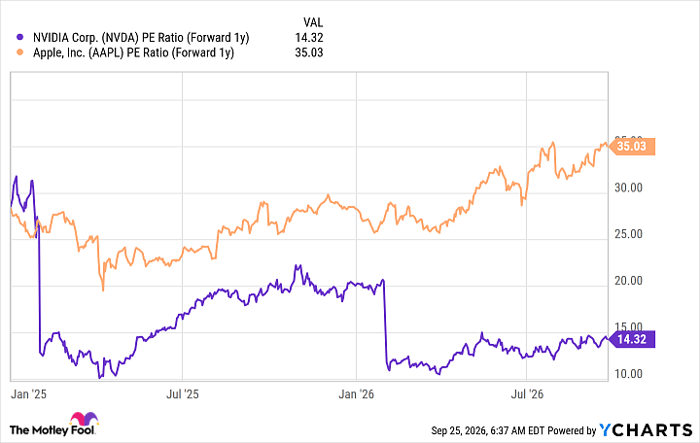
Despite Nvidia growing much faster and having a very bright outlook, the stock trades at a huge discount to Apple. And it only gets worse from here. When next year's earnings projections are considered rather than trailing earnings, Nvidia looks dirt cheap, while Apple still looks pricey.
Data by YCharts.
Using standard valuation metrics, there's really no debate about which is the better buy. Nvidia has much better growth prospects and is far cheaper than Apple. This would imply that Nvidia has the better chance of generating impressive returns over the next few years. If you're on the fence about whether you should invest in Nvidia or Apple, I think Nvidia is pretty clearly the better choice if you're seeking maximum returns.
Should you buy stock in Nvidia right now?
Before you buy stock in Nvidia, consider this:
The Motley Fool Stock Advisor analyst team just identified what they believe are the 10 best stocks for investors to buy now… and Nvidia wasn’t one of them. The 10 stocks that made the cut could produce monster returns in the coming years.
Consider when Netflix made this list on December 17, 2004... if you invested $1,000 at the time of our recommendation, you’d have $383,680!* Or when Nvidia made this list on April 15, 2005... if you invested $1,000 at the time of our recommendation, you’d have $1,382,954!*
Now, it’s worth noting Stock Advisor’s total average return is 937% — a market-crushing outperformance compared to 214% for the S&P 500. Don't miss the latest top 10 list, available with Stock Advisor, and join an investing community built by individual investors for individual investors.
See the 10 stocks »
*Stock Advisor returns as of September 27, 2026.
Keithen Drury has positions in Mastercard and Nvidia. The Motley Fool has positions in and recommends Apple, Mastercard, and Nvidia. The Motley Fool has a disclosure policy.
Recommended Articles


