


The Pentagon Is Buying eVTOLs. Here's Which Stock Wins the Defense Money.
Key Points
Pentagon priorities are shifting toward hybrid and autonomous aircraft.
Archer's Thunder platform is designed specifically for military missions.
Archer's Boeing deal could significantly expand its defense business.
- 10 stocks we like better than Archer Aviation ›
The Pentagon has spent years testing electric vertical takeoff and landing (eVTOL) aircraft, and two of the biggest beneficiaries have been Archer Aviation (NYSE: ACHR) and Joby Aviation (NYSE: JOBY). But if I'm looking for the eVTOL stock with the stronger defense opportunity today, I'm going with Archer. Let me explain.
Archer's contract with the U.S. Air Force's Agility Prime program is valued at up to $142 million. The company delivered its first Midnight aircraft to the Air Force in 2024 after receiving a military airworthiness assessment from the Department of Defense. The military has been evaluating Midnight for missions including personnel transport, logistics, medical evacuation, and intelligence and surveillance.
Missed AI’s "Act 1"? Act 2 Could Be 15x Bigger. Most investors think they missed the AI boat because they didn't buy Nvidia in 2005. But according to our analysts, we’re only at the end of "Act 1"—the R&D phase. "Act 2" is the global rollout. Continue »
That said, Joby has also collected plenty of defense money. Its Air Force contract reached a potential value of $131 million, with plans to provide as many as nine aircraft. Joby has operated aircraft at Edwards Air Force Base and continues working with the Air Force on autonomous flight technology. So why give Archer the edge?
The Pentagon's priorities are changing
Joby disclosed that the Department of Defense shifted the Agility Prime program toward hybrid aircraft and autonomous flight technologies in 2025 and reduced the scope of Joby's existing contract. Joby is responding by developing autonomous capabilities and pursuing additional government contracts, including work with L3Harris.The company also agreed to acquire defense contractor Resonant Sciences for approximately $500 million. Resonant already works on active national security programs and brings expertise in areas including advanced sensing, electronic warfare, communications, autonomous systems, and low-observability aircraft technology. It also generated more than $100 million in revenue over the previous 12 months.
Once that acquisition closes, Resonant will become Joby's dedicated defense business, giving it an established defense operation that can be combined with Joby's hybrid aircraft and autonomous-flight technology.Archer, meanwhile, has already built its defense strategy around that shift.
The company partnered with defense technology company Anduril to develop a new autonomous hybrid-electric VTOL platform. In July, the companies unveiled Thunder, a Group 5 autonomous aircraft designed specifically for military missions.
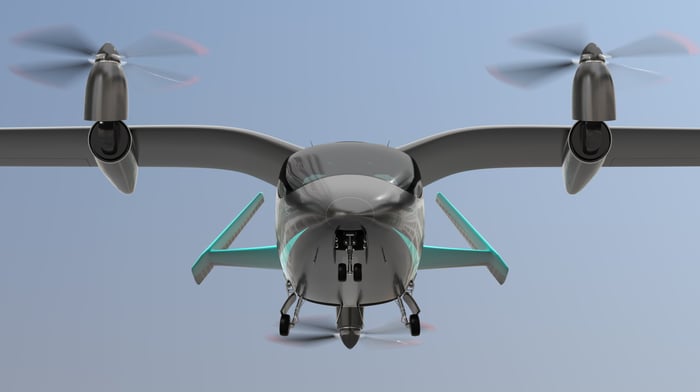
Image source: Getty Images.
Unlike Archer's all-electric Midnight air taxi, Thunder uses a hybrid-electric powertrain to provide greater range and endurance. It's also autonomous and designed to carry configurable payloads depending on the mission. Archer's defense ambitions are getting even bigger, too.
In August, Archer announced a deal to acquire Boeing's Insitu, Wisk Aero, and SkyGrid businesses. Insitu alone generates more than $200 million in annual revenue, while the three businesses would significantly expand Archer's aerospace, defense, and autonomous-flight capabilities. Of course, none of this means Archer is about to become the next Lockheed Martin.
The $142 million Air Force contract represents a maximum potential value, not guaranteed revenue, and Thunder is still a new platform that will have to prove itself. Joby shouldn't be counted out, either. Its relationship with the military goes back years, and its autonomous technology could produce additional defense contracts. But right now, Archer has the cleaner alignment with where Pentagon spending appears to be heading: autonomy, hybrid propulsion, longer range, and uncrewed military aircraft. And that gives Archer the edge in the battle for defense dollars.
Should you buy stock in Archer Aviation right now?
Before you buy stock in Archer Aviation, consider this:
The Motley Fool Stock Advisor analyst team just identified what they believe are the 10 best stocks for investors to buy now… and Archer Aviation wasn’t one of them. The 10 stocks that made the cut could produce monster returns in the coming years.
Consider when Netflix made this list on December 17, 2004... if you invested $1,000 at the time of our recommendation, you’d have $383,680!* Or when Nvidia made this list on April 15, 2005... if you invested $1,000 at the time of our recommendation, you’d have $1,382,954!*
Now, it’s worth noting Stock Advisor’s total average return is 937% — a market-crushing outperformance compared to 214% for the S&P 500. Don't miss the latest top 10 list, available with Stock Advisor, and join an investing community built by individual investors for individual investors.
See the 10 stocks »
*Stock Advisor returns as of September 26, 2026.
Jeff Siegel has no position in any of the stocks mentioned. The Motley Fool has positions in and recommends Boeing and Lockheed Martin. The Motley Fool has a disclosure policy.
Recommended Articles


