


Tokenized stockholders hit 4.3 million, up 43x in a year
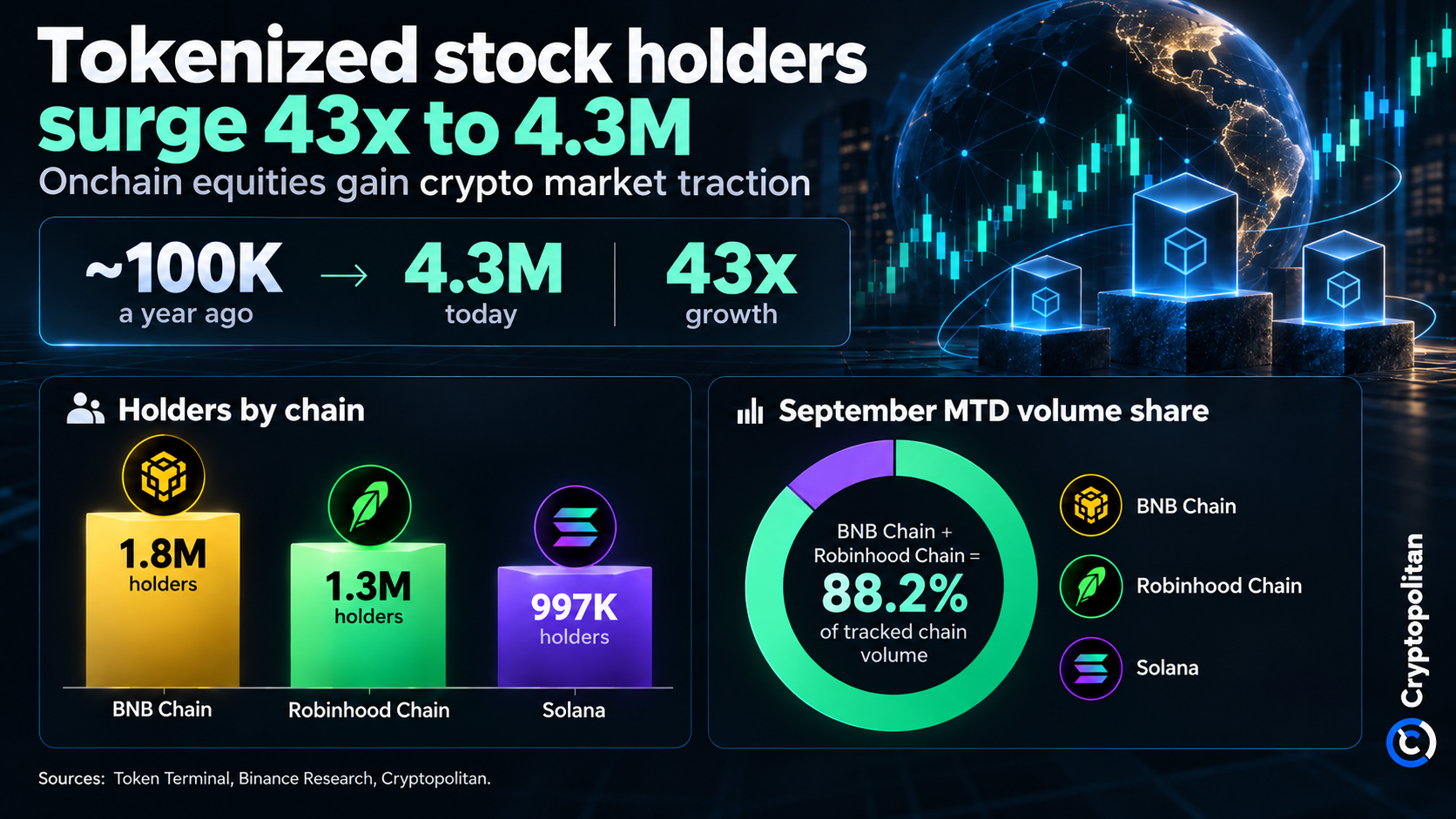
There has been an increase in the number of wallets that hold tokenized stocks from nearly 100,000 a year earlier to 4.3 million, as per Token Terminal. This staggering growth of 43 times suggests that the race is heating up among blockchains to bring public equities onchain, turning tokenized stocks from being just another niche experiment into a competition for users, liquidity, and making their offerings widely available.
BNB Chain and Robinhood Chain lead the holder count
According to statistics from Token Terminal, BNB Chain leads the pack with 1.8 million holders, followed closely by Robinhood Chain with 1.3 million, as well as Solana with 997,000 holders. This concentration strengthens a trend highlighted by Cryptopolitan earlier this month as tokenized stocks attracted an unprecedented 928,400 holders in August and BNB Chain and Robinhood Chain made up about 73% of the total.
Tokenized stock holders have grown from ~100K a year ago to 4.3M today, led by BNB Chain with 1.8M, Robinhood Chain with 1.3M, and Solana with 997K pic.twitter.com/MysBNJWacP
— Token Terminal 📊 (@tokenterminal) September 25, 2026
A second tracker demonstrates the same steep increase, but with a smaller number of holders. According to RWA.xyz, 3.89 million holders were recorded by September 25, which means an increase of 70.9% compared with the previous month.
Why the holder number is not a headcount
Those numbers need some context. Holder counts refer to blockchain addresses, not verified individuals, which means that someone using several wallets can be counted more than once. The use of incentive programs can lead to even higher numbers.
The situation was evident already in August. Cryptopolitan pointed out that the record spike coincided with Binance’s zero-maker-fee campaign and the introduction of Stock Tokens by Robinhood, which means that mere growth in wallets does not equate to an equal growth in the number of investors.
Trading is outpacing the assets themselves
The growth rate of trade is surpassing that of the overall asset pool. Binance Research reported that the market capitalization of active tokenized equity as of September 9 was around $4 billion, which translates to a 314% growth rate since the start of the year, while monthly volume went from $237 million in January to $7.9 billion in August. The total share of tracked chain volumes accounted for by BNB Chain and Robinhood Chain went from 2.3% in June to 88.2% in September month-to-date.
Utility is starting to catch up with trading. DeFi TVL tied to tokenized equities has surged 1,242% this year to $289.1 million, with 65.4% held in liquidity pools and another 28.1% in lending markets. That suggests these assets are beginning to do more than sit in wallets, with tokenized stocks increasingly finding a role as collateral and sources of onchain liquidity.
That growth appears even more remarkable when compared to an earlier Crypto.com study, which found that the market was around $1.7 billion in June, up by 149% compared to its value at the beginning of the year.
Regulators are watching the plumbing
Regulators are also starting to shape the future landscape for tokenized stocks. On September 17, the SEC approved a temporary, conditional Innovation Exemption. It allows the limited trading of tokenized NMS stocks on selected on-chain venues, with volume caps, symbol limits, and information disclosure requirements. As noted by Commissioner Mark Uyeda, the given framework will enable regulators and market players to “experiment responsibly, learn, and translate old protections to new contexts.”
Ownership adds another layer of complexity. Research by Crypto.com explains that these tokens may be backed by assets held in custody or created synthetically, but owning the token usually does not mean owning the underlying stock directly or getting shareholder voting rights.
An IMF note also warns about risks surrounding the legal link between a token and its underlying asset. Meanwhile, the ECB launched Pontes on September 21 to allow wholesale tokenized-asset transactions to settle in central bank money.
Whether Wall Street capital actually follows
What lies behind the fascination with tokenization is its huge potential. According to Citi’s Tokenization 2030 report, the value of tokenized assets could be $5.5 trillion in its base case scenario and reach $8.5 trillion in the best-case scenario by 2030. Moreover, Citi estimates that if 10% of US retail investors shifted their investments on-chain, this would create a demand for tokenized stocks in the amount of about $2.6 trillion.
The real test will be what takes place after the incentives end. The zero-maker-fee promotion of Binance will end on September 30. So, the weeks after that should show how much of the growth can be sustained.
Don’t just read crypto news. Understand it. Subscribe to our newsletter. It's free.
Recommended Articles


