


Bastion wins conditional OCC approval for a national trust bank charter
Bastion, a stablecoin infrastructure company, received conditional approval from the Office of the Comptroller of the Currency (OCC) to convert its New York trust company to Bastion Platforms National Trust Company. After meeting the remaining conditions, the charter will unify issuance, custody, and conversion of stablecoins in one federally regulated entity and bring stablecoins closer to becoming an acceptable part of bank and fintech infrastructure.
The custody alone wouldn’t make this newsworthy. What is more important is that Bastion’s approved business model also provides for white-label issuance of stablecoins and related issuer services. This means companies will be able to implement dollar-token programs without having to build the full stack on their own.
Issuance, custody and conversion under one roof
Bastion, according to the OCC Corporate Decision #1391, has made an application for conversion on March 30, 2026, under Charter Number 27198. Its primary place of business will be at 216 Bowery in New York City. The OCC has also permitted the citizenship waiver request made by one of its directors.
Among its approved activities are white-label stablecoin issuance, fiduciary custodial wallets, the conversion between fiat currency and USDC for custody clients, and assistance for other regulated stablecoin issuers. According to the announcement made by Bastion, companies will have access to its range of products through a single federally regulated counterparty. The company does not issue a stablecoin of its own, has partnered with Sony Bank, and is supported by Andreessen Horowitz and Coinbase Ventures.
Federal supervision brings Bastion’s services under a regulatory structure that is more aligned with the mainstream banking sector. CEO Nassim Eddequiouaq explained that the OCC approval is part of that transition.
“Stablecoins have moved from emerging technology into core financial infrastructure, and that requires a different standard of trust, governance and regulatory rigor.” — Nassim Eddequiouaq, Bastion CEO
Bastion has been working toward federal supervision since receiving its New York trust charter in February 2025. It also added four board members and advisors with backgrounds at American Express, Morgan Stanley, EY, and Optum.
What the charter leaves out
A national trust bank does not perform the same services as a full-service bank. According to the OCC, Bastion Platforms National Trust Company will not be able to accept deposits or have Federal Deposit Insurance Corporation (FDIC) coverage. It must acquire stock from a Federal Reserve bank before commencing operations and comply with all the remaining conditions set by the OCC.
Additionally, the charter does not imply automatic access to the payment systems of the Federal Reserve. According to a previous report of Cryptopolitan, the special purpose payment account proposed by the Fed would not widen the range of organizations permitted to open Federal Reserve accounts. Instead of a traditional deposit and lending scheme, the attraction lies in having the federal supervision and custody infrastructure.
A charter rush shaped by the GENIUS Act
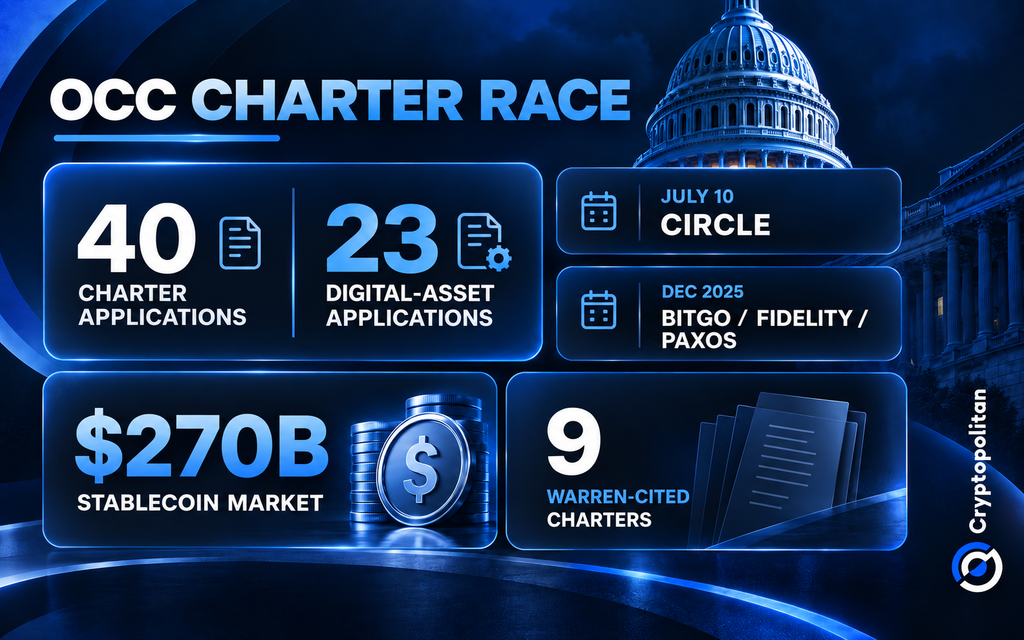
Bastion is joining a fast-moving queue. Comptroller Jonathan Gould said in August that the OCC had received 40 new-bank charter applications over roughly 18 months, with 23 involving digital-asset activity—an eightfold increase from the previous four years.
Circle received final approval on July 10 to open Circle National Trust after a December 2025 conditional approval. BitGo, Fidelity Digital Assets and Paxos were among firms that also received conditional approvals that December, according to Davis Wright Tremaine.
The GENIUS Act, enacted July 18, 2025, is shaping the framework. The OCC proposed rules in February covering reserve assets, redemption, custody, risk management and issuer oversight, and Gould said a final rule is expected by November.
Bigger dollar flows, and pushback
Brookings researchers Nellie Liang and Brent Neiman put the stablecoin market at about $270 billion as of June 2026. Because the GENIUS Act requires eligible reserve assets such as Treasury bills, growth could affect demand for short-term U.S. government debt and bank funding.
The Bank for International Settlements warned in August that wider use of dollar-pegged stablecoins could contribute to “digital dollarisation” and weaken monetary sovereignty in some economies.
The charter wave also faces legal and policy criticism. In a May 18 letter to Gould, Senator Elizabeth Warren said the OCC had approved at least nine national trust charters for crypto companies and argued that some planned activities exceeded the limits of trust-company powers.
“These companies are effectively crypto banks that want to evade the fundamental safeguards and obligations that come with being a bank.” — Sen. Elizabeth Warren
The OCC takes a different legal view. In Bastion’s decision, it concluded that the proposed custody, conversion, stablecoin issuance, and issuer services are trust-company operations or related activities permitted under federal banking law.
If you're reading this, you’re already ahead. Stay there with our newsletter.
Recommended Articles


