


Crude Oil Price Forecast: Can Brent Hold $100 Amid Hawkish Fed Rate Hikes and Easing Supply Concerns?


TradingKey - International oil prices continued to fall after the Federal Reserve resumed rate hikes in September. On Wednesday, WTI crude dropped 3.28% to settle at $102.02 per barrel; Brent crude fell 2.66% to $105.58 per barrel. Entering the Asian trading session on September 17, the two crude benchmark prices continued to slide, with Brent and WTI falling by around 1.6% and 1.1%, respectively.
This adjustment in oil prices was not caused by a single factor. Hawkish signals from the Federal Reserve, a stronger US dollar, an increase in US refined product inventories, and Saudi Arabia seeking alternative export channels combined to ease previous market concerns over a further widening supply deficit.
Why Fed Rate Hikes Weigh on Global Oil Prices
The Federal Reserve raised the target range for the federal funds rate by 25 basis points to 3.75%–4.00% in September, marking its first rate hike since July 2023. The latest dot plot showed that among 18 officials, 12 expect one more rate hike in 2026, another four expect two more hikes, and only two believe current rates are sufficient. In other words, a total of 16 officials support tightening monetary policy at least once more within the year.
Chair Kevin Warsh described the move as removing a degree of policy accommodation and emphasized that inflation remains elevated. These comments pushed the U.S. dollar and Treasury yields higher, while leading the market to reassess the outlook for U.S. economic growth and energy demand.
Rising interest rates first affect international oil prices through the U.S. dollar. Crude oil is priced in U.S. dollars; when the dollar strengthens, actual costs rise for overseas buyers purchasing crude in other currencies, thereby weighing on demand.
Meanwhile, higher interest rates also increase borrowing costs and may suppress economic activity. If the Fed continues to maintain higher rates in the future, market expectations for energy demand growth in the U.S. and globally could also be affected.
Therefore, while Fed rate hikes do not directly increase crude oil supply, they depress oil prices through exchange rates and demand expectations. For a crude oil market that had previously surged due to the Middle East conflict, the hawkish policy signals also provided investors with a reason to take profits.
Saudi Arabia Expands Alternative Exports; US Inventory Data Bearish
Compared with interest rate factors, easing supply concerns may be the more direct reason for the current pullback in oil prices.
An earlier attack on Saudi Arabia's East-West pipeline disrupted transport capacity linking eastern oil-producing regions to Red Sea export facilities, briefly sparking market fears of a further tightening in global crude supply and pushing Brent crude close to $110.
However, the latest situation has shown some changes. Saudi Aramco has begun ship-to-ship transfers through the Port of Sohar in Oman to route a portion of crude away from affected export pathways to Asian refineries. Because Sohar is located outside the Strait of Hormuz, this method can to some extent reduce the impact on exports if key infrastructure faces further attacks.
UBS analyst Giovanni Staunovo noted that news of Saudi Arabia expanding Gulf region crude exports has relieved market fears that supply disruptions might worsen. As long as alternative transport routes operate reliably, part of the supply risk premium previously baked into oil prices may recede further.
Meanwhile, U.S. inventory data provided little support for oil prices. According to U.S. Energy Information Administration (EIA) data, U.S. crude inventories fell by only about 640,000 barrels in the week ended September 11, significantly lower than the 1.62 million barrels expected by the market; gasoline and distillate inventories, on the other hand, increased.
In other words, the U.S. market currently shows no particularly clear signal of crude destocking, while gains in refined product inventories also mean that demand offers no new upward momentum for oil prices for the time being.
However, with the situation in the Middle East continuing to deteriorate, navigation restrictions in the Strait of Hormuz and attacks on energy infrastructure mean geopolitical risk premiums have not fully dissipated. Oil prices are currently more likely to enter high-level volatility rather than shifting directly into a sustained downward trend.
Crude Oil Price Technical Analysis
Source: TradingView
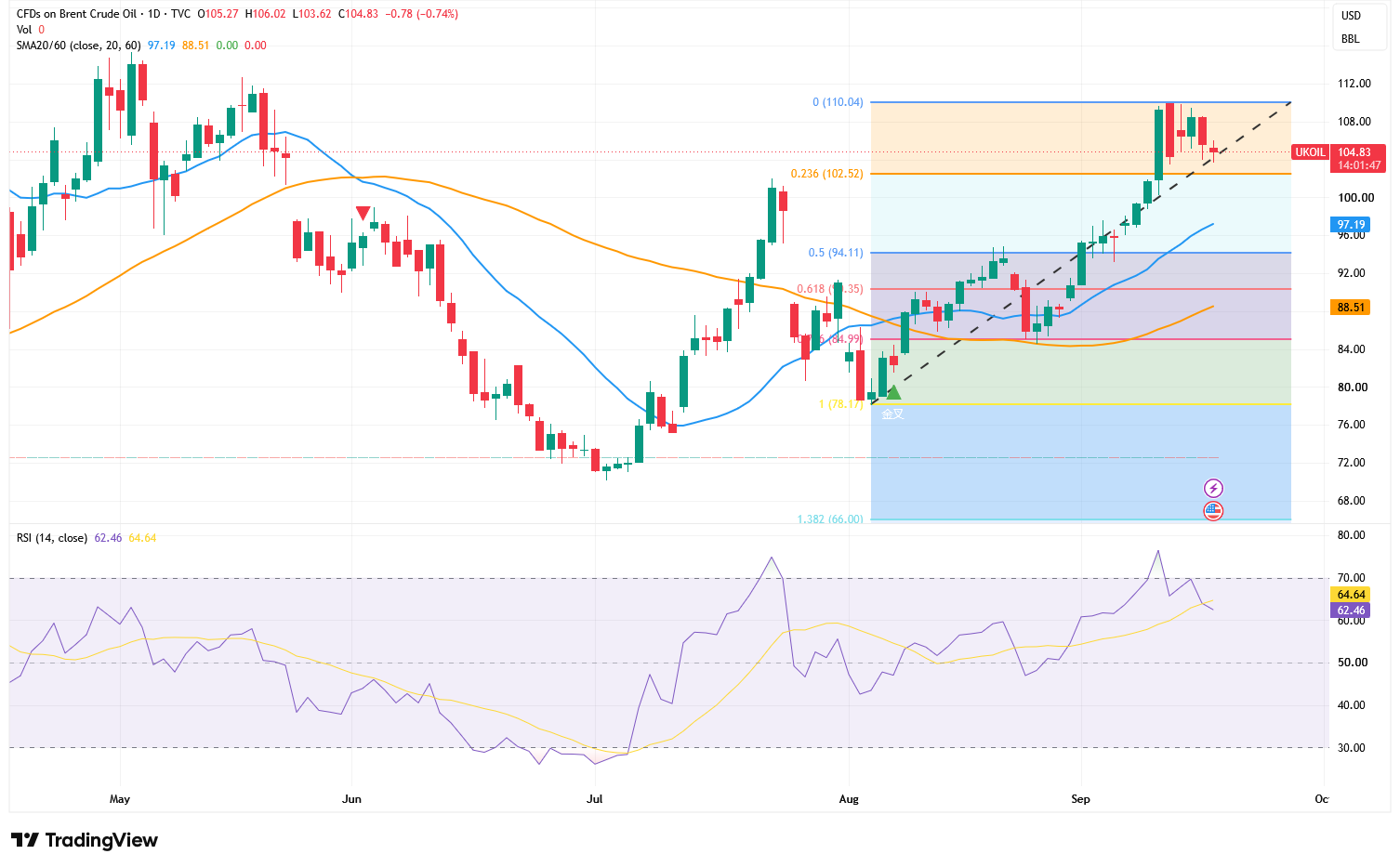
Looking at the daily chart, Brent crude entered a pullback after hitting $110.04, last trading at $104.83. However, oil prices remain above the 20-day moving average of $97.19 and the 60-day moving average of $88.51, with both moving averages continuing to point upward. This indicates that the current move is closer to a technical correction after a rapid rally, and the medium-term bullish structure remains intact.
In the short term, primary focus is on the $102.52 Fibonacci retracement level, which is also close to the ascending trendline. If oil prices can hold $102–$103, there remains potential to retest $107–$108 and challenge $110.04 again; only a daily close above $110 would open up further upside room.
The RSI has pulled back from overbought territory to 62.46 and fallen below its signal line at 64.64, indicating that upside momentum is cooling down, though it remains above 50 and has not yet shifted into significant weakness.
If $102.52 fails to hold, $100 will serve as key psychological and technical support. A daily close below $100 could extend the pullback to $97–$98, near the 20-day moving average and the 38.2% retracement level, with further support at $94.11.
Read more
* The content presented above, whether from a third party or not, is considered as general advice only. This article should not be construed as containing investment advice, investment recommendations, an offer of or solicitation for any transactions in financial instruments.


