


Europe's AI firms warn a frontier slowdown would lock in the US lead
The leading AI developers in Europe, comprising the likes of Mistral of France, are pushing back against US frontier labs that have urged them to ease up in making breakthroughs in AI capabilities. Their worry is not primarily about safety issues but rather the issues surrounding the timing of development. Europe is already lagging behind the US and China with regard to notable AI models, computing power, and funds for development.
According to Prosus, as of 2023, Europe has been responsible for 11% of AI venture funding in the global market compared to the US that had captured 77% of funding, with the gap even growing at later stages of funding.
This goes beyond the argument of safety over speed. In the case of the European competitors, they are concerned that the proposed coordinated pacing by the leading AI companies can make it even tougher for them to bridge the competitive divide.
‘Totally self-serving,’ say Europe’s challengers
The argument is about a proposal made by Dario Amodei, CEO of Anthropic, to slow down the rate of development of new AI and request an antitrust exemption for labs to work together on safety matters. It was reported by Reuters that Mistral’s representatives believe that established players are “pushing for regulation designed to favour them over competitors.”
Raphael Auphan, COO of Proton, was even more critical than Mistral’s representatives, saying that the initiatives are “totally self-serving” and serve the interests of US companies to keep them dependent on their services. Black Forest Labs argues that “arbitrary thresholds” can impede innovation, while Hugging Face’s head Clément Delangue thinks that Europe should advance, but supports Amodei’s call for independent assessment.
What Amodei actually proposed
On September 12, Amodei, in his essay “We Must Pace the Frontier”, promotes slowing down advancements of AI capability while continuing product releases and training. Amodei puts forward a three-step approach to the issue which calls for having external evaluators in place who will have employees’ level of access to the process, coordination of different laboratories in democratic countries and, eventually, international collaboration.
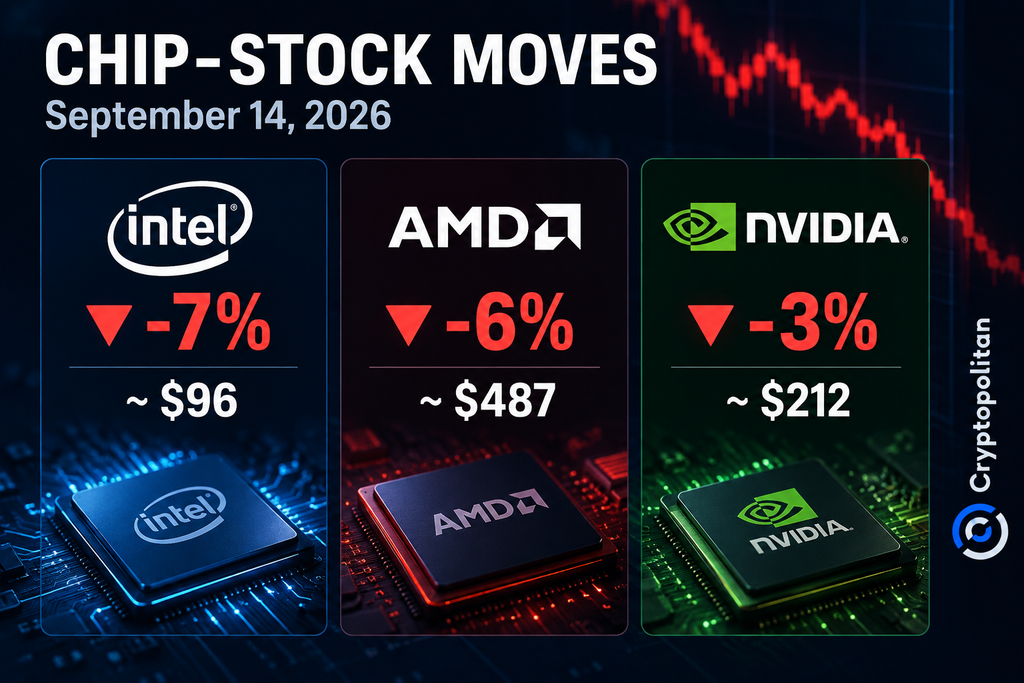
The idea was supported quickly by Elon Musk and OpenAI CEO Sam Altman. Altman endorsed the concept of embedded evaluators advocated by Anthropic while pointing out that pacing should not be understood as stopping development. It was reported by Forbes that the issue has also spilled into the market on September 14 as stocks of major AI companies fell. Intel dropped by about 7% to around $96, AMD by about 6% to $487 and Nvidia by about 3% to $212.
The gap Europe is trying to close
The stance Europe has taken indicates a considerable disparity in terms of model advancements, as well as the accompanying infrastructure. During an address on September 14, the president of the European Central Bank, Christine Lagarde, noted that there were 59 notable AI models produced by the US in 2025, China released 35 models, and France and the UK have each developed one model only. She added that the amount of global AI data-center computing capacity in the US accounts for roughly 75% while Europe has only 5%.
The most recent data from Epoch AI suggests that the gap between the notable AI models with the highest capability is also clear. US-made models rank at the top of the list in Epoch’s ECI ranking, with GPT-6 Astra at 166 points leading the pack. China’s Kimi K3 comes in 11th place at 158 points, eight points less than US leader GPT-6 Astra. Mistral Medium 3.5, developed in France and released in April, got a score of 142.5 points.
However, Europe is not that far behind in the use of AI. In the Global AI Diffusion report by Microsoft, it was revealed that generative AI usage among working-age individuals was 48.6% in Norway, 48.4% in Ireland, and 47.8% in France, compared to a mere 31.3% in the US. This means that Europe is advancing in the use of AI faster than in the creation of cutting-edge models and infrastructure.
Brussels is spending, not retreating
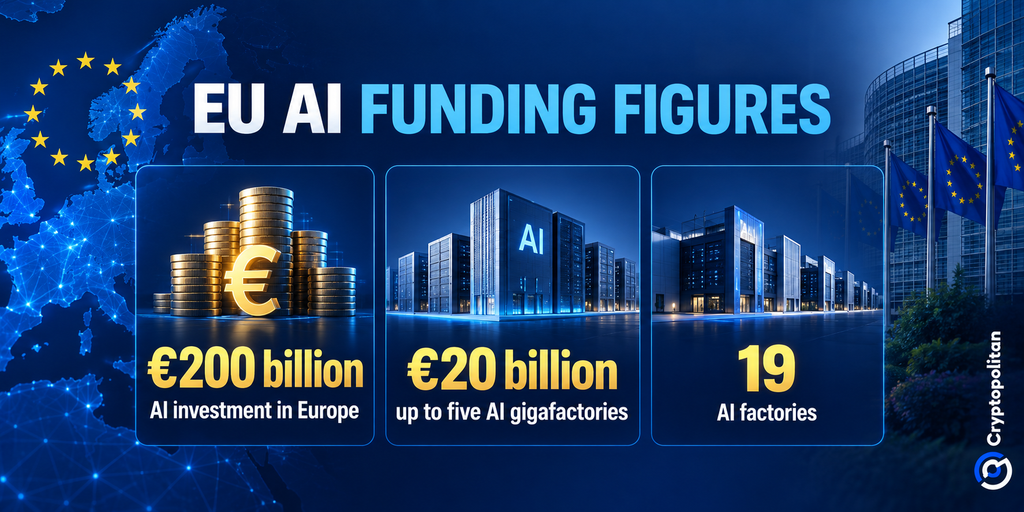
The EU is pairing regulation with investment. Its AI Continent Action Plan aims to mobilize €200 billion for AI, including a €20 billion InvestAI facility to finance up to five AI gigafactories, alongside at least 19 AI factories. The Commission also says only 13.5% of EU companies currently use AI, a gap its Apply AI strategy is meant to narrow.
Who pays for a slowdown
The competition concern is not purely theoretical. An OECD report found that concentration in AI innovation is associated with higher sales concentration, while AI startups attracting venture capital are still frequently acquired by large incumbents.
That does not prove pacing rules would protect today’s leaders. But it helps explain why smaller developers worry that new requirements could become another cost of entry.
The stakes extend beyond Europe. Cryptopolitan reported that Chinese state media framed the US slowdown push as a “Cold War” tactic aimed at preserving Washington’s lead. If US frontier labs slow while European and Chinese challengers keep pushing ahead, the result may be a shift in capital, talent, and open-model development rather than a uniform global slowdown.
Don’t just read crypto news. Understand it. Subscribe to our newsletter. It's free.
Recommended Articles


