

Gold Price Forecast: Gold Plunges to Seven-Week Low, Can $4,100 Hold?

Source Tradingkey

TradingKey - Spot gold (XAUUSD) plunged 4% on Monday to close at $4,114.93 per ounce, hitting an intraday low of $4,110.80, its lowest level since August 5. Heading into Tuesday's Asian trading session, gold prices consolidated at low levels near $4,130, as market sentiment remained cautious.

Why Are Gold Prices Falling?

After U.S. President Trump rejected Iran's peace proposal, market expectations for the reopening of the Strait of Hormuz and the de-escalation of the Middle East conflict rapidly faded.

Under normal circumstances, heightened geopolitical risks tend to spur capital inflows into gold, but this market movement has followed a different transmission pathway. The reason is that risks related to the Strait of Hormuz first drove up energy prices, and persistently rising oil prices could further elevate overall inflation. For gold, this may instead bring fresh pressure, as the market begins to worry that the Federal Reserve will need to maintain a tighter monetary policy to combat inflation.

This has also formed a clear bearish pathway: rising oil prices push up inflation expectations, inflationary pressures reinforce rate-hike bets, and subsequently drive the U.S. dollar and Treasury yields higher. Although gold possesses inflation-hedging properties in the long run, the impact of rising interest rates tends to be far more direct in short-term trading.

However, significant variables remain in the Middle East situation. Iran continues to emphasize resolving the conflict through diplomatic means, and Trump has not completely closed the window for negotiations. If the two sides resume contact, the risk premium in oil prices could retreat, easing market concerns over inflation and rate hikes.

In addition to oil prices, gains in the U.S. dollar and U.S. Treasury yields have further amplified gold's decline.

On Monday, the U.S. Dollar Index hovered near a two-month high. Since international gold is priced in U.S. dollars, a stronger dollar means higher purchasing costs for non-U.S. dollar investors, which typically weighs on gold demand.

Meanwhile, U.S. Treasury yields continued to climb, with the 10-year Treasury yield rising to near its highest level since 2007 and the 2-year yield also moving noticeably higher, leading the market to further raise expectations that the Fed will continue tightening policy in the future.

For the gold market, rising yields mean capital faces a higher opportunity cost when holding gold. Gold itself yields no interest, so when interest-bearing assets like U.S. Treasuries offer higher yields, some capital naturally reassesses gold's allocation value.

Gold Price Technical Analysis
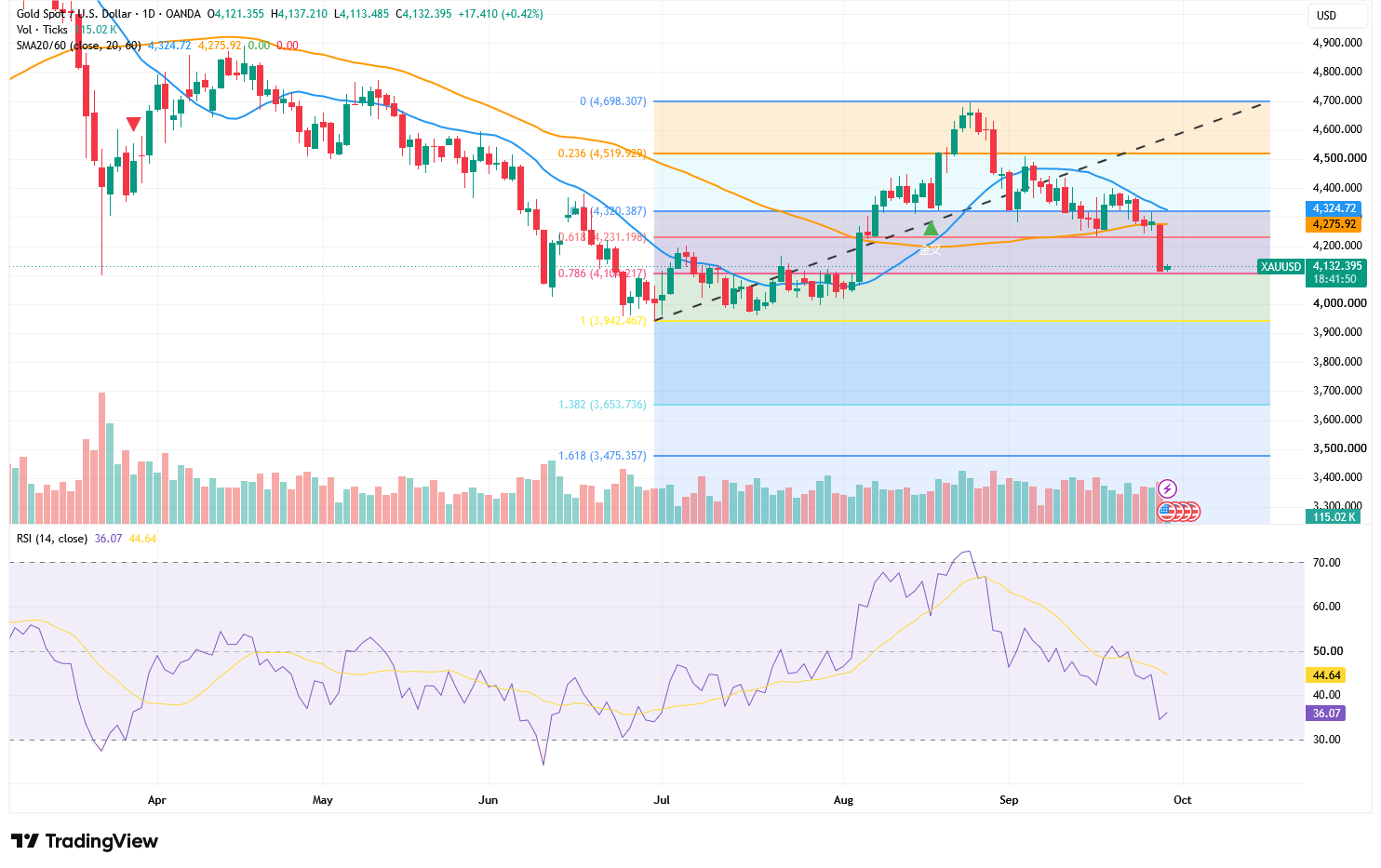
XAUUSD_2026-09-29-0b8cbd75398048afa8f190147594a40f

Source: TradingView

Judging from the daily chart, spot gold has weakened significantly after breaking below the ascending trendline, last trading near $4,132. It has lost both the 20-day moving average of $4,324.72 and the 60-day moving average of $4,275.92, indicating that bears remain in control in the short term. However, the 20-day moving average has not crossed below the 60-day moving average, meaning the medium-term trend has not fully turned bearish.

Currently, the most critical support lies between $4,100 and $4,104, with $4,104.22 corresponding to the 78.6% Fibonacci retracement level. Gold prices rebounded slightly after hitting an intraday low of $4,113, indicating buying interest is emerging near $4,100.

The RSI has dropped to 36.07, below its signal line at 44.64, reflecting that downside momentum remains strong. However, as the RSI gradually approaches the oversold zone of 30, the risk of chasing short positions is also rising.

If gold prices hold above $4,100 and reclaim $4,200–$4,231, a technical rebound could occur in the short term, with further resistance at the 60-day moving average of $4,276 and the $4,320–$4,325 range.

Conversely, if the daily close decisively breaks below $4,100, this round of correction could head further toward the psychological $4,000 mark, with focus subsequently on the previous low of $3,942.

Disclaimer: For information purposes only. Past performance is not indicative of future results.
placeholder
Gold ends three-week slide at the $4,400 line — eight straight days of ETF inflows vs a 5% 10-year and a 100 dollarSpot gold closed Friday at $4,378.39, up 0.84% on the day and about 0.8% for the week — its first weekly gain in four weeks — with the intraday high of $4,399.67 leaving it 33 cents shy of the $4,400 line. Gold ETFs have now logged eight straight sessions of inflows, but with the 10-year back above 5% and the dollar index near 100, here is what decides whether this is a reversal or a bounce.
Author  Suzie
Sep 20, Sun
Spot gold closed Friday at $4,378.39, up 0.84% on the day and about 0.8% for the week — its first weekly gain in four weeks — with the intraday high of $4,399.67 leaving it 33 cents shy of the $4,400 line. Gold ETFs have now logged eight straight sessions of inflows, but with the 10-year back above 5% and the dollar index near 100, here is what decides whether this is a reversal or a bounce.
placeholder
October hike odds climb toward 60% as Goldman and BofA both flip — what Warsh's "dose of accommodation" really changedRate futures now price roughly 55% to 62% for a 25bp hike at the October 27-28 FOMC, up from about 30% before Chair Warsh's post-meeting framing that the Fed is merely "removing some accommodation." Goldman Sachs has added an October hike to its forecast and Bank of America now sees moves in both October and December. Here is the repricing, the language behind it, and the two data points that decide it.
Author  Irene Q.
Sep 23, Wed
Rate futures now price roughly 55% to 62% for a 25bp hike at the October 27-28 FOMC, up from about 30% before Chair Warsh's post-meeting framing that the Fed is merely "removing some accommodation." Goldman Sachs has added an October hike to its forecast and Bank of America now sees moves in both October and December. Here is the repricing, the language behind it, and the two data points that decide it.
placeholder
Brent edges toward $99 as Trump rejects Iran's Hormuz proposal — why the war-risk premium won't rebuildBrent crude rose 0.92% to $98.51 and WTI gained 1.15% to $93.51 after President Trump rejected Iran's seven-day proposal to reopen the Strait of Hormuz. But both benchmarks remain about 12% below their early-September highs, because supply never actually stopped. Hormuz flows ran at 33.7 million barrels this week, in line with the prior week, and Saudi Arabia's East-West pipeline restarted on September 22.
Author  Suzie
Yesterday 06: 18
Brent crude rose 0.92% to $98.51 and WTI gained 1.15% to $93.51 after President Trump rejected Iran's seven-day proposal to reopen the Strait of Hormuz. But both benchmarks remain about 12% below their early-September highs, because supply never actually stopped. Hormuz flows ran at 33.7 million barrels this week, in line with the prior week, and Saudi Arabia's East-West pipeline restarted on September 22.
placeholder
Four jobs reports in five days: what JOLTS, ADP, claims and the September payrolls mean for the October Fed decisionThe US labour market faces its densest data week of the month. JOLTS job openings land Tuesday (7.2 million expected), ADP on Wednesday (70,000 expected), initial claims on Thursday and the September non-farm payrolls on Friday (100,000 expected, down from 162,000). Markets price a 64%-70% chance of another quarter-point Fed hike on October 28. The dollar index sits at 100.77 and the S&P 500 at 7,729.8.
Author  Mitrade
Yesterday 06: 33
The US labour market faces its densest data week of the month. JOLTS job openings land Tuesday (7.2 million expected), ADP on Wednesday (70,000 expected), initial claims on Thursday and the September non-farm payrolls on Friday (100,000 expected, down from 162,000). Markets price a 64%-70% chance of another quarter-point Fed hike on October 28. The dollar index sits at 100.77 and the S&P 500 at 7,729.8.
placeholder
RBA set to hike interest rate to 4.60% in September as inflation remains elevatedThe Reserve Bank of Australia (RBA) is widely expected to raise the Official Cash Rate (OCR) by 25 basis points (bps) to 4.60% from 4.35% on Tuesday, after keeping rates unchanged at its previous two meetings
Author  FXStreet
5 hours ago
The Reserve Bank of Australia (RBA) is widely expected to raise the Official Cash Rate (OCR) by 25 basis points (bps) to 4.60% from 4.35% on Tuesday, after keeping rates unchanged at its previous two meetings
goTop
quote