


The Japanese Yen spikes and unwinds as Iran offers to reopen Hormuz
- USD/JPY dips on Iran's Hormuz offer and climbs back to its 200-day average above 157.50.
- Bank of Japan rate at 1.25%, 2.625 points under the Fed's midpoint.
- Futures put the Fed's rate near 4.2% by December, from 3.875% now.
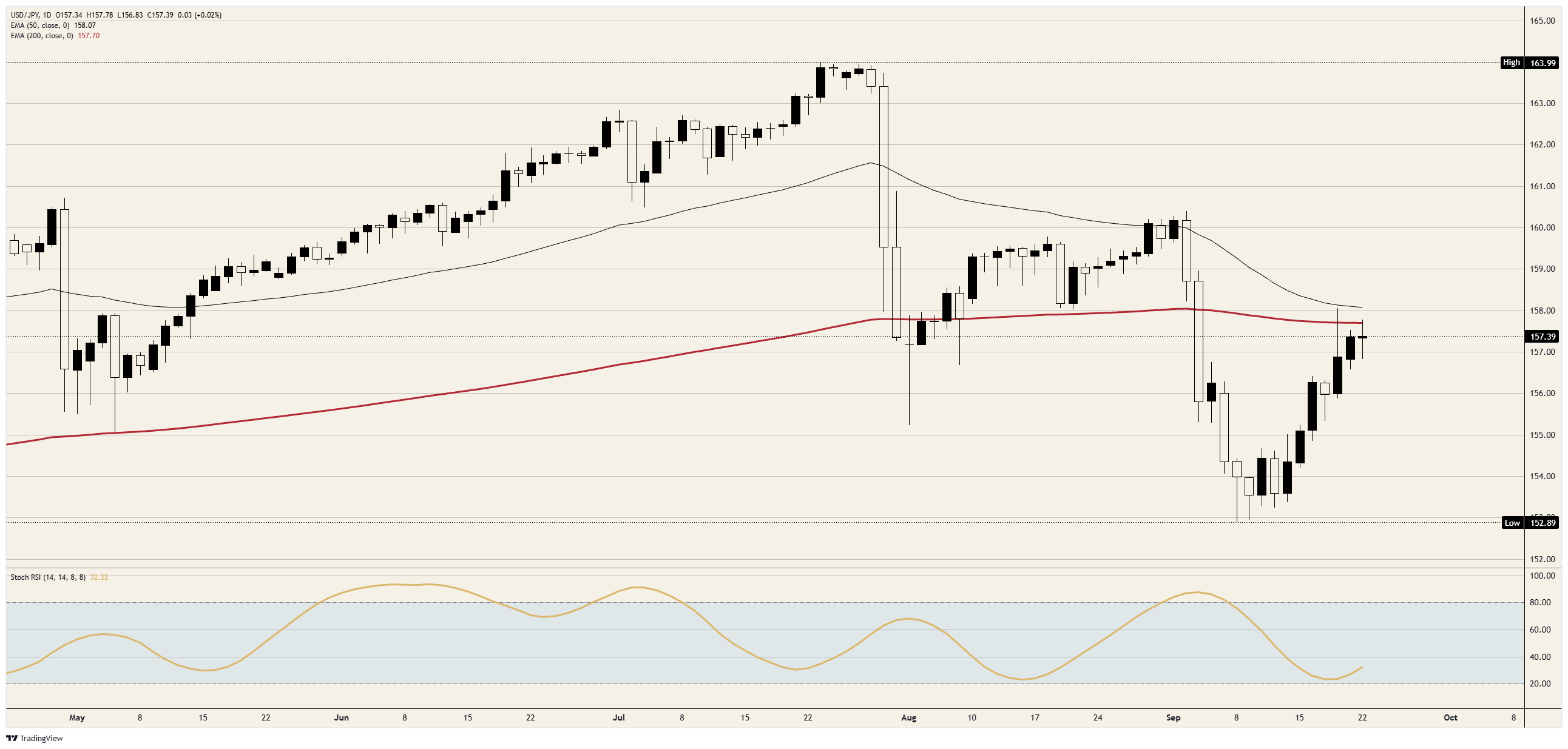
Cheaper Crude Oil should help the Yen, since Japan buys almost all of its Crude Oil abroad, and on Tuesday it helped only briefly. USD/JPY dropped close to 157.00 after reports that Iran has offered to reopen the Strait of Hormuz, then climbed back to trade near 157.50. The session high touched the 200-day average for the second time in three sessions, and the pair's low has been higher in each session since the Bank of Japan (BoJ) raised rates on September 18.
Crude Oil fell and the rate gap stayed where it was
Japan pays for its Crude Oil in Dollars, so a lower Crude Oil price means fewer Yen sold to cover the bill. A senior Iranian official told Reuters and Kyodo that Iran would reopen the strait within seven days if the US eases military pressure and lifts its blockade of Iranian ports. President Trump said at the United Nations on Tuesday that the two sides are moving toward a deal, hours after repeating his threat to destroy Iran if talks fail.
Brent traded around $100 on Tuesday. Iran's parliament speaker, Mohammad Baqer Qalibaf, said the same day that Iran would never give in to US pressure, which is why traders treated the offer as a proposal rather than a reopening. An offer with conditions attached doesn't change the fuel bill Japan pays this month, and it doesn't change what a Dollar deposit earns against a Yen one. The Yen's gain on the headline lasted about as long as it took traders to look at the rate gap again.
Boston's Fed President wants one more and two BoJ members wanted none
Boston Fed President Collins said on Monday that she backed the September 16 increase and expects one more before the end of the year, with rates then on hold through 2027, and she repeated her support for the increase on Tuesday. She doesn't vote on the Fed's rate committee until 2028, but her view matches the median of the Fed's own projections, which have the rate at 4.1% at the end of this year. Futures put it near 4.2% by December, a little above the Fed's own median.
The BoJ's rate is 1.25% after the 7-2 vote on September 18, the highest since April 1995, and board members Asada and Sato voted to keep it at 1%. A Dollar deposit pays 2.625 points more than a Yen one, and the trade that borrows Yen to buy higher-paying Dollar assets earns that difference for as long as the gap stays open. One central bank has most of its committee talking about more and the other has two members who didn't want the last one.
Tokyo reopens Thursday to a run of Fed speeches
Japanese markets are shut through Wednesday for national holidays and reopen on Thursday, when Japan's flash manufacturing survey is expected near 54.8. A reading that strong supports another BoJ increase, and the two votes against the September 18 move are why traders doubt one is coming soon. Thin holiday trading is when Japan has bought Yen before, and officials checked exchange rates with dealers on Friday, which is usually the step before buying. The full return of Tokyo's banks on Thursday makes any buying less effective, because there's more money on the other side of the trade.
The Dollar side is busier. New York Fed President Williams speaks on Thursday at 08:10 GMT and again on Friday at 09:15 GMT, and Cleveland Fed President Hammack speaks on Thursday at 12:50 GMT and Friday at 18:00 GMT. Philadelphia Fed President Paulson follows on Thursday at 13:00 GMT, and weekly jobless claims on Thursday at 12:30 GMT are forecast at 201K after 196K. Every Fed official who backs another increase adds to the gap without Japan doing anything, and that's how USD/JPY has climbed since the BoJ raised its own rate.
Levels and bias
Resistance: The pair's 200-day Exponential Moving Average (EMA) above 157.50, which Tuesday's high touched and which no daily close has cleared since early September. Then 158.00, where Friday's rally turned back on the day the rate check was reported.
Support: Tuesday's low just under 157.00, the third higher low in a row. Below it, 156.50 is Monday's low and 156.00 is where the pair traded before the BoJ decision.
Bias: Bullish above 156.50. The first objective is 158.00 and the second is 159.00, where the pair traded before the early-September drop. The daily Stochastic Relative Strength Index (Stoch RSI), a momentum gauge, shows 32 and is turning up from the bottom of its range, which favours the Dollar. The risk is Tokyo, since 158.00 is about where the pair was when officials checked rates on Friday. A daily close below 156.50 would mean the bullish case is wrong.
USD/JPY daily chart
Japanese Yen FAQs
The Japanese Yen (JPY) is one of the world’s most traded currencies. Its value is broadly determined by the performance of the Japanese economy, but more specifically by the Bank of Japan’s policy, the differential between Japanese and US bond yields, or risk sentiment among traders, among other factors.
One of the Bank of Japan’s mandates is currency control, so its moves are key for the Yen. The BoJ has directly intervened in currency markets sometimes, generally to lower the value of the Yen, although it refrains from doing it often due to political concerns of its main trading partners. The BoJ ultra-loose monetary policy between 2013 and 2024 caused the Yen to depreciate against its main currency peers due to an increasing policy divergence between the Bank of Japan and other main central banks. More recently, the gradually unwinding of this ultra-loose policy has given some support to the Yen.
Over the last decade, the BoJ’s stance of sticking to ultra-loose monetary policy has led to a widening policy divergence with other central banks, particularly with the US Federal Reserve. This supported a widening of the differential between the 10-year US and Japanese bonds, which favored the US Dollar against the Japanese Yen. The BoJ decision in 2024 to gradually abandon the ultra-loose policy, coupled with interest-rate cuts in other major central banks, is narrowing this differential.
The Japanese Yen is often seen as a safe-haven investment. This means that in times of market stress, investors are more likely to put their money in the Japanese currency due to its supposed reliability and stability. Turbulent times are likely to strengthen the Yen’s value against other currencies seen as more risky to invest in.
Recommended Articles


