


Hurricane Isaias has shut in a quarter of Gulf oil output — can WTI clear $92 before Thursday's EIA report?


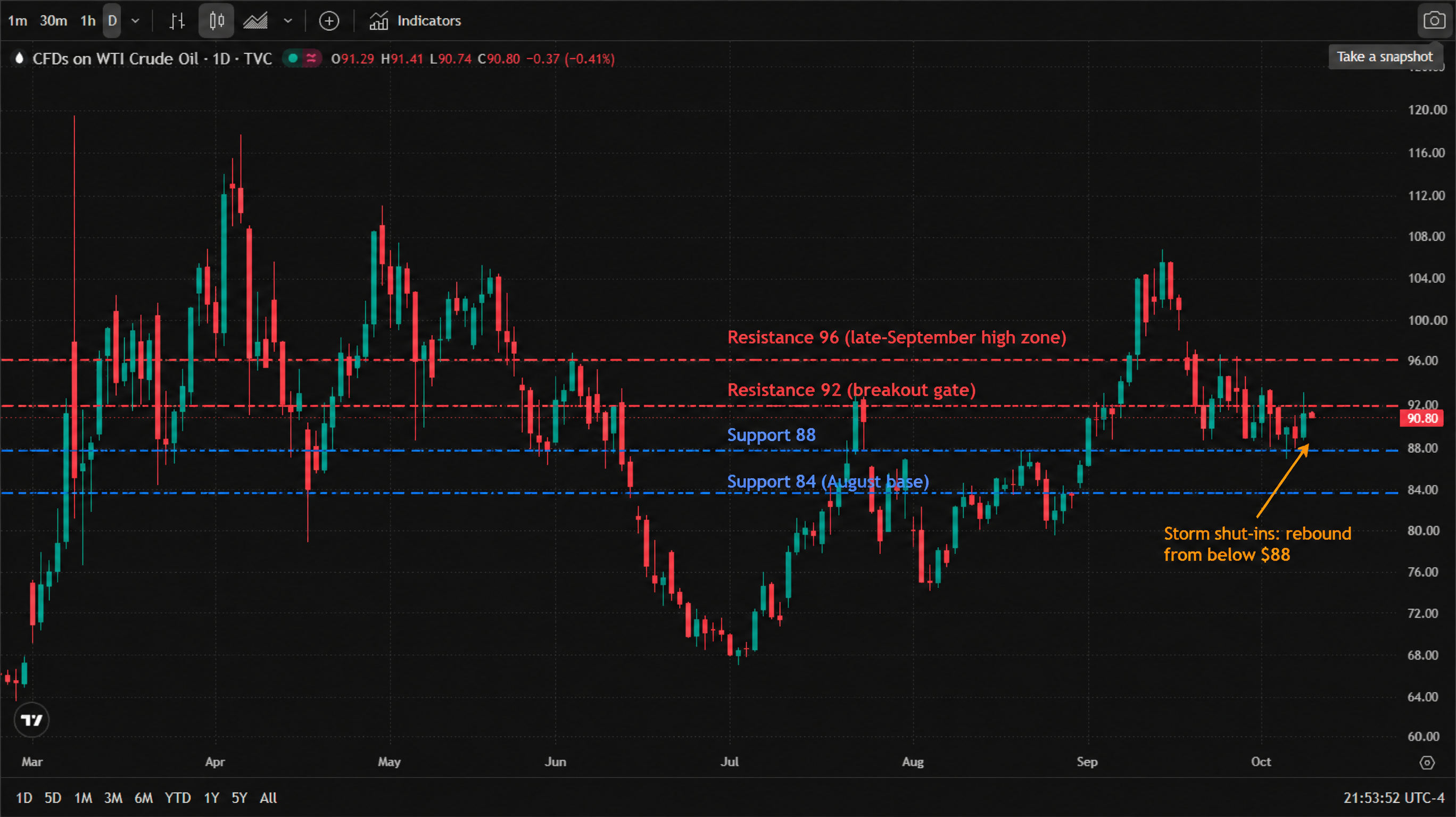
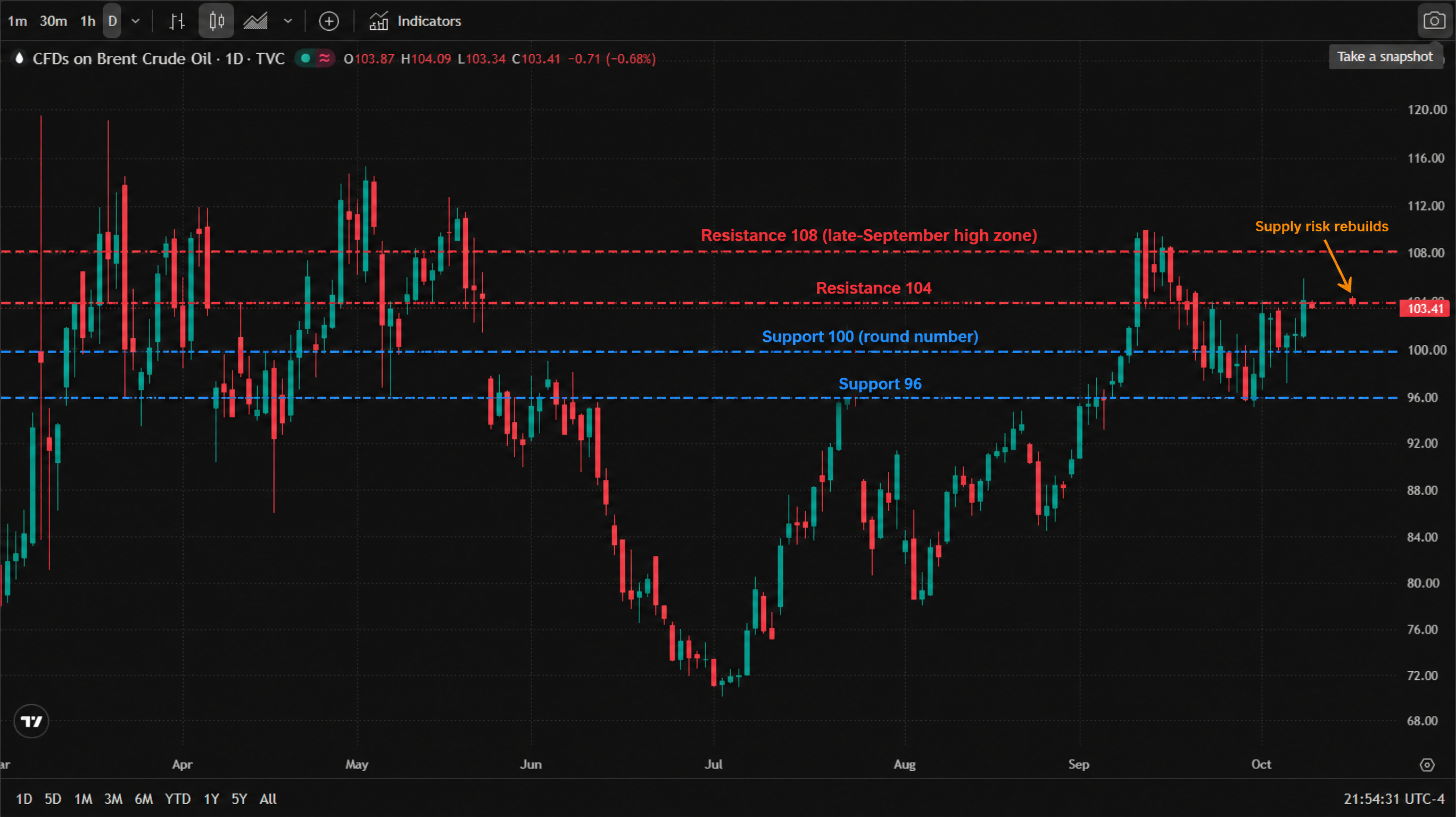
WTI crude traded at $90.80 in Friday's Asian session, up roughly 3% from Wednesday's $87.96 low, after Hurricane Isaias became the Atlantic season's first hurricane and forced producers to shut in about a quarter of US Gulf of Mexico output. Brent held at $103.41. The rebound has stalled just below the $92 line — and the first official reading of the disruption lands with the EIA weekly petroleum report on Thursday 15 October.
What the storm has taken offline
Isaias strengthened into a Category 2 hurricane on Thursday as it barrelled toward the US Gulf Coast, prompting evacuation orders in coastal areas. The timing makes it consequential for energy: the Gulf accounts for almost 15% of the crude the US pumps in a year, and operators were already curtailing output as the storm approached.
Regulatory data cited in The Wall Street Journal showed about 25% of current Gulf production was shut in as of midday Wednesday, with Shell and Chevron among the producers cutting offshore operations (Reuters). The market move followed the physical one: WTI bottomed at $87.96 on Wednesday and jumped to $91.41 as the shut-in headlines accumulated.
How we got here
The reversal is only two weeks old. In late September, crude was falling for a different reason — WTI settled at $89.38 on 29 September, the weakest since 31 August, after Saudi Arabia restored export capacity through its East–West pipeline and tanker traffic through the Strait of Hormuz increased.
October flipped the channel. Middle East tanker attacks re-intensified, and the storm added a second, purely physical supply risk closer to home. The result is a market that had been pricing normalisation now pricing disruption — and waiting for the first hard data point to size it.
What the 15 October EIA report needs to show
The EIA's weekly petroleum status report on Thursday 15 October covers the week ending 9 October, making it the first official data to register the shut-ins — in both its inventory line and its production estimate. Three things matter:
A draw rather than a build. If the shut-ins show up as a crude inventory draw, the physical tightness story gains evidence beyond headlines.
The production figure. How much Gulf output the EIA estimates was lost tells traders how much can be recovered once the storm clears.
Restart signals. Producers return as soon as inspections allow; the faster the restart headlines, the faster the risk premium unwinds.
Levels: WTI's $92 gate, Brent's $104 line
* Chart source: TradingView official chart screenshot, data source TVC (CFDs on WTI Crude Oil).
WTI key levels. Support: $90.74 (Friday's session low) / $88.00 (round number) / $84.00 (August base). Resistance: $91.41 (Friday's high) / $92.00 — the gate / $96.00 (late-September high zone). A daily close above $92 opens $96; losing $88 puts $84 back in play.
* Chart source: TradingView official chart screenshot, data source TVC (CFDs on Brent Crude Oil).
Brent key levels. Support: $103.34 (session low) / $100.00 (round number) / $96.00. Resistance: $104.00 / $108.00 (late-September high zone) / $112.00. Brent needs a close above $104 to reopen the run toward $108.
Two scenarios into the EIA print
Scenario A — the disruption persists. Damage inspections take longer than expected, restart headlines stay vague, and Thursday's EIA report shows a crude draw with a visible drop in estimated production. WTI clears $92 and targets $96, with Brent reclaiming $104 and testing $108.
Scenario B — the restart comes fast. Producers return within days, the EIA shows little net disruption, and the storm premium unwinds. WTI slides back to $88, and a break there reopens $84; Brent loses $100 and retests $96.
For context on how institutions are sizing the whole year rather than the storm: Standard Chartered recently raised its full-year average forecasts to $86 WTI / $92 Brent — both below today's spot, a reminder that forecasts and storm premiums are different things.
Read more
* The content presented above, whether from a third party or not, is considered as general advice only. This article should not be construed as containing investment advice, investment recommendations, an offer of or solicitation for any transactions in financial instruments.


