


Gold Price Analysis Today | Forex Gold Analysis | XAU/USD Analysis - November 20, 2026

Today's Gold Price
Gold price chart for today
*0% Commission and Low Spreads 0️⃣
*$50,000 in Free Virtual Funds 💰
*$100 New Customer Bonus 🎁
Gold (XAU/USD) fell below $3,600 to around $3,578.98 this morning (November 20, 2026), after the U.S. market closed below $3,650 at a 14-month low. The roughly 90% probability of a December Fed rate hike and a dollar near a 19-month high continued to weigh on gold. Despite weaker U.S. labor and manufacturing data and persistent tensions in the Strait of Hormuz, selling across asset classes alongside global equities kept precious metals under pressure. Today's focus is whether gold can hold $3,570–3,590 and rebound.
Today's Key Points
| Key Points |
|
|
|
Gold breaks below $3,600 after closing under $3,650 at a 14-month low as Fed rates and the dollar weigh
U.S. spot gold fell $98.60 (-2.65%) to around $3,625.50 per ounce after touching $3,625.30, breaking below $3,650 to a 14-month low. Renewed selling this morning pushed it below $3,600 to around $3,578.98. Silver dropped $2.120 (-4.71%) to $42.830 amid weakness in industrial commodities.
U.S. data weakened: Unemployment claims rose to 203,000, above the 197,000 forecast, continuing claims climbed to 1.763 million, the November Philadelphia Fed index fell from 20.9 to 6.3, and the October LEI declined 0.3% to 99.3. Persistent inflation and resilient consumption nevertheless left futures pricing in a roughly 90% chance of a 25 bps Fed hike at the December 8–9 meeting. Some participants left the door open to an increase larger than 25 bps and continued tightening into early 2027. Although the 10-year Treasury yield eased to around 5.04%, the dollar remained near a 19-month high, keeping gold under pressure.
Hormuz shipping stalls, but oil holds steady after rising U.S. inventories offset support for safe-haven demand
Tensions in the Strait of Hormuz remain severe following attacks on 3 vessels belonging to the Abu Dhabi National Oil Company (ADNOC). Commercial vessel traffic fell to just 5 ships on Saturday and none were observed on Sunday, compared with 31 a week earlier. The U.S. continues to blockade Iranian ports, and peace talks have made no progress.
Despite elevated energy risks, crude closed little changed after volatile trading. WTI slipped $0.05 to $83.21, while Brent gained $0.03 to $91.98. A stronger dollar and a 3.4 million-barrel rise in U.S. crude inventories to 417.8 million barrels, alongside a 5.2 million-barrel increase in gasoline stocks, outweighed support for safe-haven buying in gold.
U.S. and European stocks tumble amid AI selling, pressuring liquidity across asset classes ahead of tonight's data
Global stocks sold off sharply on concerns over AI valuations and high borrowing costs. The Dow Jones fell 1,101.11 points (-2.19%) to 49,097.06, the S&P 500 declined 2.02% to 7,175.83 for its 6th consecutive daily loss, and the Nasdaq dropped 2.25% to 23,879.20. Nvidia reversed to close down 3.3%, although Anthropic rose 17.1% to $97.17 from its $83.00 IPO price. Canada's TSX fell 1.59%, tracking gold miners Franco-Nevada (-2.51%) and Wheaton Precious Metals (-3.17%). Europe's Stoxx 600 slipped 0.6%, with the DAX (-1.06%) and FTSE 100 (-0.93%) also lower.
Simultaneous selling in equities and precious metals suggests institutions are reducing commodity holdings to hold dollar cash and buy U.S. Treasuries. Tonight at 22:00, markets will watch the November University of Michigan consumer sentiment index and remarks from Fed officials to assess inflation expectations.



Technical Analysis of Gold (XAU/USD)
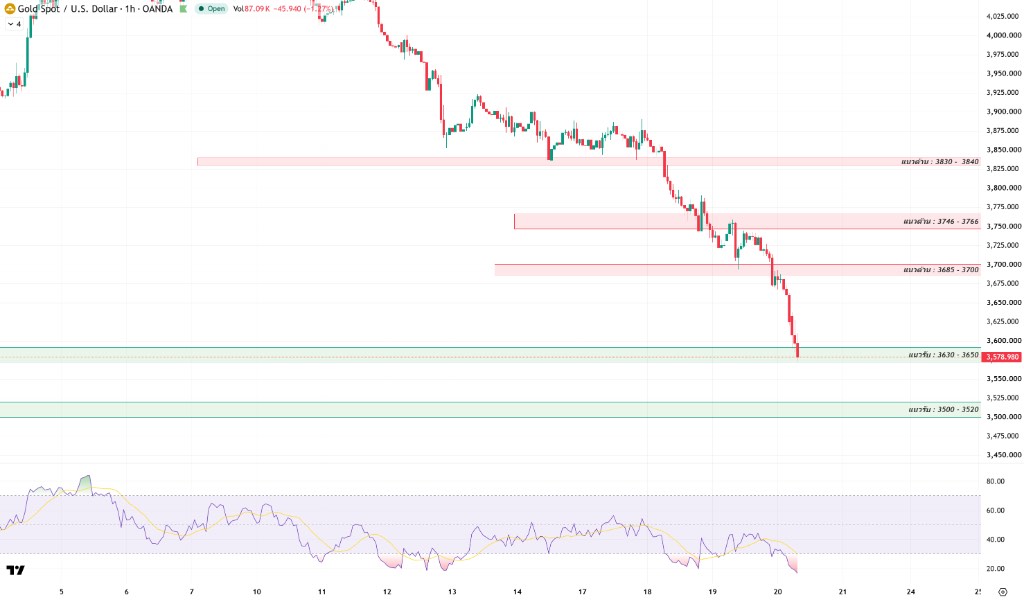
On the 1-hour chart, gold remains in a steep downtrend after yesterday's rebound failed at $3,746–3,766. It then broke below $3,685–3,700 and $3,630–3,650, with a large bearish candle pushing it below $3,600 to test support at $3,570–3,590 near $3,578.98 (-1.27%).
The 1-hour RSI fell deep into oversold territory near 16–18, below 20 and well beneath its yellow moving average near 29–30. This indicates extremely stretched short-term selling pressure, leaving scope for a technical rebound at any time. However, no upward crossover or bullish divergence has yet confirmed a reversal.
Today's key test is whether gold can halt its decline and form a higher low above $3,570–3,590 before reclaiming $3,625–3,650. Otherwise, a short-term rebound could still prove to be a bull trap before renewed selling.
Holding firmly at $3,570–3,590 and reclaiming $3,625–3,650 would open the way toward resistance at $3,685–3,700, $3,746–3,766 and $3,830–3,840. A 1-hour close below $3,570 would instead lead to further declines toward $3,500–3,520 and $3,450–3,475.
Today's Gold Price Outlook
| Scenarios |
|
|
|
Today's Trading Strategy
For short-term traders: Trade the range with discipline. Avoid chasing short positions while RSI is below 20, watch candlesticks at key zones, and always use a stop-loss.
- Buy setup: Wait for a reversal candle at $3,570–3,590 or $3,500–3,520 to trade a rebound toward $3,625–3,650 and $3,685–3,700, with a stop-loss below support.
- Sell setup: Look to sell if a rebound fails at $3,625–3,650 or $3,685–3,700, or follow the move after a close below $3,570. Targets are $3,500–3,520 and $3,450–3,475, with a stop-loss above resistance.
For longer-term holders: Pressure from Fed rates and a strong dollar remains dominant. Delay purchases and wait for a firm base around $3,500–3,520 or a sustained move above $3,685–3,700 before accumulating.
Daily Support and Resistance Levels
| Type | Price Level |
| Support #1 | $3,570–3,590 |
| Support #2 | $3,500–3,520 |
| Support #3 | $3,450–3,475 |
| Resistance #1 | $3,625–3,650 |
| Resistance #2 | $3,685–3,700 |
| Resistance #3 | $3,746–3,766 |
Today's Questions (FAQ)
Why is gold still falling sharply despite weak U.S. labor and manufacturing data?
Unemployment claims rose to 203,000 and the Philadelphia Fed index fell to 6.3, but persistent inflation left markets pricing in a 90% chance of a 25 bps December Fed hike. The dollar therefore remained near a 19-month high, keeping gold under pressure.
Why aren't investors buying gold as a safe haven amid steep U.S. stock declines and tensions in Hormuz?
When tech stocks fall sharply, institutions often sell across asset classes, including gold, to reduce risk and hold dollar cash and U.S. Treasuries yielding more than 5%. Meanwhile, oil has held steady because of rising U.S. inventories, reducing near-term support for gold.
Read more
The above content was completed with the assistance of AI and has been reviewed by an editor.


