




Verizon vs. AT&T: Which Dividend Stock Is the Better Buy for Retirement Income?
Key Points
Verizon pays a much higher yield than AT&T.
Verizon also operates at higher margins and trades at a lower valuation.
- 10 stocks we like better than AT&T ›
Verizon (NYSE: VZ) and AT&T (NYSE: T), two of the largest telecom companies in the U.S., are both popular dividend stocks. Verizon pays a forward yield of 6.2%, while AT&T pays a forward yield of 4.6%. Both stocks also look like bargains in this frothy market: Verizon trades at nine times forward earnings, while AT&T has a forward price-to-earnings ratio of 10.
But over the past 12 months, Verizon's stock dipped 4% as AT&T's stock dropped 10%. Let's see why Verizon held up better than AT&T -- and if it's the better income play for retirees.
Missed Nvidia in 2009? This Rare Signal Is Flashing Again. In 2009, a "Double Down" signal flashed for a little-known chipmaker called Nvidia. For the first time in years, that same "Total Conviction" signal is flashing for a company 1/100th the size of Nvidia. Continue »

Image source: Getty Images.
The differences between Verizon and AT&T
Verizon and AT&T both generate most of their revenue from their wireless businesses. As of their latest quarters, Verizon served 147 million wireless subscribers, while AT&T Mobility (including FirstNet and Cricket Wireless) served 121.4 million subscribers.
AT&T, which divested its media businesses over the past few years to focus on strengthening its core telecom business, is gaining postpaid wireless subscribers at a faster rate than Verizon.
In the second quarter of 2026, AT&T reported 432,000 postpaid phone net additions, while Verizon only reported 184,000 postpaid phone net additions in the same period.
AT&T is capturing more subscribers with its bundled fiber-and-wireless promotions, while Verizon has reined in its promotions and focused on acquiring higher-value customers instead. That's why Verizon constantly maintains higher gross and operating margins than AT&T.
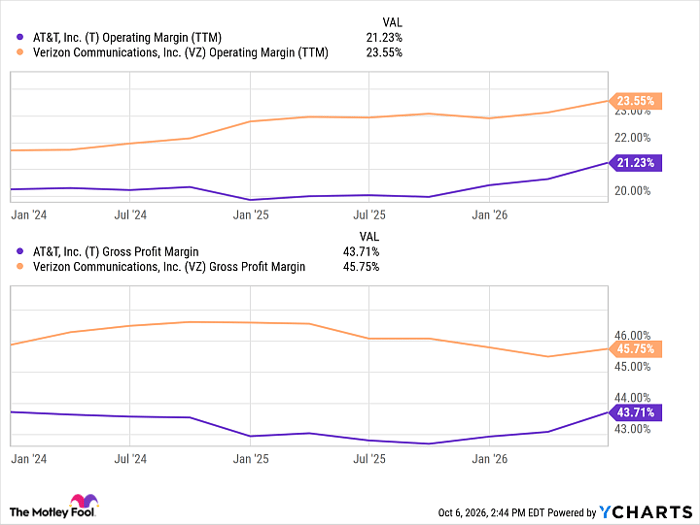
Source: YCharts
Verizon and AT&T are both expanding their broadband internet networks. Verizon is expanding its 5G Home Internet service (which complements its wireless segment), while its recent acquisition of Frontier will significantly boost its presence in the wireline and fiber markets. AT&T is also expanding its fiber-optic networks, but its strategy is more capital-intensive than Verizon's.
Why is Verizon the better investment?
We've already established that Verizon pays a higher dividend yield, trades at a lower valuation, and operates at higher margins than AT&T. However, another factor that makes Verizon a stronger investment than AT&T is the 10-Year Treasury yield -- which currently sits at 5.3%.
That high yield -- which will also drive companies and banks to offer higher-yielding debt, CDs, and savings accounts to stay competitive -- will draw investors away from lower-yielding dividend stocks like AT&T. Verizon's yield remains comfortably above that level, so it should be better insulated from that pressure. Verizon might get in trouble if the Fed keeps hiking its benchmark rates to tame inflation, but it should be a safer place to park your cash than AT&T for the foreseeable future.
Should you buy stock in AT&T right now?
Before you buy stock in AT&T, consider this:
The Motley Fool Stock Advisor analyst team just identified what they believe are the 10 best stocks for investors to buy now… and AT&T wasn’t one of them. The 10 stocks that made the cut could produce monster returns in the coming years.
Consider when Netflix made this list on December 17, 2004... if you invested $1,000 at the time of our recommendation, you’d have $364,023!* Or when Nvidia made this list on April 15, 2005... if you invested $1,000 at the time of our recommendation, you’d have $1,467,933!*
Now, it’s worth noting Stock Advisor’s total average return is 948% — a market-crushing outperformance compared to 214% for the S&P 500. Don't miss the latest top 10 list, available with Stock Advisor, and join an investing community built by individual investors for individual investors.
See the 10 stocks »
*Stock Advisor returns as of October 6, 2026.
Leo Sun has positions in Verizon Communications. The Motley Fool recommends Verizon Communications. The Motley Fool has a disclosure policy.
Recommended Articles


