




Starlink Is Now SpaceX's Cash Machine. Can It Help the Stock Double?
Key Points
Starlink is arguably SpaceX's best-performing segment right now.
Starlink's success on its own isn't enough to power SpaceX stock higher.
- 10 stocks we like better than Space Exploration Technologies ›
When Space Exploration Technologies (NASDAQ: SPCX) was preparing to go public, many experts worried that the company's targeted $1.77 trillion valuation was too rich. Most of these experts, however, also believed that the company's Starlink division held great promise.
For example, Jeremy Grantham -- a co-founder of GMO Asset Management and a well-known prognosticator of market bubbles -- warned investors against investing in SpaceX during its IPO.
Missed Nvidia in 2009? This Rare Signal Is Flashing Again. In 2009, a "Double Down" signal flashed for a little-known chipmaker called Nvidia. For the first time in years, that same "Total Conviction" signal is flashing for a company 1/100th the size of Nvidia. Continue »
"In the end, the reality will come out, and this will turn out to be, of course, one of the landmark historical events that I so value in history looking back," Grantham cautioned. "It will be amazing, by the way, if it doesn't collapse, because it will need such massive developments on AI that our entire lives are totally different."
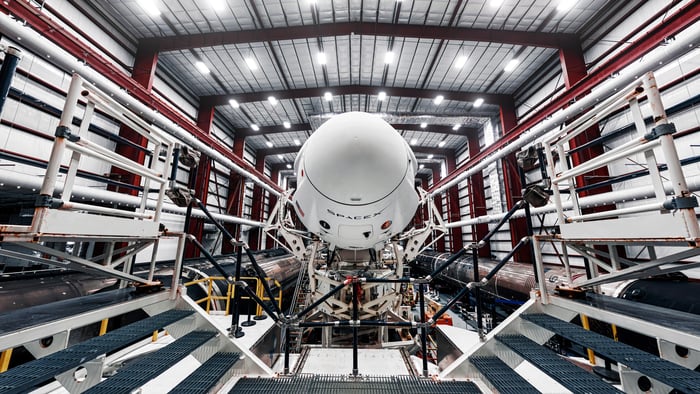
Image source: Getty Images.
SpaceX's stock price has been on a bit of a roller-coaster ride since the IPO, but it remains above its IPO valuation. Grantham predicted possible short-term price appreciation given SpaceX's limited supply of publicly traded shares. "[S]upply and demand being what it is," he said, "it's hard to imagine the price won't go up, and perhaps it will go up a lot."
Grantham was extremely bearish on SpaceX as an investment opportunity. It's perhaps surprising, then, that he was a fan of SpaceX's Starlink division. Here's what he said in a podcast interview this summer:
"Great idea, by the way. Makes money. But this is not Starlink. Maybe I'd be an investor too, if it were Starlink."
Last year, Starlink was the odd bright spot for SpaceX's financials. The division produced $4.4 billion in operating profit off $11.4 billion in sales. SpaceX's other divisions posted operating losses on less revenue.
Starlink's success continued in 2026. Last quarter, Starlink generated $1.7 billion in operating profit. The rest of SpaceX's divisions lost a combined $1.8 billion.
Impressive revenue growth and continued profitability are expected to continue for Starlink. Morningstar predicts the segment will become "a substantial, high-growth business anchored in a focused but meaningful $129 billion global market."
Here's the problem: Starlink won't be enough to double SpaceX's stock price on its own. In fact, Starlink may ultimately be immaterial to SpaceX's long-term potential.
Here's why Starlink matters for SpaceX, and why it doesn't
It's important to understand Starlink within the context of SpaceX's other businesses.
According to SpaceX's IPO prospectus, the company's total long-term addressable market is valued at $28.6 trillion. Starlink only accounts for $1.6 trillion of that total. Some analysts don't even value the Starlink opportunity that highly.
"The $1.6 trillion TAM figure from SpaceX appears to aggregate the total connectivity market across most countries (excluding China and Russia) and all segments, including wireless, broadband, and enterprise," Morningstar analysts contend. "... We think that this significantly overstates realistic market opportunity for Starlink, as satellite-based connectivity faces physical and technological constraints that are very difficult to overcome in a dense urban environment."
Starlink matters for SpaceX because it helps scale the company's rocket technology through a profitable venture -- profits that can then be redirected to other purposes. What other purposes? Almost exclusively, SpaceX's future hinges on the success of its AI division, which accounts for $26.5 trillion of the company's total claimed $28.5 trillion addressable market.
Starlink's cash flow will help mitigate shareholder dilution and support other growth opportunities. On its own, however, Starlink's success won't move SpaceX's stock price much in the long term. Only the success (or failure) of SpaceX's AI efforts will have a meaningful effect in the years and decades to come.
Should you buy stock in Space Exploration Technologies right now?
Before you buy stock in Space Exploration Technologies, consider this:
The Motley Fool Stock Advisor analyst team just identified what they believe are the 10 best stocks for investors to buy now… and Space Exploration Technologies wasn’t one of them. The 10 stocks that made the cut could produce monster returns in the coming years.
Consider when Netflix made this list on December 17, 2004... if you invested $1,000 at the time of our recommendation, you’d have $361,650!* Or when Nvidia made this list on April 15, 2005... if you invested $1,000 at the time of our recommendation, you’d have $1,437,517!*
Now, it’s worth noting Stock Advisor’s total average return is 936% — a market-crushing outperformance compared to 211% for the S&P 500. Don't miss the latest top 10 list, available with Stock Advisor, and join an investing community built by individual investors for individual investors.
See the 10 stocks »
*Stock Advisor returns as of October 4, 2026.
Ryan Vanzo has no position in any of the stocks mentioned. The Motley Fool has no position in any of the stocks mentioned. The Motley Fool has a disclosure policy.
Recommended Articles


