




Could This Overlooked Dividend Growth ETF Help Make You a Millionaire?
Key Points
The Vanguard Dividend Appreciation ETF (VIG) has averaged 10% annual total returns since its inception.
Companies must have increased their annual dividends for at least 10 consecutive years to be eligible for VIG.
VIG is much more tech-heavy than typical dividend ETFs because it doesn't place a huge emphasis on high yields.
- 10 stocks we like better than Vanguard Dividend Appreciation ETF ›
Stock price appreciation gets a lot of attention because it's straightforward. You buy a stock for $X, sell it for $Y, and the difference is how much you (ideally) made. However, dividends are a large part of many investors' total returns, and dividend exchange-traded funds (ETFs) can be productive pieces of any portfolio.
There are dozens of dividend ETFs to choose from, but one I like is the Vanguard Dividend Appreciation ETF (NYSEMKT: VIG). You don't often think of dividend ETFs as millionaire-makers, but if VIG continues at its historical pace, it's a worthwhile option for long-term investors.
Missed Nvidia in 2009? This Rare Signal Is Flashing Again. In 2009, a "Double Down" signal flashed for a little-known chipmaker called Nvidia. For the first time in years, that same "Total Conviction" signal is flashing for a company 1/100th the size of Nvidia. Continue »

Image source: Getty Images.
How feasible is $1 million?
Since it began trading in April 2006, VIG has averaged 10% annual total returns. Those aren't eye-popping returns, but they add up significantly, thanks to compounding.
If you invest $500 monthly and average 10% annual returns, you could reach $1 million in around 31 years. If you were to invest $1,000 or $2,000 monthly, you could hit the mark in around 24 or 18 years, respectively.
The exact time it takes will ultimately depend on how much you invest and the returns, but with enough time and consistency, VIG is capable of making it happen.
A different approach to dividends
Compared to many other dividend ETFs, VIG offers a relatively low yield of 1.5%. However, yield isn't VIG's selling point; its focus on dividend growth is.
VIG only considers companies that have increased their annual dividend for at least 10 consecutive years, excluding the top 25% highest-yielding stocks that qualify. The latter criterion helps avoid yield traps (companies with high yields but poor underlying businesses).
Exact payouts fluctuate with dividend ETFs because different holdings pay dividends at different times, but VIG's dividend payout has jumped over 919% since it began trading. The $0.930 it'll pay on Sept. 30 is up 849%.
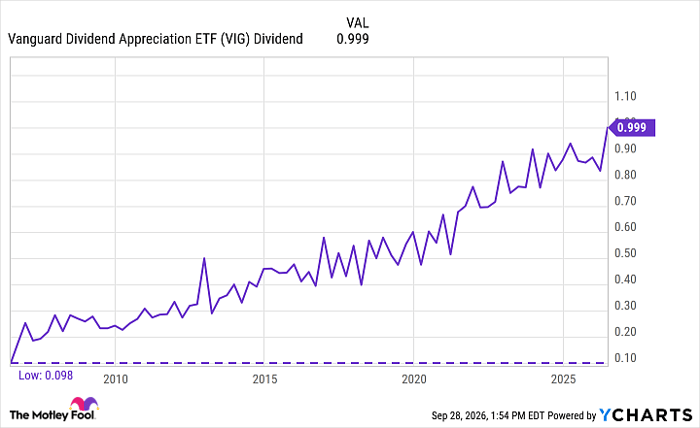
VIG Dividend data by YCharts.
VIG is led by blue chip companies
Since VIG doesn't have strict yield requirements and focuses more on dividend growth, it's much more tech-heavy than you'd expect from a dividend ETF (25.60% of it). Its top three holdings are Microsoft (4.67%), Apple (4.50%), and Broadcom (4.34%). These aren't poster children for dividend stocks, but they have impressive dividend track records.
Microsoft has increased its dividend for 22 consecutive years and has increased it 133% in the past decade. Apple has increased its dividend for 14 consecutive years and increased it 89% in the past decade, and Broadcom has increased its dividend for 15 consecutive years and increased it a hefty 537% in the past decade.
These are just a few examples. VIG's 333 holdings include plenty of blue chip giants across industries, with a history of success and a reputation for being shareholder-friendly. It holds dozens of Dividend Kings (companies with at least 50 consecutive years of dividend increases).
If you have your eyes set on a million, you want a dividend ETF that you don't have to second-guess. One where you can passively invest (and ideally reinvest) and trust that time will do the heavy lifting is hard to beat, and VIG provides just that.
Should you buy stock in Vanguard Dividend Appreciation ETF right now?
Before you buy stock in Vanguard Dividend Appreciation ETF, consider this:
The Motley Fool Stock Advisor analyst team just identified what they believe are the 10 best stocks for investors to buy now… and Vanguard Dividend Appreciation ETF wasn’t one of them. The 10 stocks that made the cut could produce monster returns in the coming years.
Consider when Netflix made this list on December 17, 2004... if you invested $1,000 at the time of our recommendation, you’d have $365,910!* Or when Nvidia made this list on April 15, 2005... if you invested $1,000 at the time of our recommendation, you’d have $1,418,530!*
Now, it’s worth noting Stock Advisor’s total average return is 930% — a market-crushing outperformance compared to 211% for the S&P 500. Don't miss the latest top 10 list, available with Stock Advisor, and join an investing community built by individual investors for individual investors.
See the 10 stocks »
*Stock Advisor returns as of October 2, 2026.
Stefon Walters has positions in Apple and Microsoft. The Motley Fool has positions in and recommends Apple, Broadcom, Microsoft, and Vanguard Dividend Appreciation ETF. The Motley Fool has a disclosure policy.
Recommended Articles


