




Should You Forget Tesla and Buy These 3 Robotics Stocks Instead?
Key Points
Teradyne is already putting robots to work across manufacturing while benefiting from AI-driven semiconductor demand.
Zebra is connecting machine vision, software, and data tools to make automation smarter across physical operations.
Rockwell gives investors exposure to AI and robotics through its established industrial automation business.
- 10 stocks we like better than Rockwell Automation ›
If you're interested in robotics as a real business, not just a fancy, broad, science fiction-esque idea, I don't think investors need Tesla (NASDAQ: TSLA) to get that exposure during the next few years.
Tesla has talked openly about robots and automation. However, most of its actual results are still to come, and the company's revenue and earnings come from selling cars, energy products, and software tied to those businesses. The robot narrative is more promise than near‑term reality in my opinion, and that makes it hard to judge how much of today's valuation you're really paying for robotics versus everything else.
Missed AI’s "Act 1"? Act 2 Could Be 15x Bigger. Most investors think they missed the AI boat because they didn't buy Nvidia in 2005. But according to our analysts, we’re only at the end of "Act 1"—the R&D phase. "Act 2" is the global rollout. Continue »
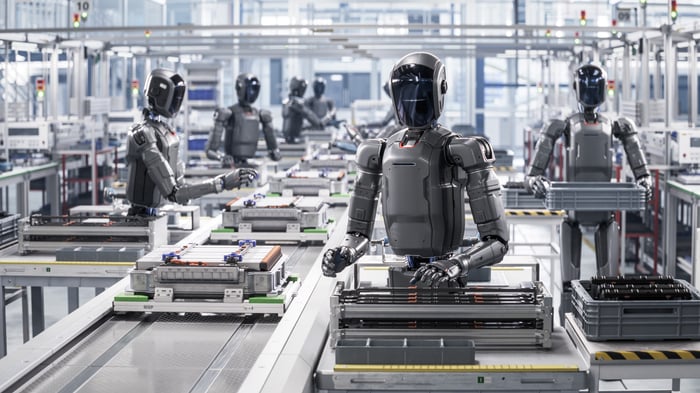
Image source: Getty Images.
There's another way to play this theme. You can own companies that already sell robots, automation platforms, and machine‑vision technology to factories and warehouses, offering new robotics capabilities and artificial intelligence (AI) to established customer bases. That's what Teradyne (NASDAQ: TER), Zebra Technologies (NASDAQ: ZBRA), and Rockwell Automation (NYSE: ROK) are doing right now. To me, these companies are more likely to drive measurable growth in robotics during the next couple of years than Tesla's still‑developing humanoid projects.
1. Teradyne: Robots where work actually happens
Teradyne describes itself as a provider of automated test equipment and advanced robotics, and it has been busy turning that robotics label into real deployments. In 2026, the company highlighted its Teradyne Robotics unit, unveiling a wide range of "production‑ready physical AI applications" at the Automate trade show and expanding a partnership with Flex to scale intelligent automation across global manufacturing. It also opened a new office in India to deepen its support for semiconductor and electronics manufacturers, hinting at more robots and automation being installed in one of the world's fastest‑growing manufacturing regions.
Teradyne's robots are already tied into real manufacturing workflows, and its presence is growing in regions where new factories are being built. When buying this stock, keep in mind that the shares have already climbed about 200% during the past year, while some planned insider selling could add pressure.
If you're averaging into Teradyne, it may make more sense to wait for dips rather than go all in at current prices. The company continues to benefit from strong demand for semiconductor testing equipment, especially as AI and memory chips continue to drive growth.
2. Zebra: Turning machine vision into frontline automation
Zebra Technologies has built a portfolio focused on digitizing and automating workflows for frontline workers, and this year it took a big step to sharpen that focus. The company sold its Robotics Automation business to Skild AI, taking cash and an equity stake to concentrate its investment in higher‑growth areas such as radio‑frequency identification (RFID), machine vision, and artificial intelligence on the shop floor. At the same time, Zebra launched a new machine‑vision camera and showcased an ecosystem of automation solutions at Automate 2026 that connect physical assets, workers, and data across the supply chain.
In plain terms, Zebra is turning robots from a stand-alone product into part of a broader intelligent operations story. This story is where cameras, scanners, and software guide whatever automation a customer uses. That approach can scale faster than betting everything on a single robot body.
This company is a strong buy because it's leaning into the growing push toward automation, with its hardware, software, and data-capture tools connecting physical operations and digital workflows. The business is also seeing stronger demand across manufacturing and healthcare.
3. Rockwell: AI plus autonomous robots inside factories
Rockwell Automation frames itself as the world's largest company dedicated to industrial automation and digital transformation, and robotics falls within that broader mission. In 2026, it announced plans to demonstrate at the INTERPHEX biotech conference how life‑sciences manufacturers are integrating AI‑driven analytics, autonomous mobile robots, and digital manufacturing platforms into real production environments, according to R&D World.
Rockwell has a strong foothold in industrial automation, with sticky customers, high margins, and solid growth as factories invest more in robotics and AI. Rockwell is already expanding its robotics and AI-enabled automation business, but as a cyclical industrial company, its results still depend on broader factory spending.
Should you buy stock in Rockwell Automation right now?
Before you buy stock in Rockwell Automation, consider this:
The Motley Fool Stock Advisor analyst team just identified what they believe are the 10 best stocks for investors to buy now… and Rockwell Automation wasn’t one of them. The 10 stocks that made the cut could produce monster returns in the coming years.
Consider when Netflix made this list on December 17, 2004... if you invested $1,000 at the time of our recommendation, you’d have $375,240!* Or when Nvidia made this list on April 15, 2005... if you invested $1,000 at the time of our recommendation, you’d have $1,403,292!*
Now, it’s worth noting Stock Advisor’s total average return is 932% — a market-crushing outperformance compared to 211% for the S&P 500. Don't miss the latest top 10 list, available with Stock Advisor, and join an investing community built by individual investors for individual investors.
See the 10 stocks »
*Stock Advisor returns as of October 2, 2026.
Micah Zimmerman has no position in any of the stocks mentioned. The Motley Fool has positions in and recommends Teradyne, Tesla, and Zebra Technologies. The Motley Fool recommends Rockwell Automation. The Motley Fool has a disclosure policy.
Recommended Articles


