




Prediction: A Stock Market Crash Is on the Way. Investors Who Do This 1 Thing Can Still Come Out on Top, Based on 155 Years' Worth of History
Key Points
The Buffett Indicator measures the value of the total stock market relative to GDP, and it sits at an all-time high right now.
The Shiller CAPE ratio is at its highest levels since the late 1990s, just before the dot-com bubble burst.
History shows how investors can employ certain strategies to emerge as winners.
- 10 stocks we like better than S&P 500 Index ›
The past few years have been a gift for anyone who stayed invested instead of booking gains. Between the start of 2023 through late September 2026, the S&P 500 (SNPINDEX: ^GSPC) has compounded at roughly 21% a year, while the Nasdaq Composite (NASDAQINDEX: ^IXIC) and Dow Jones Industrial Average (DJINDICES: ^DJI) have gained 29% and 12% per year, respectively. These are the kind of numbers that make investors feel invincible.
Most of the big winners have come from artificial intelligence (AI) -- the chips, cloud platforms, and software wrapping itself around every business process. The indexes are climbing largely because a handful of giant companies keep delivering monster earnings and the market is paying up for the next chapter.
Missed Nvidia in 2009? This Rare Signal Is Flashing Again. In 2009, a "Double Down" signal flashed for a little-known chipmaker called Nvidia. For the first time in years, that same "Total Conviction" signal is flashing for a company 1/100th the size of Nvidia. Continue »
Generational runs never last forever, though. A couple of long-standing valuation gauges now sit at levels that have historically preceded weaker returns. A stock market crash does not need to be right around the corner to still matter, but momentum traders who treat every dip as a buying opportunity in the same popular stocks are setting themselves up to get blindsided. Nevertheless, there is a way to stay invested through market turmoil and still come out ahead, and it's not by chasing the flashiest AI upstart.
Image source: Getty Images.
The Buffett Indicator is blinking red
Warren Buffett once called the ratio of total U.S. stock market value to gross domestic product (GDP) "probably the best single measure of where valuations stand at any given moment." He popularized this measurement in a 2001 interview with Fortune magazine after watching the market implode after the dot-com bubble burst.
The idea is simple: over long stretches, corporate profits cannot outrun the economy. When the market's total valuation extends beyond the size of the underlying economy, you are effectively paying a premium that future growth must justify.
The Buffett Indicator, as it has become known, currently sits roughly at a record high of 236%. Buffett himself warned that when the ratio approaches 200%, investors are "playing with fire." We are well past that threshold. Smart investors care because they understand the Buffett Indicator is not a clock that rings the day before a sharp reversal. It's best used as a temperature check. When the entire market is priced as if every company will keep growing faster than the country's economy, the margin of safety starts eroding quickly.
The CAPE ratio is rising, and that's usually not a good thing
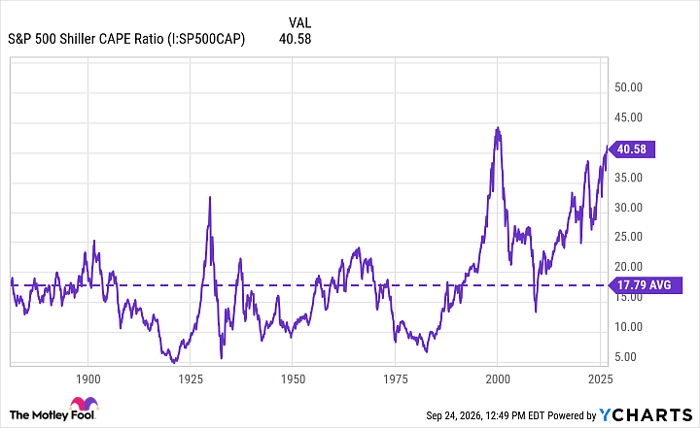
The CAPE ratio -- cyclically adjusted price-to-earnings (P/E), or Shiller P/E -- does a job similar to the Buffett Indicator, but from a different angle. It takes the S&P 500 price and divides it by 10 years of inflation-adjusted earnings so one boom year or one recession does not distort the overall picture.
S&P 500 Shiller CAPE Ratio data by YCharts
Nearly 155 years' worth of data shows the CAPE's long-run average hovers at more than 17. Right now, it reads close to 41 -- a level witnessed only during the final days of the dot.com bubble. As the trends in the chart show, a rising CAPE consistently foreshadows muted returns during the following decade. When the ratio becomes stretched for extended periods, subsequent annualized real returns have often landed in the low single-digit percentages or even turned negative.
Is the stock market in a bubble right now?
The combination of a sky-high Buffett Indicator and a historically high CAPE ratio does not necessarily prove the market is in a full-blown AI bubble. It also does not confirm every stock is doomed. What it does suggest, however, is the easy money from valuation expansion is probably behind us.
Although companies like Nvidia, Alphabet, Amazon, Meta Platforms, Microsoft, Palantir Technologies, and Broadcom really are building durable advantages and earning enormous profits thanks to AI, plenty of others are slapping "AI" on their website and hoping unsophisticated investors buy into the narrative. History is littered with similar examples: although the internet was real, mant of the hot companies from the late 1990s never survived. That same pattern could be playing out right now.
If you study the CAPE ratio chart, it also becomes clear that throughout history the stock market has always eventually rebounded. Against this backdrop, the winning strategy that consistently works is surprisingly old-fashioned. Investors should look for businesses with genuine economic moats -- pricing power, network effects, and switching costs that build scale competitors cannot easily replicate.
It's important to have a preference for businesses like the ones above that already generate reliable cash flow from diversified operations rather than a single source of income. These companies can keep investing, returning capital to investors, and survive no matter what the next few years throw at them -- whether the stock market plunges 20% or grinds sideways for a while.
Although the stock market can keep running on momentum and hype for a while, the investors who will win in the long-run are the ones who already own quality businesses that can fund themselves through any economic cycle.
Should you buy stock in S&P 500 Index right now?
Before you buy stock in S&P 500 Index, consider this:
The Motley Fool Stock Advisor analyst team just identified what they believe are the 10 best stocks for investors to buy now… and S&P 500 Index wasn’t one of them. The 10 stocks that made the cut could produce monster returns in the coming years.
Consider when Netflix made this list on December 17, 2004... if you invested $1,000 at the time of our recommendation, you’d have $383,680!* Or when Nvidia made this list on April 15, 2005... if you invested $1,000 at the time of our recommendation, you’d have $1,382,954!*
Now, it’s worth noting Stock Advisor’s total average return is 937% — a market-crushing outperformance compared to 214% for the S&P 500. Don't miss the latest top 10 list, available with Stock Advisor, and join an investing community built by individual investors for individual investors.
See the 10 stocks »
*Stock Advisor returns as of September 27, 2026.
Adam Spatacco has positions in Alphabet, Amazon, Microsoft, Nvidia, and Palantir Technologies. The Motley Fool has positions in and recommends Alphabet, Amazon, Broadcom, Meta Platforms, Microsoft, Nvidia, and Palantir Technologies. The Motley Fool has a disclosure policy.
Recommended Articles


