




Has AGNC's Monthly Dividend Made Up for What Its Share Price Did?
Key Points
AGNC Investment's share price has fallen about 50% since its IPO.
While its dividend rate has also declined, it has paid out more than $50 per share in cumulative dividends since its IPO.
That income has more than offset the decline in its share price.
- 10 stocks we like better than AGNC Investment Corp. ›
AGNC Investment (NASDAQ: AGNC) completed its IPO in May 2008 at $20 per share. Today, shares of the mortgage REIT trade at around $10 per share, a staggering 50% below their IPO price.
However, the company's monthly dividends have more than offset the slump in its share price. AGNC has paid out over $50 per share in cumulative dividends since its IPO, more than double its IPO price. With dividends reinvested, it has significantly outperformed mortgage REITs and other financial stocks since its IPO.
Missed AI’s "Act 1"? Act 2 Could Be 15x Bigger. Most investors think they missed the AI boat because they didn't buy Nvidia in 2005. But according to our analysts, we’re only at the end of "Act 1"—the R&D phase. "Act 2" is the global rollout. Continue »

Image source: Getty Images.
What happened to AGNC's stock?
AGNC Investment's founders formed it in the depths of the financial crisis, seeing an opportunity to create a leading Agency MBS (mortgage-backed securities guaranteed against credit losses by government agencies like Fannie Mae). It invests in Agency MBS on a leveraged basis, primarily through repurchase agreements, and uses dynamic risk management strategies to navigate market risks, including interest rate changes.
The company has had to maneuver around several market cycles, unexpected events, and market volatility over the years, which have weighed on its investment returns and earnings. AGNC Investment has still managed to significantly expand its Agency MBS portfolio (it reached $97.2 billion at the end of the second quarter), financed primarily by selling stock. As a result, its shares outstanding have risen a staggering 7,660% since its IPO. This combination of earnings volatility and dilution is why its share prices have fallen 50% since the IPO.
How the dividend has helped offset the declining share price
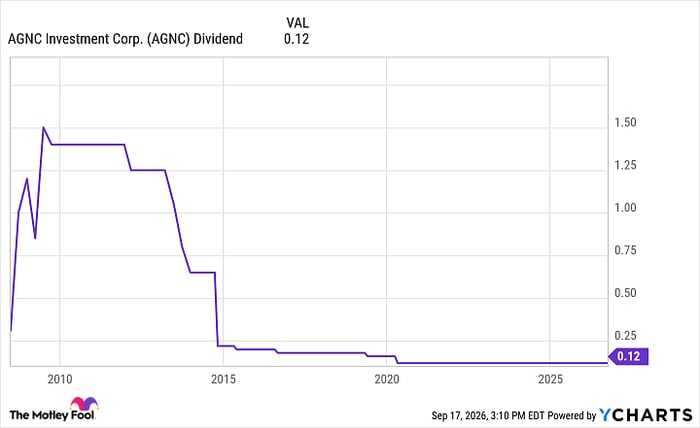
Despite all AGNC Investment has faced over the years, it has paid dividends every period since its IPO, starting quarterly before switching to monthly dividends in October 2014. However, while the REIT consistently paid dividends throughout its history, the rate has steadily fallen:
AGNC Dividend data by YCharts
Still, it has now paid out over $50 per share in cumulative dividends since its IPO. That dividend income has more than offset the roughly $10 decline in its share price since the IPO. For example, if an IPO investor reinvested their dividends, their total return would be nearly 600% (over 11% annualized). That's higher than the total return of other financial stocks, mortgage REITs, and real estate since its IPO. However, if an IPO investor pocketed the cash, their cumulative return would be much lower at 200%, though that has still more than offset the $10-per-share decline in the stock price.
The dividend is the return
Given its business model and history, investors shouldn't look at AGNC Investment's current 14.4% dividend yield and assume they can bank on that as their annual return. The REIT's share price and dividend are likely to continue to decline as it navigates volatility and issues additional shares to grow its portfolio. As a result, it's not the best stock to buy if you want to grow your wealth while collecting a rising dividend income stream. However, it is an enticing option if you value high current income above all else.
Should you buy stock in AGNC Investment Corp. right now?
Before you buy stock in AGNC Investment Corp., consider this:
The Motley Fool Stock Advisor analyst team just identified what they believe are the 10 best stocks for investors to buy now… and AGNC Investment Corp. wasn’t one of them. The 10 stocks that made the cut could produce monster returns in the coming years.
Consider when Netflix made this list on December 17, 2004... if you invested $1,000 at the time of our recommendation, you’d have $387,158!* Or when Nvidia made this list on April 15, 2005... if you invested $1,000 at the time of our recommendation, you’d have $1,365,749!*
Now, it’s worth noting Stock Advisor’s total average return is 932% — a market-crushing outperformance compared to 211% for the S&P 500. Don't miss the latest top 10 list, available with Stock Advisor, and join an investing community built by individual investors for individual investors.
See the 10 stocks »
*Stock Advisor returns as of September 19, 2026.
Matt DiLallo has no position in any of the stocks mentioned. The Motley Fool has no position in any of the stocks mentioned. The Motley Fool has a disclosure policy.
Recommended Articles


