




Even With the S&P 500 at All-Time Highs, I'd Buy This High-Yield Dividend Stock Without Any Hesitation in September.
Key Points
P&G pays about three times the S&P 500’s yield at current prices.
This top consumer staple has paid 136 straight years of dividends, funded by steady demand for everyday essentials.
Management plans to return $15 billion to shareholders in dividends and buybacks in fiscal 2027.
- 10 stocks we like better than Procter & Gamble ›
Procter & Gamble (NYSE: PG) is one of the largest consumer staples, and investors can currently buy it at a discount, trading about 19% off its highs.
Even as the S&P 500 is up about 12% year to date, investors are not getting much income from index funds these days, with the S&P offering just a 1% yield. P&G yields close to 3%, and that dividend is backed by household brands people buy in any economy, which is why I'd feel comfortable buying the stock this month.
Missed Nvidia in 2009? This Rare Signal Is Flashing Again. In 2009, a "Double Down" signal flashed for a little-known chipmaker called Nvidia. For the first time in years, that same "Total Conviction" signal is flashing for a company 1/100th the size of Nvidia. Continue »
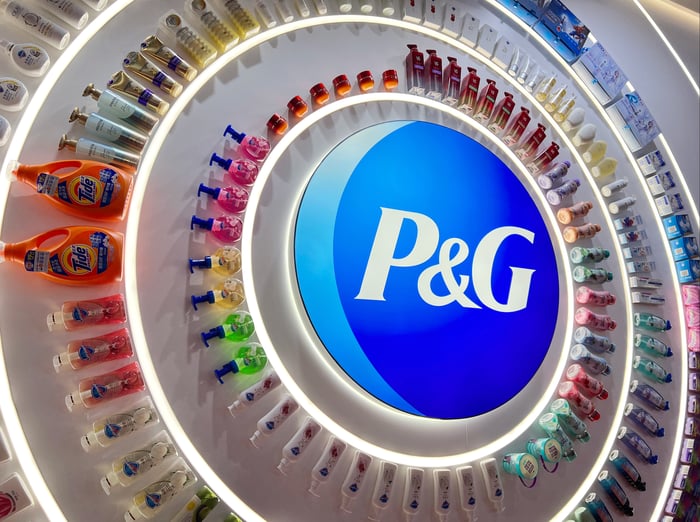
Image source: Getty Images.
A quality dividend stock
P&G's quarterly dividend is $1.0885 per share, or $4.35 annualized. At today's $147.50 share price, the forward yield is 2.95% -- nearly three times the average stock in the S&P 500 index.
This is one of the most reliable dividend payers in the entire market. P&G has paid a dividend for 136 consecutive years and increased it for 70 straight years -- a track record few companies can match and one that has earned it the title Dividend King. It reflects steady sales and free cash flow from everyday essentials like Tide, Pampers, Crest, Gillette, and Olay.
The dividend has grown at a 5.6% annualized rate over the past five years. Over the last year, it paid just over $10 billion in dividends from about $15 billion in free cash flow -- a manageable payout ratio of around 67%.
Management plans to return about $15 billion in fiscal 2027 (ending in June): roughly $10 billion in dividends and $5 billion in buybacks. Those repurchases also steadily reduce the share count, helping support growth in earnings per share and dividends per share.
Why P&G will keep growing
About half of sales come from North America and 23% from Europe, but that leaves ample expansion opportunities in the rest of the world. In fiscal 2026, organic sales and adjusted earnings rose 1% year over year, which looks solid against the weak consumer spending trends in the U.S. due to inflation and higher fuel prices.
Over time, its brand strength, global distribution, and ongoing cost improvements should support more growth. The company continues to invest in product innovation and marketing while trimming weaker categories -- all of which is part of a long-term strategy to maintain excellent financial performance that can support a growing dividend.
P&G uses local consumer insights to win share in specific markets. For example, it found most U.K. households soak dishes before washing, so it introduced Fairy Skip the Soak Power Spray, lifting total brand household penetration by five points to 61%. This is how it can successfully expand into international markets over time.
Wall Street expects P&G's earnings to grow about 5% annually over the next few years, a pace that can support continued dividend growth. With high yields and recession-resistant brands, Procter & Gamble stock looks like a smart buy on the dip.
Should you buy stock in Procter & Gamble right now?
Before you buy stock in Procter & Gamble, consider this:
The Motley Fool Stock Advisor analyst team just identified what they believe are the 10 best stocks for investors to buy now… and Procter & Gamble wasn’t one of them. The 10 stocks that made the cut could produce monster returns in the coming years.
Consider when Netflix made this list on December 17, 2004... if you invested $1,000 at the time of our recommendation, you’d have $445,833!* Or when Nvidia made this list on April 15, 2005... if you invested $1,000 at the time of our recommendation, you’d have $1,402,153!*
Now, it’s worth noting Stock Advisor’s total average return is 993% — a market-crushing outperformance compared to 214% for the S&P 500. Don't miss the latest top 10 list, available with Stock Advisor, and join an investing community built by individual investors for individual investors.
See the 10 stocks »
*Stock Advisor returns as of September 5, 2026.
John Ballard has no position in any of the stocks mentioned. The Motley Fool has no position in any of the stocks mentioned. The Motley Fool has a disclosure policy.
Recommended Articles


