




Here's What $1,000 in Visa Stock at Its IPO Would Be Worth Today
Key Points
Visa's dividend is growing rapidly and adding substantial value to the stock.
There are high barriers to entry in the credit card network space, and Visa is the largest of the four major networks.
Visa has an asset-light model that generates high profits.
- 10 stocks we like better than Visa ›
Most investors don't get the opportunity to invest in an initial public offering (IPO). Until recently, IPOs were strictly for institutional investors, and retail investors only had the chance to invest when stocks went public.
Now, many high-profile IPOs put aside some shares for retail investors. The most notable example was Space Exploration Technologies, or SpaceX, which earmarked about 20% of IPO shares for retail investors. However, even in that case, there was much more demand than supply.
Missed Nvidia in 2009? This Rare Signal Is Flashing Again. In 2009, a "Double Down" signal flashed for a little-known chipmaker called Nvidia. For the first time in years, that same "Total Conviction" signal is flashing for a company 1/100th the size of Nvidia. Continue »
Image source: Visa.
However, if you had managed to invest $1,000 in Visa (NYSE: V) stock when it went public, you'd be a lot richer today.
What $1,000 in Visa's IPO is worth today
Visa went public only 18 years ago, in 2008. It raised $17.9 billion and was the largest IPO at the time.
Since then, $1,000 invested in Visa's IPO has grown 2,960% and is worth $30,610 at today's prices.
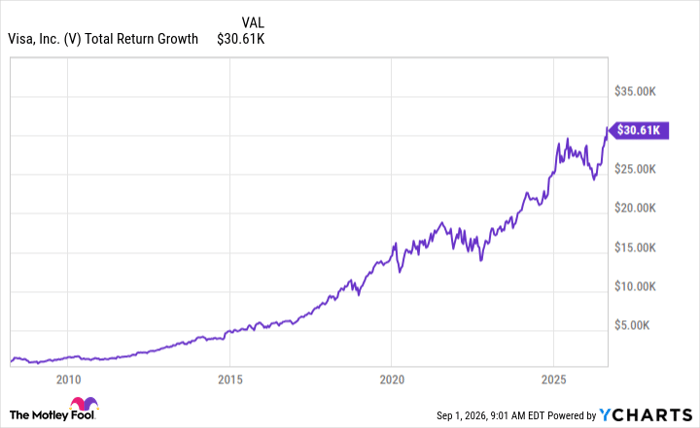
V Total Return Level data by YCharts
That includes dividends. Without reinvested dividends, the stock is worth $26,860 on its own, a major difference.
The dividend yields only 0.71% at the current price, but Visa has raised it for 18 straight years since it went public, and it has increased by 2,450% since then.
What's in store for Visa shareholders?
Visa has an exceptional business model that makes it a critical part of the global payments process without incurring credit risk. There are high barriers to entry in the credit card network space, since so much of the world's payment infrastructure already runs through Visa and its main competitors, Mastercard, American Express, and Discover, which Capital One owns. Visa has an edge over all other networks due to its scale; it's the largest credit card network in the world, with more than 5 billion cards in use and $17 trillion in processed payment volume.
It doesn't produce physical products or carry inventory, and its asset-light model produces impressive profits. It has an enviable operating margin of 66.25% as of the 2026 fiscal third quarter (ended June 30), and earnings per share increased 10% year over year to $2.97.
In general, investing in Visa is a bet on the economy. Since the economy expands more often than it contracts, Visa stock is reliable for long-term growth. It continues to demonstrate robust growth despite inflationary pressures, with a 14% year-over-year increase in sales.
All this means $1,000 invested today is likely to reward shareholders over the next 18 years and beyond.
Should you buy stock in Visa right now?
Before you buy stock in Visa, consider this:
The Motley Fool Stock Advisor analyst team just identified what they believe are the 10 best stocks for investors to buy now… and Visa wasn’t one of them. The 10 stocks that made the cut could produce monster returns in the coming years.
Consider when Netflix made this list on December 17, 2004... if you invested $1,000 at the time of our recommendation, you’d have $435,803!* Or when Nvidia made this list on April 15, 2005... if you invested $1,000 at the time of our recommendation, you’d have $1,334,577!*
Now, it’s worth noting Stock Advisor’s total average return is 966% — a market-crushing outperformance compared to 211% for the S&P 500. Don't miss the latest top 10 list, available with Stock Advisor, and join an investing community built by individual investors for individual investors.
See the 10 stocks »
*Stock Advisor returns as of September 2, 2026.
American Express is an advertising partner of Motley Fool Money. Jennifer Saibil has positions in American Express. The Motley Fool has positions in and recommends American Express, Mastercard, and Visa. The Motley Fool recommends Capital One Financial. The Motley Fool has a disclosure policy.
Recommended Articles


