




The Memory Crunch Is Bigger Than Expected. 1 Top Stock to Buy on the Dip (Hint: Not Micron or Sandisk)
Key Points
Lam Research sells semiconductor manufacturing equipment, and it gets a nice portion of its revenue from the memory industry.
Lam's guidance suggests that its growth rate is poised to accelerate in the current fiscal year.
The growing demand for memory equipment should help Lam sustain its healthy growth rate over the long run.
- 10 stocks we like better than Lam Research ›
Memory demand has been outstripping supply due to the strong consumption of dynamic random-access memory (DRAM) and NAND flash storage chips by artificial intelligence (AI) data centers.
The memory crunch has been so acute that prices have climbed by a whopping 500% in just one year, as reported by Tom's Hardware. Importantly, the memory shortage won't be easing any time soon. Deloitte estimates that DRAM prices could jump 4x in 2026 despite efforts by memory manufacturers to bring additional supply online.
Missed Nvidia in 2009? This Rare Signal Is Flashing Again. In 2009, a "Double Down" signal flashed for a little-known chipmaker called Nvidia. For the first time in years, that same "Total Conviction" signal is flashing for a company 1/100th the size of Nvidia. Continue »
The favorable demand-supply dynamics have fueled outstanding growth in the revenue and earnings of Micron Technology and Sandisk. The good news for Sandisk and Micron stock investors is that the supply crunch may not ease until 2029 or 2030, according to Deloitte. This could pave the way for more upside in both stocks.
However, we are going to take a closer look at the prospects of Lam Research (NASDAQ:LRCX), a company that can win big from the memory supply crunch. Let's look at the reasons why this semiconductor stock will be a major beneficiary of the memory boom.

Image source: Getty Images.
Lam Research is a key player in the memory ecosystem
Deloitte estimates that the combined capital expenditure of memory manufacturers could jump from $58 billion in 2025 to $97 billion this year. That figure could increase to $146 billion in 2027. Meanwhile, the overall semiconductor industry's capex could hit $198 billion this year, followed by $260 billion in 2027.
These numbers bode well for Lam Research, as it sells semiconductor manufacturing equipment used by memory manufacturers, foundries, and integrated device manufacturers. The company gets 46% of its revenue from sales of memory equipment. This puts Lam Research right in the middle of the global memory boom.
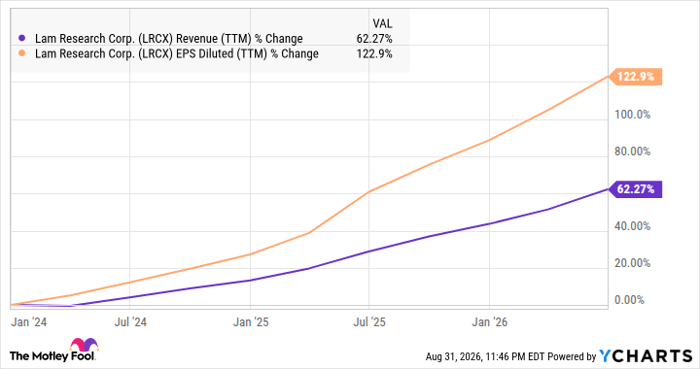
Not surprisingly, Lam's revenue and earnings have been growing at a nice clip.
LRCX Revenue (TTM) data by YCharts
Lam reported a 26% increase in revenue in the recently concluded fiscal 2026 to $23.2 billion. Its earnings per share jumped by an even more impressive 39% to $5.76. The good news for Lam investors is that the company anticipates a solid uptick in growth rate this year. It projects a 52% year-over-year increase in revenue in the current quarter to $8.1 billion. Meanwhile, earnings per share are expected to soar by 71% from the year-ago quarter to $2.15.
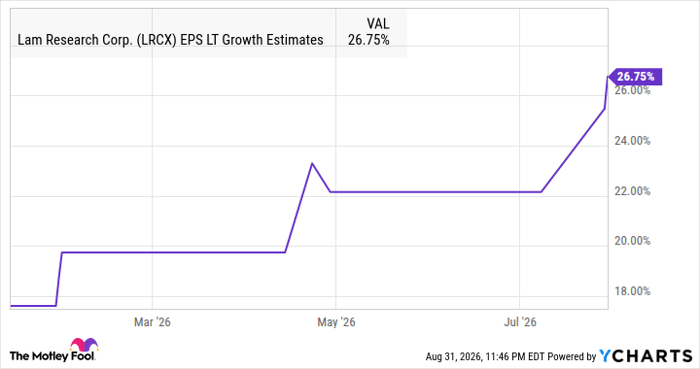
So, it is easy to see why analysts are now expecting Lam Research to clock robust earnings growth over the long run.
LRCX EPS LT Growth Estimates data by YCharts
Don't be surprised to see that estimate move higher in the future. Deloitte notes that the new memory supply won't be coming online until 2029 or 2030, as building new memory manufacturing plants takes time. So, the ongoing supply crunch could worsen by then, creating demand for more equipment over the long run.
As such, Lam Research's healthy growth trajectory can continue over the long run.
Investors have a great opportunity to buy Lam stock on the dip now
Lam Research stock has jumped 76% in 2026, as of this writing. However, it has slipped 30% from the 52-week high it reached on June 30. So, savvy investors have a nice opportunity to buy this AI stock before it steps on the gas again, especially considering its improving earnings growth prospects.
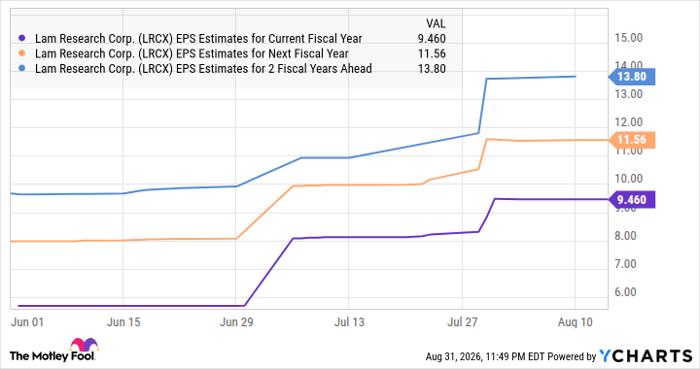
Analysts predict a 62% jump in Lam's earnings per share in fiscal 2027 to $9.46. The forecast for the next couple of years suggests a nice bump in its bottom line.
LRCX EPS Estimates for Current Fiscal Year data by YCharts
However, Lam's growth could be much better than Wall Street anticipates, given that the memory crunch appears larger than expected. Memory manufacturers are likely to continue investing in equipment until the end of the decade to fill the supply gap. This could set Lam up for a bigger increase in earnings.
Assuming Lam's bottom line grows at an annual rate of 27% in the long run (based on the chart seen in the previous section), its earnings per share could increase to $19.38 per share after four years (using fiscal 2027's projected earnings of $9.46 per share as the base). If Lam stock trades at even 30 times earnings at that time (a discount to the tech-focused Nasdaq-100 index's earnings multiple of 34), its stock price could reach $581 in four years.
That's a potential 93% jump from current levels, which is why investors should consider buying Lam on the dip, as it could regain its mojo and soar higher.
Should you buy stock in Lam Research right now?
Before you buy stock in Lam Research, consider this:
The Motley Fool Stock Advisor analyst team just identified what they believe are the 10 best stocks for investors to buy now… and Lam Research wasn’t one of them. The 10 stocks that made the cut could produce monster returns in the coming years.
Consider when Netflix made this list on December 17, 2004... if you invested $1,000 at the time of our recommendation, you’d have $435,803!* Or when Nvidia made this list on April 15, 2005... if you invested $1,000 at the time of our recommendation, you’d have $1,334,577!*
Now, it’s worth noting Stock Advisor’s total average return is 966% — a market-crushing outperformance compared to 211% for the S&P 500. Don't miss the latest top 10 list, available with Stock Advisor, and join an investing community built by individual investors for individual investors.
See the 10 stocks »
*Stock Advisor returns as of September 2, 2026.
Harsh Chauhan has no position in any of the stocks mentioned. The Motley Fool has positions in and recommends Lam Research and Micron Technology. The Motley Fool has a disclosure policy.
Recommended Articles


