




Nvidia's 70% Growth Forecast Is a Supply Ceiling. Demand Is Actually Stronger Than That.
Key Points
Last quarter, Nvidia doubled its revenue year over year to nearly $100 billion.
Amazon Web Services is adding 2 million graphics processing units (GPUs), and sales of Vera Rubin are ramping up faster than any platform before it.
Nvidia is securing land, power, and financing to support a cloud backlog that now exceeds $2 trillion.
- 10 stocks we like better than Nvidia ›
Nvidia (NASDAQ: NVDA) delivered another impressive set of quarterly results last week, reporting that revenue grew by 106% to $96 billion. It was the fourth straight quarter of accelerating top-line growth, which is rare for a company with a revenue base this large. In the earnings release, CEO Jensen Huang declared that "compute is revenue" after arguing that AI had reached an "inflection point" by becoming productive.
Data center revenue reached $89 billion, up 117%, as demand for its processors continued to outstrip the company's ability to supply them.
Missed Nvidia in 2009? This Rare Signal Is Flashing Again. In 2009, a "Double Down" signal flashed for a little-known chipmaker called Nvidia. For the first time in years, that same "Total Conviction" signal is flashing for a company 1/100th the size of Nvidia. Continue »
Management forecast revenue growth of roughly 70% for fiscal 2028, noting that its production capacity was constrained by memory supply. "Our demand is much higher than that," Huang pointed out on the earnings call.
CFO Colette Kress projected $1.3 trillion in capex from the top five hyperscalers next year and a cloud backlog of over $2 trillion.
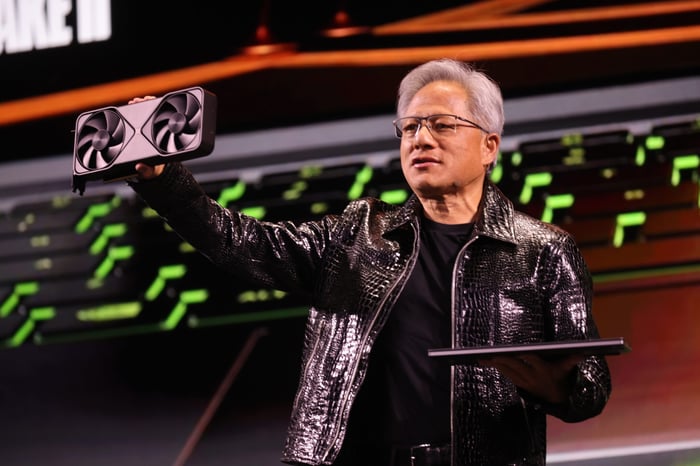
Image source: The Motley Fool
More than just a chipmaker
The chipmaker is increasingly financing the AI build-out. With its customers' spending outpacing their cash generation, Nvidia is helping secure over $500 billion in capital from third parties.
The company guarantees minimum revenue via take-or-pay contracts for part of the capacity, then earns from hardware sales and again from the rental upside. As the CFO put it on the call, "We get paid twice." Kress also acknowledged the obvious counterpoint, saying, "We know some will call this circular financing. We see it differently."
This model is supported by physical infrastructure, with Nvidia securing 4.25 gigawatts of power at SB Energy's Ohio campus to host OpenAI's compute. The company continues to move up the stack with its Vera CPU in production and networking revenue hitting a new high.
Sales of Vera Rubin, the next-generation CPU/GPU platform, are ramping up quickly and are expected to reach around 20% of data center revenue in the third quarter. Amazon Web Services alone will add 2 million additional GPUs through the first half of fiscal 2029.
Each platform generation has improved the revenue Nvidia captures per gigawatt, from roughly $18 billion with Hopper to $25 billion with Blackwell and $40 billion with Vera Rubin.
Custom silicon and the cost of money
Nvidia's earnings report arrived the day after OpenAI published benchmarks for its custom Jalapeno chip, which topped Nvidia's Blackwell in efficiency. However, the comparison was against a chip using older HBM3E memory, not the HBM4 memory in Nvidia's new Rubin platform, which is already shipping. Developing it was a smart move by OpenAI, but, as with any new chip, reaching production at scale will be challenging and take time.
A more immediate consideration is the cost of money, as the yield on the 30-year Treasury is above 5%. With Nvidia's financing model dependent on access to capital, rising long-term interest rates could tighten access for the labs and the neoclouds, while falling yields would loosen it.
Nvidia's shares are up 5% since the report, and the stock trades at roughly 18 times forward earnings. While the question of how much impact competitors' custom silicon will have on its business remains a long-term variable, Nvidia is building and financing the AI infrastructure powered by its chips. This position should serve it well as long as demand for them outstrips supply.
Should you buy stock in Nvidia right now?
Before you buy stock in Nvidia, consider this:
The Motley Fool Stock Advisor analyst team just identified what they believe are the 10 best stocks for investors to buy now… and Nvidia wasn’t one of them. The 10 stocks that made the cut could produce monster returns in the coming years.
Consider when Netflix made this list on December 17, 2004... if you invested $1,000 at the time of our recommendation, you’d have $435,803!* Or when Nvidia made this list on April 15, 2005... if you invested $1,000 at the time of our recommendation, you’d have $1,334,577!*
Now, it’s worth noting Stock Advisor’s total average return is 966% — a market-crushing outperformance compared to 211% for the S&P 500. Don't miss the latest top 10 list, available with Stock Advisor, and join an investing community built by individual investors for individual investors.
See the 10 stocks »
*Stock Advisor returns as of September 2, 2026.
Bryan White has no position in any of the stocks mentioned. The Motley Fool has positions in and recommends Amazon and Nvidia. The Motley Fool has a disclosure policy.
Recommended Articles


