




Nvidia Just Returned a Record $26 Billion to Shareholders After Increasing Its Dividend by 2,400%. I Predict Another Massive Dividend Increase.
Key Points
Demand is outpacing supply for Nvidia's latest Vera Rubin computing platform.
Nvidia is sticking to its plan to return at least 50% of free cash flow to shareholders.
Quicker-than-expected cash-flow growth paves the way for accelerated buybacks and dividend raises.
- 10 stocks we like better than Nvidia ›
Nvidia (NASDAQ: NVDA) recently delivered exceptional second-quarter fiscal 2027 results. It more than doubled revenue and operating income year over year while maintaining a sky-high 75% gross margin, despite a 55% increase in operating expenses.
This was also the first quarter since Nvidia raised its quarterly payout from $0.01 per share to $0.25 per share -- a 2,400% dividend raise. Nvidia paid $6.05 billion in dividends in its latest quarter -- up from just $244 million in the first quarter of fiscal 2027. And in total, it returned a record $25.78 billion to shareholders through stock buybacks and dividends.
Missed Nvidia in 2009? This Rare Signal Is Flashing Again. In 2009, a "Double Down" signal flashed for a little-known chipmaker called Nvidia. For the first time in years, that same "Total Conviction" signal is flashing for a company 1/100th the size of Nvidia. Continue »
For context, Apple (NASDAQ: AAPL), which is typically the most aggressive company at returning capital to shareholders -- bought back $25.95 billion in stock and paid $4 billion in dividends in its latest quarter.
After correctly predicting Nvidia would make a substantial dividend increase in 2026, I'm predicting Nvidia will implement yet another massive dividend raise within the next year. Here's why.

Image source: Nvidia.
Nvidia's growth shows no signs of slowing
Over the last couple of years, Nvidia has transformed from a high-octane growth stock that reinvested most of its excess capital back into the business to one that generates so much free cash flow (FCF) that it can afford to invest aggressively in research and development and return FCF to shareholders. This dynamic starkly contrasts with a company like Apple, which is no longer growing at a breakneck pace but is generating consistently high-margin cash flow that it uses to rapidly repurchase stock -- resulting in a 31.6% reduction in its share count over the last decade.
An expanding capital return program can sometimes signal that a business is maturing to the point where it doesn't have enough good ideas to put capital to work without taking on excess risk. But that isn't the case with Nvidia.
Nvidia gets a lot of attention as the world's most valuable company because its stock price has risen severalfold in recent years. But arguably the bigger story is that its earnings and revenue have grown even faster.
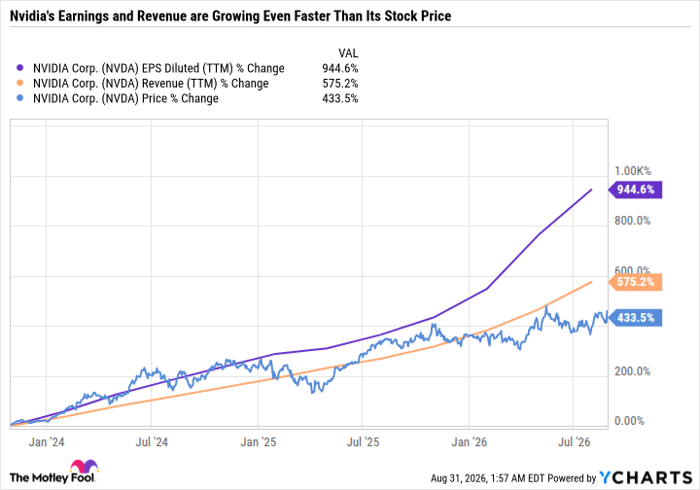
NVDA EPS Diluted (TTM) data by YCharts
It's virtually unheard of for a company this size to continue growing so quickly while maintaining high margins. And yet, Nvidia is growing quickly because it remains at the cutting edge of artificial intelligence (AI) innovation.
The next growth catalyst for Nvidia is its Vera Rubin platform, which began shipments in August. Nvidia expects Rubin to account for 20% of its data center revenue in the upcoming quarter -- marking the fastest ramp-up in company history. Rubin marks a monumental shift in AI computing and includes a rack-scale offering comprising multiple Nvidia chips and networking infrastructure. Nvidia expects the majority of AI infrastructure to be powered by this rack-scale solution due to its extreme co-design efficiency, which is the product of Nvidia controlling a larger share of the data center addressable market rather than just providing a few key components -- namely, graphics processing units.
Extra cash is funneling directly to shareholders
Rubin's impact is so significant that Nvidia has already released guidance for fiscal 2028 revenue, even though it is only halfway through fiscal 2027. Despite difficult comps, Nvidia is calling for fiscal 2028 revenue to increase by 70% year over year. And despite higher memory chip costs, Nvidia's margins remain sky-high, which is leading to surging FCF.
Nvidia CFO Colette Kress said the following on Nvidia's second-quarter fiscal 2027 earnings call:
In Q2, we returned a record $26 billion to shareholders, $20 billion through share repurchases, and $6 billion through our quarterly dividend of $0.25 per share. Relative to our plan to return 50% or more of free cash flow, we have returned 60% on a year-to-date basis. Going forward, we intend to increase and return excess free cash flow net of strategic uses.
That commentary suggests Nvidia is generating more cash than it knows what to do with, even after accounting for capital expenditures and operating expenses. So, going forward, it will simply pass more cash directly to shareholders. And given that buybacks are still more than 4 times larger than its dividends, I could see Nvidia continuing to increase its payout to shareholders.
Nvidia remains a compelling value
Nvidia is transitioning from a cyclical semiconductor stock to a steady cash cow with a broadening customer base that includes hyperscalers, AI labs, AI start-ups, and enterprises that need compute. Nvidia will reduce its sensitivity to cyclical downturns as more companies depend on its hardware and software ecosystem for AI compute, from generative AI use cases to inference-heavy agentic AI becoming mainstream in enterprise workflows.
I could see a large portion of Nvidia's business become more dependent on maintaining and upgrading AI infrastructure than on an influx of hyperscaler spending. And if that happens, Nvidia could gradually evolve into an even higher-margin, higher-quality version of what Apple is today. Only Nvidia trades at just 23.4 times forward earnings compared to 36.2 for Apple.
Add it all up, and Nvidia remains one of the best AI stocks to buy now, especially for investors looking for a proven company with growing earnings rather than one priced on sky-high expectations alone.
Should you buy stock in Nvidia right now?
Before you buy stock in Nvidia, consider this:
The Motley Fool Stock Advisor analyst team just identified what they believe are the 10 best stocks for investors to buy now… and Nvidia wasn’t one of them. The 10 stocks that made the cut could produce monster returns in the coming years.
Consider when Netflix made this list on December 17, 2004... if you invested $1,000 at the time of our recommendation, you’d have $437,097!* Or when Nvidia made this list on April 15, 2005... if you invested $1,000 at the time of our recommendation, you’d have $1,355,077!*
Now, it’s worth noting Stock Advisor’s total average return is 978% — a market-crushing outperformance compared to 213% for the S&P 500. Don't miss the latest top 10 list, available with Stock Advisor, and join an investing community built by individual investors for individual investors.
See the 10 stocks »
*Stock Advisor returns as of September 2, 2026.
Daniel Foelber has positions in Nvidia. The Motley Fool has positions in and recommends Apple and Nvidia. The Motley Fool has a disclosure policy.
Recommended Articles


