




If the Stock Market Crashes Tomorrow, History Says Investors Should Make This 1 Specific Move
Key Points
Major market indexes have wavered in recent weeks, and investors are losing confidence.
Investing in quality stocks is key to surviving a stock market crash.
Over the long haul, it's incredibly likely the market will thrive despite short-term volatility.
- 10 stocks we like better than S&P 500 Index ›
Investors are beginning to get nervous about the stock market.
Nearly 45% of investors expect stock prices to fall in the next six months, according to a poll from the American Association of Individual Investors published in late August 2026, while only around 33% believe the market will continue climbing.
Missed Nvidia in 2009? This Rare Signal Is Flashing Again. In 2009, a "Double Down" signal flashed for a little-known chipmaker called Nvidia. For the first time in years, that same "Total Conviction" signal is flashing for a company 1/100th the size of Nvidia. Continue »
Major market indexes have also stagnated in recent months. After years of record-breaking gains, the S&P 500 (SNPINDEX: ^GSPC) is up by just 2% over the last three months, while the tech-heavy Nasdaq Composite (NASDAQINDEX: ^IXIC) has fallen by 2% in that time.
There's no way to predict the market's short-term future, but a bear market is coming eventually. Hypothetically, if the market were to crash tomorrow, history says this is the smartest move investors can make right now.
Image source: Getty Images.
The move that will protect your portfolio against a market crash
The single most effective way to protect your investments is to ensure you own a well-diversified portfolio full of stocks with robust fundamentals.
Stock price alone can't predict how well a company will fare during a bear market. Some stocks are fueled primarily by hype, driving up their price while the companies themselves sit on shaky foundations. When a recession hits, those foundations may not be strong enough to weather economic volatility.
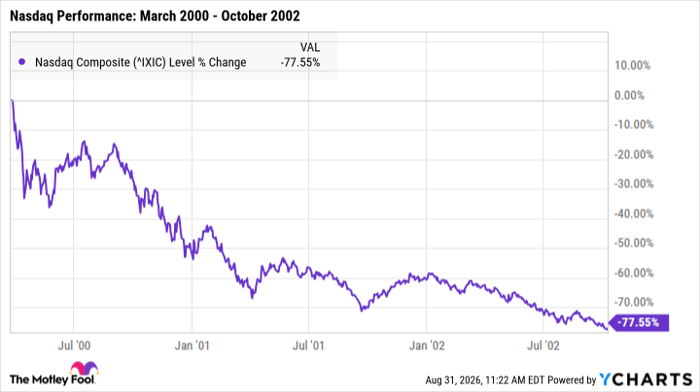
The dot-com bubble is perhaps the clearest example of this. Tech stocks exploded in value in the late 1990s, with the S&P 500 surging by nearly 200% between 1995 and 1999 alone. Yet many of these companies had unsustainable business models, lacked a clear competitive advantage, or were poorly managed.
^IXIC data by YCharts
When the bubble popped, hundreds of stocks crumbled under the weight of a bear market. The Nasdaq lost nearly 80% of its value between 2000 and 2002, and countless stocks crashed hard and never recovered.
Healthy stocks, though, are far more likely to recover from volatility. Companies like Amazon, Apple, and Microsoft were all hit hard during the dot-com bubble. However, because they had strong competitive advantages and solid foundations, they not only recovered, but became industry-leading behemoths.
Is it safe to invest in the stock market right now?
With a surge in AI spending renewing concerns about a bubble, it can be tempting to avoid investing altogether. But history suggests it's actually safer to continue investing despite the potential for short-term volatility.
Recessions are a normal part of the market's cycle, so it's only a matter of time before we face a downturn. But nobody -- even the experts -- can predict when it will begin. If the market still has many months or even years of growth ahead, you risk missing out on lucrative returns by avoiding investing.
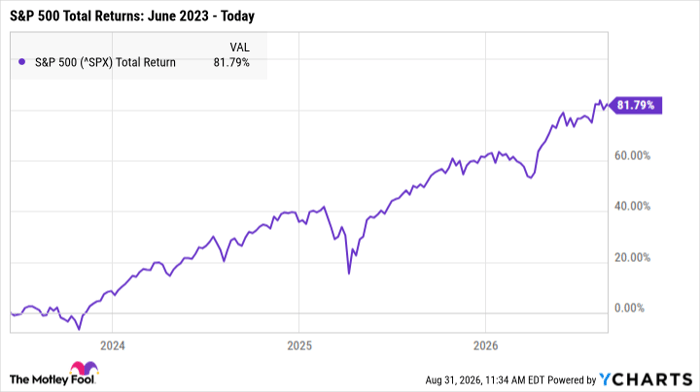
For example, in June 2023, analysts at Deutsche Bank predicted a "near 100%" chance that a recession would begin in the next 12 months. Fast-forward to today, and not only has that recession still not arrived, but the S&P 500 has surged by nearly 82% since that prediction.
^SPX data by YCharts
The safest thing investors can do right now is to invest in quality stocks with strong fundamentals and stay invested for the long haul.
The healthiest companies may not always be the flashiest or most popular, but they'll have solid finances, a competent leadership team, and perhaps most importantly, a durable competitive advantage over peers. No matter what's looming for the market, these stocks have the best shot at thriving over time.
Should you buy stock in S&P 500 Index right now?
Before you buy stock in S&P 500 Index, consider this:
The Motley Fool Stock Advisor analyst team just identified what they believe are the 10 best stocks for investors to buy now… and S&P 500 Index wasn’t one of them. The 10 stocks that made the cut could produce monster returns in the coming years.
Consider when Netflix made this list on December 17, 2004... if you invested $1,000 at the time of our recommendation, you’d have $437,097!* Or when Nvidia made this list on April 15, 2005... if you invested $1,000 at the time of our recommendation, you’d have $1,355,077!*
Now, it’s worth noting Stock Advisor’s total average return is 978% — a market-crushing outperformance compared to 213% for the S&P 500. Don't miss the latest top 10 list, available with Stock Advisor, and join an investing community built by individual investors for individual investors.
See the 10 stocks »
*Stock Advisor returns as of September 2, 2026.
Katie Brockman has no position in any of the stocks mentioned. The Motley Fool has positions in and recommends Amazon, Apple, and Microsoft. The Motley Fool has a disclosure policy.
Recommended Articles


