




2 Dow Jones Stocks Down Over 20% I'd Buy on the Dip
Key Points
Housing is weak, but Home Depot controls just 15% of a $1.1 trillion opportunity.
McDonald's highly profitable franchise model is generating gobs of free cash flow, helping fund more dividends.
- 10 stocks we like better than Home Depot ›
The Dow Jones Industrial Average tracks 30 industry leaders, making it a useful benchmark for identifying solid investments. Two Dow members I've been watching are Home Depot (NYSE: HD) and McDonald's (NYSE: MCD). These stocks are trading more than 20% off their highs, sending their dividend yields up. Here's what I like about each company's competitive position to justify buying the dip.
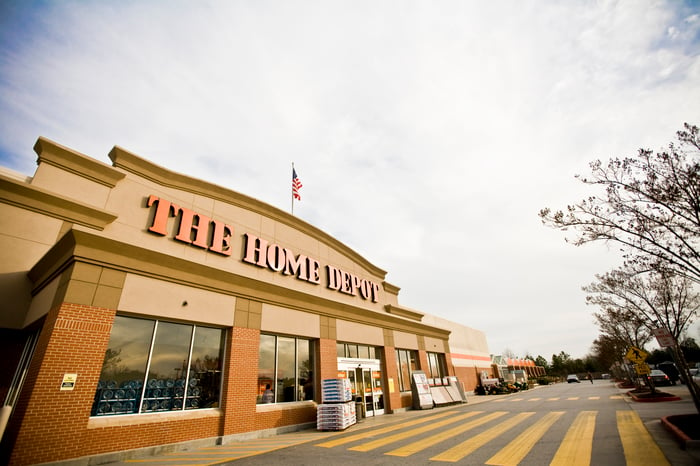
Image source: Home Depot.
Missed Nvidia in 2009? This Rare Signal Is Flashing Again. In 2009, a "Double Down" signal flashed for a little-known chipmaker called Nvidia. For the first time in years, that same "Total Conviction" signal is flashing for a company 1/100th the size of Nvidia. Continue »
Home Depot
Home Depot is the leading home improvement retailer, and a sluggish housing market has weighed on sales, pushing the stock 25% below its 2024 all-time high of $431 per share. The dip has also lifted the forward dividend yield to 2.84%, based on its $2.33 quarterly payment.
With interest rates still elevated, many consumers have put off big-ticket home projects. In fiscal 2025, Home Depot's comparable sales rose just 0.3%. That improved to 1.7% last quarter, but transactions remain down.
This is a cyclical downturn, not a broken business. Home Depot's competitive position remains strong, and its large store base would be difficult to replicate. It has more than 2,300 warehouse stores and over 1,300 SRS Distribution branches. Over the last year, it generated $169 billion in revenue, yet that's still relatively small relative to its addressable market.
Its stores function as local hubs in residential markets across the U.S. The company rolled out express delivery nationwide last month, aiming to get tens of thousands of items to customers in under three hours -- an added convenience that should support demand when the market recovers.
Management sizes the North American home improvement market at $1.1 trillion, leaving Home Depot's share at only 15%. That leaves a meaningful runway for long-term growth.
The stock's value is best seen in the dividend. Home Depot pays an annualized dividend of $9.32 per share, or about 65% of earnings, which leaves room to maintain and keep growing the payout even in a weak housing environment. The dividend has risen at a 6.6% annualized rate over the past three years.
Home Depot's competitive position, long growth runway, and attractive yield are reasons I'd consider buying the stock now.
McDonald's
The Golden Arches are recognized worldwide, and that kind of brand power carries real value for investors. Execution missteps and a softer consumer backdrop have pushed the stock down 24% from its prior high of $341 per share. But McDonald's has raised its dividend for nearly 50 years and currently yields 2.82%, based on the current $1.86 quarterly payment.
McDonald's is a highly profitable business. About 95% of its 45,000-plus locations are franchised. The company typically owns or leases the land and buildings, while franchisees pay for the equipment, seating, and decor.
As a result, McDonald's earns a large share of its revenue from rents and royalties rather than burgers and fries. In 2025, it generated $16.5 billion in franchise revenue, with $9.7 billion coming from company-operated restaurants. Those high-margin rents and royalties helped produce $7 billion in free cash flow.
That said, sales have been pressured this year by execution issues and a cautious consumer. Global comparable sales increased just 1.3% year over year in the second quarter, reflecting weak traffic following management's pullback of certain digital offers.
Still, the brand's reach is hard to miss. McDonald's has nearly 220 million active loyalty users, which management says is one of the largest loyalty programs in the world.
Even with near-term pressure, management is investing for long-term earnings growth by streamlining operations, improving food quality, and using its data more effectively with artificial intelligence (AI).
The dip has pulled the forward price-to-earnings multiple down to 20, which looks reasonable enough, but the dividend is the clearest sign of value. The company pays out about 60% of earnings, supporting today's yield, and the dividend has grown at a 8% annualized rate over the past three years.
Sales could stay soft for a while, but investors are getting paid to wait. McDonald's franchise model, brand strength, and growing dividend make it a compelling buy on the dip.
Should you buy stock in Home Depot right now?
Before you buy stock in Home Depot, consider this:
The Motley Fool Stock Advisor analyst team just identified what they believe are the 10 best stocks for investors to buy now… and Home Depot wasn’t one of them. The 10 stocks that made the cut could produce monster returns in the coming years.
Consider when Netflix made this list on December 17, 2004... if you invested $1,000 at the time of our recommendation, you’d have $440,710!* Or when Nvidia made this list on April 15, 2005... if you invested $1,000 at the time of our recommendation, you’d have $1,335,252!*
Now, it’s worth noting Stock Advisor’s total average return is 978% — a market-crushing outperformance compared to 213% for the S&P 500. Don't miss the latest top 10 list, available with Stock Advisor, and join an investing community built by individual investors for individual investors.
See the 10 stocks »
*Stock Advisor returns as of August 30, 2026.
John Ballard has no position in any of the stocks mentioned. The Motley Fool has positions in and recommends Home Depot. The Motley Fool recommends the following options: long January 2028 $320 calls on McDonald's and short January 2028 $340 calls on McDonald's. The Motley Fool has a disclosure policy.
Recommended Articles


