




XRP pullback tests $1.40 support amid Ripple Prime product suite expansion
- XRP retreats toward $1.40 immediate support, aligning with a broader crypto market cooldown.
- Ripple Prime announces the launch of Delta One business to support swaps across US equities indices and digital assets.
- XRP sits on robust support levels defined by major moving averages even as momentum indicators decline.
Ripple (XRP) extends lock-step trading for the third straight day on Friday, as support at $1.40 comes under pressure. The remittance token has remained largely in defense mode since last week’s 72% rally from $1.00 to highs around $1.70.
The $1.40 support level is expected to remain resilient, limiting further downside risk and preserving recent gains, while increasing the probability of a bullish reversal.
Ripple Prime launches Delta One business suite
Ripple announced the launch of Delta One business within its Ripple Prime global, multi-asset brokerage platform on Thursday. The new service is designed to enable institutional users to execute Total Return Swaps across United States (US) equities, indices and digital assets, all within a ready environment suited to the reporting requirements of asset managers and hedge funds.
The launch of Delta One represents a major milestone in Ripple Prime’s strategic growth, broadening its footprint in the equities market while enhancing its comprehensive suite of prime brokerage, clearing, and financing solutions spanning forex, derivatives, fixed income, and digital assets.
Ripple Prime recently secured an upsized $275 million private placement of senior unsecured notes, bolstering its capital base and providing additional resources to fuel ongoing expansion initiatives. This underscores the platform's growing use cases and the convenience it offers institutions.
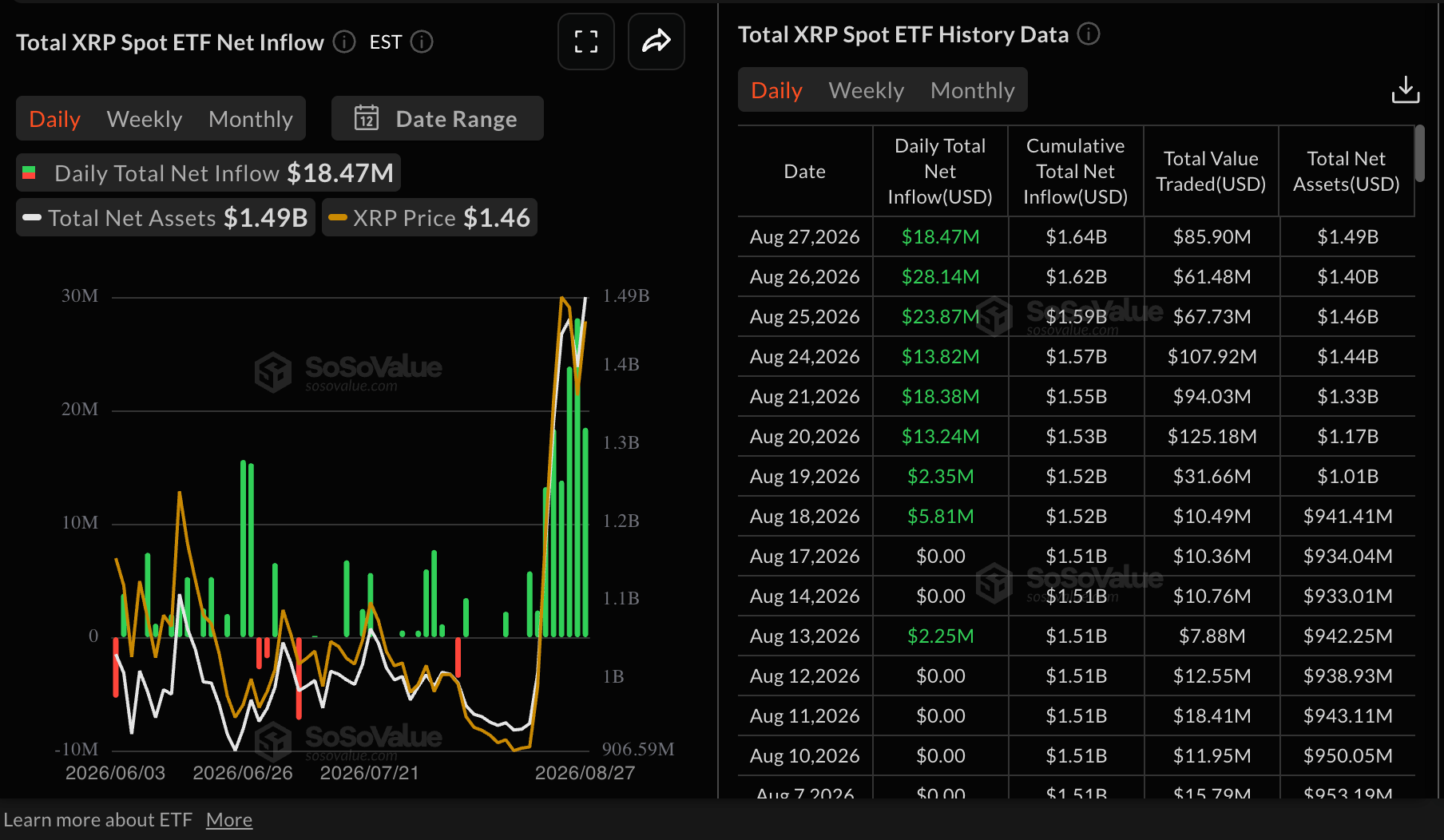
Meanwhile, interest in XRP remains high as evidenced by inflows into Exchange-Traded Funds (ETFs) extending for the eighth consecutive day, with $18 million recorded on Thursday. Meanwhile, cumulative inflows average $1.64 billion, with net assets under management at $1.49 billion. Sustained inflows into related investment products tend to mitigate selling pressure in the open market and underpin positive investor sentiment.
Technical analysis: XRP nears key support
XRP trades at $1.42, extending a bullish phase above its major Exponential Moving Averages (EMAs), which reinforces an underlying upward bias. Momentum stays constructive as the Moving Average Convergence Divergence (MACD) histogram remains positive on the daily chart and the line holds above zero, while the Relative Strength Index (RSI) hovers just above 70, hinting at strong but increasingly stretched buying pressure.
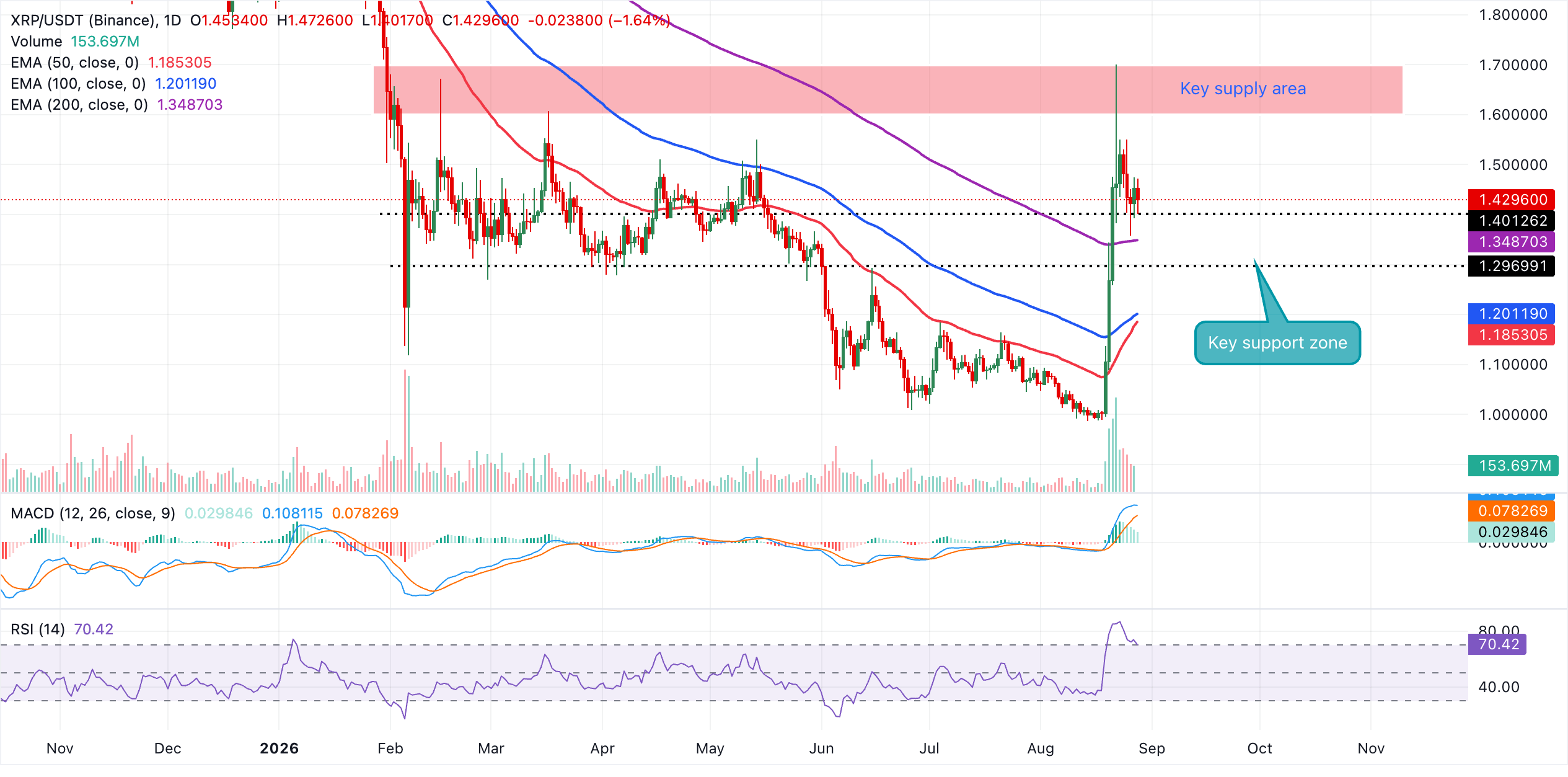
Initial support is aligned with the 200-day EMA at $1.35, where a pullback could test the durability of the latest breakout. A deeper slide would expose the 100-day EMA at $1.20, followed by the 50-day EMA at $1.19, levels that underpin the broader uptrend even if overbought conditions trigger a corrective phase.
(The technical analysis of this story was written with the help of an AI tool. Know more.)
Crypto ETF FAQs
An Exchange-Traded Fund (ETF) is an investment vehicle or an index that tracks the price of an underlying asset. ETFs can not only track a single asset, but a group of assets and sectors. For example, a Bitcoin ETF tracks Bitcoin’s price. ETF is a tool used by investors to gain exposure to a certain asset.
Yes. The first Bitcoin futures ETF in the US was approved by the US Securities & Exchange Commission in October 2021. A total of seven Bitcoin futures ETFs have been approved, with more than 20 still waiting for the regulator’s permission. The SEC says that the cryptocurrency industry is new and subject to manipulation, which is why it has been delaying crypto-related futures ETFs for the last few years.
Yes. The SEC approved in January 2024 the listing and trading of several Bitcoin spot Exchange-Traded Funds, opening the door to institutional capital and mainstream investors to trade the main crypto currency. The decision was hailed by the industry as a game changer.
The main advantage of crypto ETFs is the possibility of gaining exposure to a cryptocurrency without ownership, reducing the risk and cost of holding the asset. Other pros are a lower learning curve and higher security for investors since ETFs take charge of securing the underlying asset holdings. As for the main drawbacks, the main one is that as an investor you can’t have direct ownership of the asset, or, as they say in crypto, “not your keys, not your coins.” Other disadvantages are higher costs associated with holding crypto since ETFs charge fees for active management. Finally, even though investing in ETFs reduces the risk of holding an asset, price swings in the underlying cryptocurrency are likely to be reflected in the investment vehicle too.
Recommended Articles


