




The Bond Market Is Flashing a Warning Signal to Investors. Here's What Comes Next.
Key Points
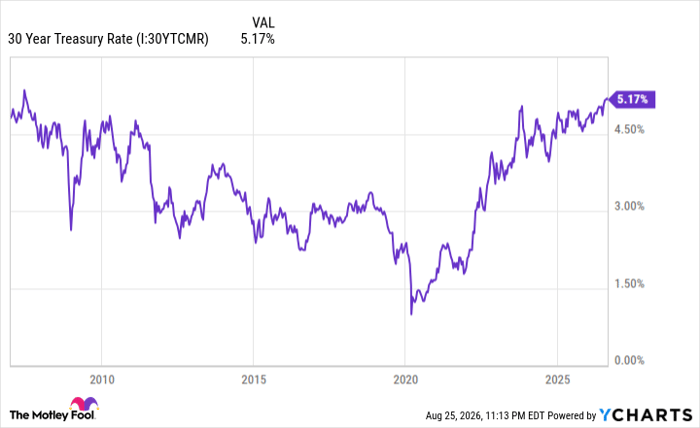
The yield on the 30-year U.S. Treasury bond recently passed 5.2%, its highest level since before the global financial crisis of 2008.
Higher bond yields don’t have to be bad news for the economy, the stock market, or your investment portfolio.
If you worry that interest rates will go higher (and long-term bond prices go lower), consider buying a shorter-term Treasury bond fund like the iShares 3-7 Year Treasury Bond ETF (IEI).
- These 10 stocks could mint the next wave of millionaires ›
The 30-year Treasury yield has recently spiked to over 5.2%, reaching its highest level since 2007. When bond yields rise, bond prices go down. Higher yields might be tempting for new bond buyers, but they're bad news for investors who already own bonds. And long-duration bonds like the 30-year Treasury are at particular risk for higher interest rates. The longer a bond's duration, the harder its price is hit by rising yields.
Missed Nvidia in 2009? This Rare Signal Is Flashing Again. In 2009, a "Double Down" signal flashed for a little-known chipmaker called Nvidia. For the first time in years, that same "Total Conviction" signal is flashing for a company 1/100th the size of Nvidia. Continue »
30 Year Treasury Rate data by YCharts
Higher yields on U.S. Treasury bonds can also be psychologically significant for investors. Many investors get nervous when Treasury yields rise because they fear that it's a sign of a looming debt crisis, a stock market crash, or loss of confidence in the U.S. dollar.
Despite the anxious headlines about bond yields, it's important for investors to take a deep breath. Higher yields on the 30-year Treasury don't have to be bad news for your investments. Let's look at what messages the bond market is sending -- and which bond ETFs you might want to buy or avoid.

Image source: Getty Images.
Why 30-year Treasury yields are up
There's no single reason why the 30-year Treasury yield is up, but the U.S. national debt is a big factor. U.S. government debt recently passed $40 trillion, and there seems to be no end in sight to rising government borrowing. That likely means a larger supply of U.S. Treasury bonds in the future, and higher yields for bond investors.
But the national debt is not the only reason. Bond yields tend to go up during times of higher inflation, and many investors are still waiting (increasingly impatiently) for inflation to get back down to the Fed's stated target of 2% per year. Oil prices have recently spiked due to the start of the Iran war in February, which has also been bad news for inflation and U.S. government borrowing costs. If that conflict fully and truly ends, interest rates (and 30-year Treasury bond yields) might decrease.
High bond yields aren't always bad news. They can also be a sign of steady economic growth. Another reason for higher 30-year Treasury yields is the expansion of corporate bond issuance from the artificial intelligence (AI) boom. AI hyperscalers are issuing hundreds of billions of dollars in corporate bonds over the next few years to help pay for the AI infrastructure build-out.
According to Vanguard research, these AI hyperscaler bonds made up about 11% of the total U.S. investment-grade bond supply so far in 2026. More corporate bonds coming onto the bond market means a greater supply of bonds -- likely leading to lower Treasury bond prices and higher bond yields.
How should you invest in bonds with higher Treasury yields?
Buying bonds is not risk-free. When bond interest rates go up, bond prices go down. Long-term bonds like the 30-year Treasury are particularly sensitive to this risk. The Vanguard Extended Duration Treasury ETF (NYSEMKT: EDV) holds long Treasury bonds with durations of 20-30 years. Unfortunately, the past few years of rising interest rates have hurt this bond ETF's performance. It has delivered negative average annual returns (by net asset value) of -6.34% over the past three years, and -12.67% over the past five years.
If you still want the guaranteed income of U.S. Treasuries but want to avoid the more intense interest rate risk of long-duration bonds, you might want to buy a more short-term Treasury bond ETF. The iShares 3-7 Year Treasury Bond ETF (NASDAQ: IEI) could fit that strategy. This bond ETF has barely broken even over the past five years, with average annual returns of 0.05%. But it's done better over the past three years, with average annual returns of 3.73%.
Keep calm and keep investing
Higher 30-year Treasury bond yields don't have to be a sign of a looming crisis. The stock market could keep going up even if yields go higher. The bond market seems to be recalibrating the risk of long-term government debt amid high corporate bond issuance and rapid economic growth. Instead of making any knee-jerk moves in response to a higher 30-year Treasury yield, it's important for investors to keep investing appropriately according to their own risk tolerance, time horizon, and long-term goals.
Stay diversified. Keep buying high-quality stocks and bond ETFs that you are willing to hold for the long term, or at least five to 10 years. Not every move in the 30-year Treasury yield is "bad news." A lot of it becomes background noise over the long run, while your portfolio can continue to grow.
Where to invest $1,000 right now
When our analyst team has a stock tip, it can pay to listen. After all, Stock Advisor’s total average return is 964%* — a market-crushing outperformance compared to 212% for the S&P 500.
They just revealed what they believe are the 10 best stocks for investors to buy right now, available when you join Stock Advisor.
See the stocks »
*Stock Advisor returns as of August 27, 2026.
Ben Gran has no position in any of the stocks mentioned. The Motley Fool has no position in any of the stocks mentioned. The Motley Fool has a disclosure policy.
Recommended Articles


