




History Says This Is the Single Best Strategy for Investors if a Market Crash Is Imminent
Key Points
Growing concern over AI spending, stretched valuations, and other macro factors have investors worried.
Even so, one group of stocks has outperformed over the long run -- and with less volatility.
You can buy individual stocks or an index fund to protect your portfolio.
- 10 stocks we like better than Invesco Exchange-Traded Fund Trust - Invesco S&P 500 Quality ETF ›
This has been another fantastic year for stock investors so far. Despite some headwinds, investors have bought into multiple pullbacks in stock prices, pushing the S&P 500 and Dow Jones Industrial Average to new all-time highs as of this writing. The tech-heavy Nasdaq Composite trades within 3% of its high.
But that relative weakness in the Nasdaq over the last few weeks has some investors worried about the broader market. The bull market has been driven by artificial intelligence, and it's possible a collapse in AI spending could be its undoing. Combined with uncertainty about the war in Iran, President Donald Trump's tariff policies, and the Federal Reserve's monetary policy, some see cracks forming.
Missed Nvidia in 2009? This Rare Signal Is Flashing Again. In 2009, a "Double Down" signal flashed for a little-known chipmaker called Nvidia. For the first time in years, that same "Total Conviction" signal is flashing for a company 1/100th the size of Nvidia. Continue »
The good news is there's a simple strategy that can protect your portfolio if you think a market crash is imminent. Importantly, it won't require giving up the potential upside of stocks if the bull market continues to march forward.
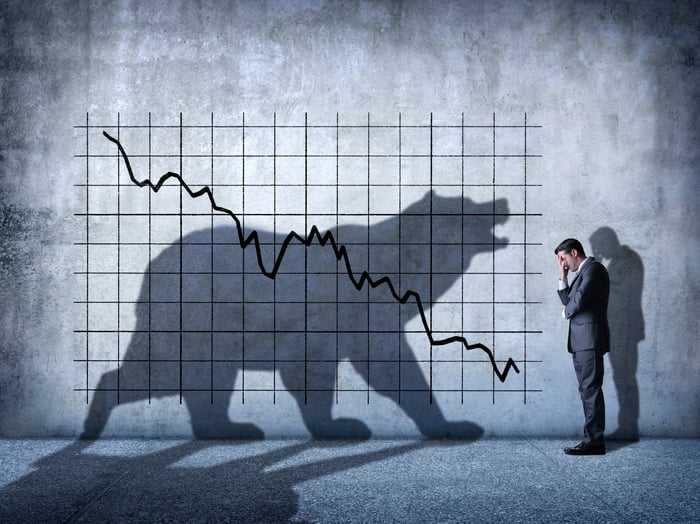
Image source: Getty Images.
The investment factor that outperforms over the long run
Long-term outperformance typically comes in two forms: above-average performance during bull markets or above-average performance during bear markets. A strategy that can maximize one side without a huge negative impact on the other side of the equation will perform exceptionally well as the market shifts from bull market to bear market and back again.
Most investors would prefer less volatility in their portfolios, accepting returns that don't quite meet the market average during upswings but don't fall nearly as much during bad times. Those investors should be looking at the "quality" factor when choosing stocks.
Quality isn't a subjective term here. Quality stocks are those with high profitability, low financial risk, and strong cash-flow generation. The S&P 500 Quality index uses a quality score to determine its constituents, which is calculated from return on equity, net changes in operating assets, and the financial leverage ratio to produce a single metric by which it ranks all S&P 500 constituents.
Quality stocks, with their strong balance sheets and excellent cash-flow generation, hold up better in market downturns. In fact, quality stocks are the only investment style that have outperformed the broader index in every market downturn since 1990, according to an analysis from J.P. Morgan. The S&P 500 Quality index has captured just 78.2% of the downside in broad market declines since 1995.
At the same time, quality stocks tend to keep up with the market when it climbs. The Quality index has participated in 96.6% of the broader index's upside. The result is long-term outperformance over a full market cycle (or multiple cycles). In the 12 years since its inception, the S&P 500 Quality index has outperformed the S&P 500, with an annualized compound total return of about 14% vs. 13.8% for the broader index, while exhibiting lower volatility. That's despite the period being mostly dominated by growth stocks and extended bull markets.
How can you position your portfolio?
If you're worried about a market crash, you should consider selling positions in more speculative investments. Reduce your exposure to companies with low or no profitability and high amounts of debt on their balance sheets. These are the stocks that are likely to get hit hardest by investors worried about an economic downturn. Companies in the neocloud space could be particularly vulnerable if the downturn stems from a slowdown in AI spending.
In their place, you should look for companies with high quality scores: steady earnings growth, growing operating cash flow, and low levels of net debt. If you prefer index funds, the Invesco S&P 500 Quality ETF (NYSEMKT: SPHQ) provides a low-cost way to track the 100 highest-quality stocks in the S&P 500. Since it merely tracks the index, it can keep its net expense ratio to just 0.15%.
It's important to remember that the market can continue to push stock prices higher for longer than you expect. Even with valuations stretched, uncertainty in the bond market, questions about the economy, and declining investor sentiment, investors should avoid ditching equities altogether. A shift toward quality stocks is a way to maintain exposure to the asset class and capture most of the upside while providing good downside protection.
Should you buy stock in Invesco Exchange-Traded Fund Trust - Invesco S&P 500 Quality ETF right now?
Before you buy stock in Invesco Exchange-Traded Fund Trust - Invesco S&P 500 Quality ETF, consider this:
The Motley Fool Stock Advisor analyst team just identified what they believe are the 10 best stocks for investors to buy now… and Invesco Exchange-Traded Fund Trust - Invesco S&P 500 Quality ETF wasn’t one of them. The 10 stocks that made the cut could produce monster returns in the coming years.
Consider when Netflix made this list on December 17, 2004... if you invested $1,000 at the time of our recommendation, you’d have $397,405!* Or when Nvidia made this list on April 15, 2005... if you invested $1,000 at the time of our recommendation, you’d have $1,344,091!*
Now, it’s worth noting Stock Advisor’s total average return is 953% — a market-crushing outperformance compared to 214% for the S&P 500. Don't miss the latest top 10 list, available with Stock Advisor, and join an investing community built by individual investors for individual investors.
See the 10 stocks »
*Stock Advisor returns as of August 7, 2026.
JPMorgan Chase is an advertising partner of Motley Fool Money. Adam Levy has no position in any of the stocks mentioned. The Motley Fool has positions in and recommends JPMorgan Chase. The Motley Fool has a disclosure policy.
Recommended Articles


