




Nvidia vs. Micron: Which AI Chip Stock Has More Upside Potential?
Key Points
Most artificial intelligence (AI) development happens inside large, centralized data centers.
Nvidia is a top supplier of graphics processing units (GPUs), which are the primary data center chips used in AI workloads.
Micron Technology supplies some of the best high-bandwidth memory for data centers, which help GPUs achieve maximum processing speeds.
- 10 stocks we like better than Nvidia ›
Developing artificial intelligence (AI) requires substantial computing power, which is why it typically occurs in large, centralized data centers. This infrastructure includes thousands of specialized chips called graphics processing units (GPUs) specifically designed for data-intensive AI workloads.
High-bandwidth memory (HBM) is also a critical component in the hardware stack because it stores data in a ready state until GPUs are ready to process it. A low memory capacity can cause bottlenecks and force GPUs to pause their workloads while they wait to receive more data, whereas a high capacity keeps data flowing smoothly to unlock maximum processing speeds.
Will AI create the world's first trillionaire? Our team just released a report on the one little-known company, called an "Indispensable Monopoly" providing the critical technology Nvidia and Intel both need. Continue »
Nvidia (NASDAQ: NVDA) makes the world's best GPUs, while Micron Technology (NASDAQ: MU) makes some of the highest-capacity HBM. Both companies have soared in value thanks to the AI boom, but which one has more upside potential from here?

Image source: Getty Images.
The case for Nvidia
Nvidia has led the market for AI data center chips since it launched the H100 GPU in 2022, which was based on its Hopper architecture. Today, the company's Blackwell-based GB300 GPU delivers up to 50 times more performance than the H100 in certain configurations, so the pace of innovation has been staggering.
In the second half of this year, Nvidia will start shipping commercial quantities of its new Vera Rubin semiconductor platform, which includes the Rubin GPU, the Vera CPU, and a slate of new networking components. The company says it will be so powerful that developers can train AI models using 75% fewer GPUs, resulting in a whopping 90% reduction in inference token costs.
Inference tokens can be words, symbols, or images generated whenever a user prompts an AI chatbot or agent. Reducing token costs could drive a significant increase in AI usage while also boosting AI providers' profit margins. Both things are likely to bolster demand for Nvidia's GPUs.
Nvidia generated a record $215.9 billion in revenue during its fiscal year 2026 (ended Jan. 25), along with earnings of $4.77 per share. Its stock currently trades at a price-to-earnings (P/E) ratio of 36.1, which is a substantial discount to its 10-year average of 61.6.
Wall Street estimates that Nvidia will grow its earnings to $8.29 per share during fiscal 2027 (according to Yahoo! Finance), placing its stock at an even more attractive forward P/E ratio of 21.3.
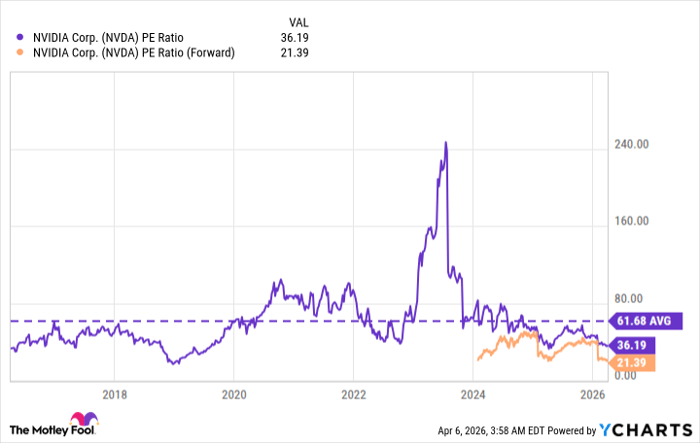
NVDA PE Ratio data by YCharts
Nvidia stock would have to soar by 189% over the next year just for its P/E ratio to align with its 10-year average of 61.6. That isn't guaranteed to happen, but the stock could still deliver significant upside even if it were to fall short.
The case for Micron
Micron's flagship HBM3E memory solution for the data center provides up to 50% more capacity than competing hardware while consuming 30% less energy. The net result is faster processing speeds with lower costs, which is why Nvidia is using it alongside its Blackwell GB300 GPUs.
But Micron recently launched its HBM4 solution, which offers 60% more capacity than its HBM3E solution, in addition to a 20% improvement in energy efficiency. It was actually designed for the Vera Rubin platform, so the partnership between Nvidia and Micron is about to enter its next phase.
But Micron also has a massive AI opportunity outside the data center. It's one of the world's top suppliers of memory for personal computers (PCs) and smartphones, and these devices are gradually processing more AI workloads. The company says PCs with agentic AI capabilities require up to 32 gigabytes of dynamic random access memory (DRAM), which is twice as much as non-AI PCs. More memory means more money for Micron.
Micron recently reported its operating results for its fiscal 2026 second quarter (ended Feb. 26). The company generated a record $23.9 billion in total revenue, up an eye-popping 196% year over year.
Micron's earnings also exploded higher by 756% during the second quarter, and management is forecasting a staggering 1,025% earnings growth in the current third quarter. Micron stock is now trading at a P/E ratio of just 17.7 and a forward P/E ratio of 6.5 based on Wall Street's consensus estimate for the company's full-year fiscal 2026 earnings.
Therefore, despite the company's blistering growth, its stock is significantly cheaper than the S&P 500 (SNPINDEX: ^GSPC), which trades at a P/E of 23.5 as of April 6.
The verdict
Micron stock is clearly much cheaper than Nvidia stock, so in theory, it could deliver more upside from here. However, memory prices are heavily inflated across all segments right now because surging demand from the AI industry has triggered one of the most severe supply shortages ever.
Therefore, Micron's staggering earnings growth may not be sustainable once more production capacity comes online over the next couple of years. Wall Street is quite good at looking past short-term shocks to a company's financial results (both positive and negative), which is why Micron's P/E ratio is so low right now.
While demand for GPUs also exceeds supply, these prices have been far less volatile. That makes Nvidia's financial results more predictable, which is why I think its stock will deliver more upside than Micron's from here.
Should you buy stock in Nvidia right now?
Before you buy stock in Nvidia, consider this:
The Motley Fool Stock Advisor analyst team just identified what they believe are the 10 best stocks for investors to buy now… and Nvidia wasn’t one of them. The 10 stocks that made the cut could produce monster returns in the coming years.
Consider when Netflix made this list on December 17, 2004... if you invested $1,000 at the time of our recommendation, you’d have $532,929!* Or when Nvidia made this list on April 15, 2005... if you invested $1,000 at the time of our recommendation, you’d have $1,091,848!*
Now, it’s worth noting Stock Advisor’s total average return is 928% — a market-crushing outperformance compared to 186% for the S&P 500. Don't miss the latest top 10 list, available with Stock Advisor, and join an investing community built by individual investors for individual investors.
See the 10 stocks »
*Stock Advisor returns as of April 8, 2026.
Anthony Di Pizio has no position in any of the stocks mentioned. The Motley Fool has positions in and recommends Micron Technology and Nvidia. The Motley Fool has a disclosure policy.
Recommended Articles


