




This Unstoppable Vanguard ETF Is Beating the S&P 500, the Nasdaq-100, and the Dow Jones in 2026
Key Points
The S&P 500, the Nasdaq-100, and the Dow Jones Industrial Average are each down more than 5% in 2026.
The Russell 2000 small-cap index is flat for the year because it's less exposed to the ongoing geopolitical tensions in the Middle East.
The Vanguard Russell 2000 ETF tracks the performance of the index, and it could be poised to deliver a strong relative return in 2026.
- 10 stocks we like better than Vanguard Russell 2000 ETF ›
The U.S. stock market is off to a difficult start to 2026. Ongoing geopolitical tensions in the Middle East have sent the price of oil soaring, which is creating economic instability and clouding the earnings picture for corporate America. As a result, the S&P 500, the Nasdaq-100, and the Dow Jones Industrial Average have each suffered year-to-date declines of more than 5% so far.
However, another index is bucking the losses to trade flat for the year. The Russell 2000 is home to approximately 2,000 of the smallest companies listed on U.S. stock exchanges, many of which operate exclusively in America, so they are somewhat insulated from global conflicts.
Will AI create the world's first trillionaire? Our team just released a report on the one little-known company, called an "Indispensable Monopoly" providing the critical technology Nvidia and Intel both need. Continue »
The Vanguard Russell 2000 ETF (NASDAQ: VTWO) is an exchange-traded fund (ETF) that tracks the performance of the index by holding the same stocks and maintaining similar weightings. Here's why it could continue outperforming the major stock market indexes.

Image source: Getty Images.
Small-cap stocks can produce blistering returns
The companies in the Russell 2000 come from 11 different economic sectors, so the index is highly diversified. It's also quite balanced; its largest sector is healthcare, which has a weighting of 18.7%, followed by industrials at 18.1% and financials at 17.2%. The S&P 500, for example, is far more top-heavy, with a whopping 33.3% of its portfolio parked in the information technology sector alone.
A more evenly distributed index tends to deliver steadier returns with less volatility than an index with a high degree of portfolio concentration. On that note, the top 10 holdings in the Vanguard Russell 2000 ETF account for just 5.6% of the value of its portfolio, so unlike the S&P, the Nasdaq-100, and the Dow, its performance isn't beholden to a mere handful of stocks:
|
Stock |
Vanguard ETF Portfolio Weighting |
|---|---|
|
1. Bloom Energy |
1.09% |
|
2. Fabrinet |
0.63% |
|
3. Coeur Mining |
0.56% |
|
4. Credo Technology |
0.55% |
|
5. Hecla Mining |
0.51% |
|
6. EchoStar Corp |
0.50% |
|
7. Nextpower |
0.49% |
|
8. Kratos Defense |
0.48% |
|
9. IonQ |
0.42% |
|
10. Sterling Construction |
0.41% |
Data source: Vanguard. Portfolio weightings are accurate as of Feb. 28, 2026, and are subject to change.
Small-cap stocks are often overlooked by investors, but they can produce incredible returns. Bloom Energy stock is up by a whopping 500% over the last 12 months as demand for the company's on-site clean energy solutions soars from leading data center operators who are seeking alternative sources of electricity for their artificial intelligence (AI) infrastructure.
Then there is Credo Technology stock, which has soared by more than 700% over the last five years on the back of strong demand for the company's data center networking solutions, which accelerate the speed at which information moves between chips and devices.
Shares of both Coeur Mining and Hecla Mining have more than doubled over the past year. They are major explorers and producers of precious metals in North America, so they are benefiting from the significant increase in the value of gold and silver since the start of 2025.
Most of the companies in the Russell 2000 conduct nearly all of their business inside America, so they are less affected by geopolitical tensions than the multinational giants that dominate other indexes like the S&P 500. Amazon, for instance, has suffered direct attacks on several of its data centers in the Middle East over the last month, which is concerning for shareholders.
Domestic companies are also experiencing tailwinds from favorable government policies. The Trump administration has imposed tariffs on imported goods, which increase the price of foreign-made products for American consumers, making locally manufactured goods more attractive. The Trump administration is also slashing regulatory red tape for many industries to reduce the cost of doing business for American enterprises.
2026 could be a strong year for the Vanguard ETF
The Russell 2000 normally underperforms the other U.S. indexes, mainly because it has no exposure to the trillion-dollar giants producing faster revenue growth, earnings growth, and returns than the rest of the market. Nvidia stock, for example, has rocketed higher by almost 20,000% (or 200 times) over the last 10 years.
Investors who bought the Vanguard Russell 2000 ETF exactly a decade ago would still be sitting on a strong return of 132% today, but they would have done much better in an ETF that tracks one of the three major U.S. indexes instead:
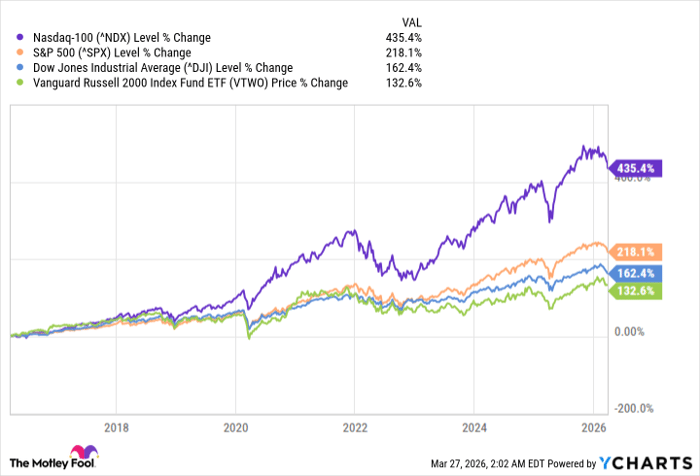
^NDX data by YCharts.
With that said, the Russell is capable of outperforming its larger peers occasionally, and the stars certainly seem to be aligning in 2026. With favorable government policies and ongoing geopolitical tensions, it's no surprise the index is bucking the sharp losses experienced by the other U.S. indexes.
Even if the conflict in the Middle East were to resolve immediately, its impact on the global economy could reverberate for months or even years as large organizations express more caution when expanding overseas. Plus, while the U.S. is considered to be energy independent, higher oil prices could hurt consumers in many of the countries where multinational companies draw large sums of revenue. That is another reason why companies operating solely in America could outperform.
Should you buy stock in Vanguard Russell 2000 ETF right now?
Before you buy stock in Vanguard Russell 2000 ETF, consider this:
The Motley Fool Stock Advisor analyst team just identified what they believe are the 10 best stocks for investors to buy now… and Vanguard Russell 2000 ETF wasn’t one of them. The 10 stocks that made the cut could produce monster returns in the coming years.
Consider when Netflix made this list on December 17, 2004... if you invested $1,000 at the time of our recommendation, you’d have $503,861!* Or when Nvidia made this list on April 15, 2005... if you invested $1,000 at the time of our recommendation, you’d have $1,026,987!*
Now, it’s worth noting Stock Advisor’s total average return is 884% — a market-crushing outperformance compared to 179% for the S&P 500. Don't miss the latest top 10 list, available with Stock Advisor, and join an investing community built by individual investors for individual investors.
See the 10 stocks »
*Stock Advisor returns as of March 31, 2026.
Anthony Di Pizio has no position in any of the stocks mentioned. The Motley Fool has positions in and recommends Amazon, Bloom Energy, IonQ, Kratos Defense & Security Solutions, Nextpower, Nvidia, and Sterling Infrastructure. The Motley Fool has a disclosure policy.
Recommended Articles


