




1 Reason Eli Lilly Stock Is Still a Buy
Key Points
Eli Lilly boasts competitive margins by industry standards.
Several initiatives could help the company improve on that front.
- 10 stocks we like better than Eli Lilly ›
Despite its leadership in the weight-loss medicine market, Eli Lilly (NYSE: LLY) is not performing well this year, with its shares down 15% to date. Some worry that the drugmaker will eventually face stiff competition in its core niche, eroding its pricing power and profits. However, Eli Lilly has several strengths that should help it perform well over the medium term, even beyond its deep pipeline. Let's look at one reason the stock could deliver strong returns through the next five years.

Image source: Getty Images.
Will AI create the world's first trillionaire? Our team just released a report on the one little-known company, called an "Indispensable Monopoly" providing the critical technology Nvidia and Intel both need. Continue »
Eli Lilly's expanding margins
Since 2020, Eli Lilly's gross and operating margins have improved noticeably. The company's margins as of the fourth quarter of 2025 are higher than those of its similarly sized peers.
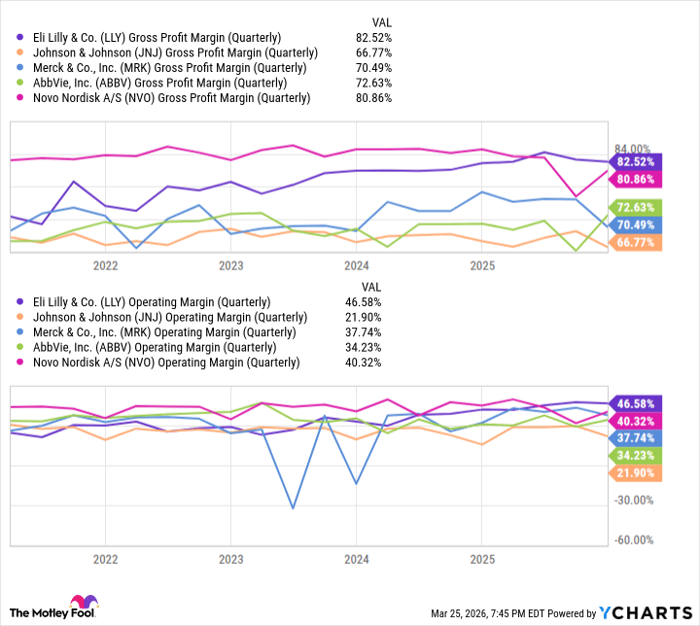
LLY Gross Profit Margin (Quarterly) data by YCharts
Eli Lilly has benefited from rapidly growing sales of GLP-1 brands like Zepbound and Mounjaro for the treatment of obesity and diabetes, respectively. However, that might not be the whole story. The margin improvements tell us that sales are growing much faster than expenses, which may indicate that Eli Lilly is manufacturing its drugs more efficiently, among other factors. Management's comments confirm that theory. In recent earnings calls, the company has credited, in part, improved production costs.
Now, there are threats to Eli Lilly's margin expansion. The company has noted that lower-realized prices for some of its products have offset some of the margin gains driven by improved costs of production. As more anti-obesity drugs enter the market, things could get even more challenging on that front. However, there are also reasons Eli Lilly could maintain relatively high margins over the medium term, even beyond new, potential best-in-class drugs it could launch. Here are two of them.
First, Eli Lilly is investing heavily in expanding its manufacturing capacity. The company has done so to the tune of $55 billion since 2020. These investments may harm profits and margins in the short run, but they should eventually help boost the company's manufacturing capacity while lowering costs, thereby driving significant economies of scale. Second, Eli Lilly's investments in artificial intelligence (AI) could also have an impact, although not immediately. Eli Lilly built the largest supercomputer in the pharmaceutical industry with the assistance of Nvidia.
The company's goals include accelerating drug discovery, efficiently designing clinical trials, and more. Even small, perhaps 5%, cuts to the time and money it typically takes to get a brand-new compound from the lab into the clinic may have an impact across the entire business, helping lower expenses and boost margins. So, investors should keep an eye on Eli Lilly's AI-related efforts. Meanwhile, the company's strong revenue and earnings growth, and an industry-leading lineup and pipeline in one of the fastest-growing therapeutic areas, make the stock attractive.
Should you buy stock in Eli Lilly right now?
Before you buy stock in Eli Lilly, consider this:
The Motley Fool Stock Advisor analyst team just identified what they believe are the 10 best stocks for investors to buy now… and Eli Lilly wasn’t one of them. The 10 stocks that made the cut could produce monster returns in the coming years.
Consider when Netflix made this list on December 17, 2004... if you invested $1,000 at the time of our recommendation, you’d have $503,268!* Or when Nvidia made this list on April 15, 2005... if you invested $1,000 at the time of our recommendation, you’d have $1,049,793!*
Now, it’s worth noting Stock Advisor’s total average return is 898% — a market-crushing outperformance compared to 182% for the S&P 500. Don't miss the latest top 10 list, available with Stock Advisor, and join an investing community built by individual investors for individual investors.
See the 10 stocks »
*Stock Advisor returns as of March 28, 2026.
Prosper Junior Bakiny has positions in Eli Lilly and Nvidia. The Motley Fool has positions in and recommends Nvidia. The Motley Fool has a disclosure policy.
Recommended Articles


