




Should You Sell Your Stocks Right Now? History Offers a Crystal-Clear Answer.
Key Points
Economists at Goldman Sachs recently raised their recession odds to 30%.
Despite a downturn potentially looming, history has good news for investors.
The right strategy can help minimize risk and set you up for lucrative long-term earnings.
- 10 stocks we like better than S&P 500 Index ›
Major market indexes have tumbled in recent weeks, with the S&P 500 (SNPINDEX: ^GSPC) down nearly 6% from its high last month and the Nasdaq Composite (NASDAQINDEX: ^IXIC) falling close to 9% from its peak, as of this writing. Recession fears are also ramping up, as surging oil prices put pressure on the economy.
So what does that mean for investors? If the U.S. enters a recession in 2026, stock prices could plunge. Fortunately, history offers a clear answer to how this might affect investors' strategies.
Will AI create the world's first trillionaire? Our team just released a report on the one little-known company, called an "Indispensable Monopoly" providing the critical technology Nvidia and Intel both need. Continue »
Image source: Getty Images.
The future is bright for investors
With stock prices steadily dropping, it may be tempting to sell your stocks now before they lose any more value. However, history suggests that holding your investments is the more lucrative choice.
So much of the short-term future is uncertain right now. While some investors worry a bear market is on the horizon, economists at Goldman Sachs only predict a 30% chance of a U.S. recession beginning in the next 12 months. While that's still an increase from previous forecasts, a recession this year isn't guaranteed.
What is almost guaranteed, though, is the market's ability to thrive over time. To be clear, nothing is 100% certain when it comes to the stock market. But major market indexes have a century of history proving that they can survive even the most severe periods of volatility.
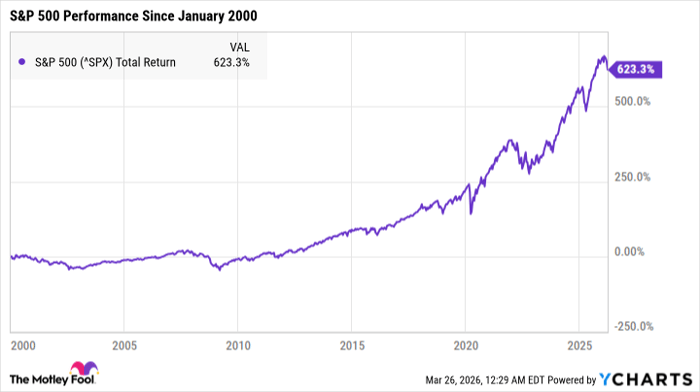
In the last two decades alone, the market has faced historic downturns. In the early 2000s, for instance, the U.S. faced not only another war in the Middle East but also the dot-com implosion and collapse of the tech industry. Then, as soon as the market recovered from that downturn, the Great Recession began.
Despite all of that volatility, however, the S&P 500 has earned total returns of more than 623% since January 2000.
^SPX data by YCharts
Of course, hindsight is 20/20. If investors had known the dot-com bubble was about to burst, selling beforehand would have been a financially smart move.
In most cases, however, there's no way to know whether we're in a bear market or recession until we're already deep in the thick of it. By that point, stock prices will have typically fallen so far that selling would result in steep losses.
This makes it incredibly tough to time the market effectively. If you sell now and stock prices bounce back, you risk missing out on potential gains. But if you wait until we're already in a recession to sell, you risk locking in losses.
The best move investors can make right now
Selling your stocks now may seem like the safer option. If history shows us anything, however, it's that holding your investments for the long haul can be more lucrative and less risky.
With a long-term outlook, you don't need to worry about selling your stocks at just the right moment. Your portfolio may lose value in the short term if we face a recession, but over time, strong investments will recover and deliver positive total returns.
In fact, right now can actually be a smart time to buy more stocks. With stock prices falling, many investments are more affordable than they've been in months. By loading up on high-quality stocks and holding them for at least five to seven years, you're far more likely to make it through a recession unscathed.
Should you buy stock in S&P 500 Index right now?
Before you buy stock in S&P 500 Index, consider this:
The Motley Fool Stock Advisor analyst team just identified what they believe are the 10 best stocks for investors to buy now… and S&P 500 Index wasn’t one of them. The 10 stocks that made the cut could produce monster returns in the coming years.
Consider when Netflix made this list on December 17, 2004... if you invested $1,000 at the time of our recommendation, you’d have $503,268!* Or when Nvidia made this list on April 15, 2005... if you invested $1,000 at the time of our recommendation, you’d have $1,049,793!*
Now, it’s worth noting Stock Advisor’s total average return is 898% — a market-crushing outperformance compared to 182% for the S&P 500. Don't miss the latest top 10 list, available with Stock Advisor, and join an investing community built by individual investors for individual investors.
See the 10 stocks »
*Stock Advisor returns as of March 28, 2026.
Katie Brockman has no position in any of the stocks mentioned. The Motley Fool has positions in and recommends Goldman Sachs Group. The Motley Fool has a disclosure policy.
Recommended Articles


