




Where Will Micron Technology Stock Be in 2030?
Key Points
Its earnings potential suggests the stock could jump significantly, despite terrific gains over the past year.
The favorable dynamics right now in the memory market should continue to support a rally in Micron stock.
- 10 stocks we like better than Micron Technology ›
Micron Technology (NASDAQ: MU) released its fiscal 2026 second-quarter results (for the three months ended Feb. 26) on March 18, and its results clearly indicate that its phenomenal growth isn't going to slow down anytime soon.
Micron stock has shot up 346% in the past year, and it looks like the memory specialist's red-hot run is going to continue for the next five years. Let's see why that's likely to be the case.
Will AI create the world's first trillionaire? Our team just released a report on the one little-known company, called an "Indispensable Monopoly" providing the critical technology Nvidia and Intel both need. Continue »

Image source: Micron Technology.
Micron should benefit from favorable memory pricing through 2030
Micron's latest results were phenomenal. The company's revenue almost tripled year over year to $23.9 billion, while adjusted earnings jumped by almost 8x to $12.20 per share. The numbers blew past Wall Street's expectations of $9.31 per share in earnings on $20.07 billion in revenue, which wasn't surprising, given the artificial intelligence (AI)-fueled demand for memory chips.
Management noted on the latest earnings conference call that AI data centers are poised to consume more than half of the memory industry's shipments this year. Moreover, there isn't enough supply available to meet the booming AI-fueled demand. CEO Sanjay Mehrotra points out that Micron is being "able to fulfill only 50% to two-thirds" of the demand from its key customers in the medium term.
Importantly, the terrific memory demand from AI data centers isn't going to subside anytime soon. Micron's peer SK Hynix notes that the memory supply is lagging demand by 20%. The South Korean memory giant believes that memory makers won't be able to meet demand until 2030, even as they bring additional capacity online.
After all, building new fabrication plants takes time, and demand for AI chips is growing at a breathtaking pace. Deloitte estimates that AI data center workloads could triple or quadruple each year between 2026 and 2030, creating a need for more chips. The consulting giant notes that chip manufacturers have been using high-bandwidth memory (HBM) in their chips to move data at a faster pace between different types of AI data center processors.
This explains why Bloomberg anticipates the HBM market to grow at an annual pace of 42% through 2033. Not surprisingly, chipmakers such as Micron have been prioritizing HBM production, leaving a gap in the personal computer (PC) and smartphone markets. An increase in the production costs of PCs and smartphones due to high memory prices will reduce their sales in 2026, according to Gartner. So, once memory manufacturers build enough capacity to serve the AI data center market, they will have to turn their attention to the PC and smartphone markets as well.
All this suggests that the demand for memory chips is poised to remain strong over the next five years, which should ideally help Micron sustain impressive levels of revenue and earnings growth.
Meanwhile, the company's outlook makes it clear that 2026 is going to be a blockbuster year. It expects a record $33.5 billion in revenue in the current quarter, a jump of more than 3.5x over the year-ago period's $9.3 billion. Micron's revenue in fiscal 2025 (which ended in August of last year) stood at $37.4 billion, which means that the company is on track to do almost a similar amount of business in a single quarter.
Micron has guided for $19.15 in earnings per share for the current quarter, which would be a 10x increase over the year-ago period. Analysts would have settled for $10.77 earnings per share. So, the company's bottom-line growth is poised to accelerate in the current quarter, which has prompted analysts to significantly boost their earnings expectations for Micron.
The stock could jump significantly by 2030
The chart indicates that Micron's earnings will reach $98.55 per share in the next fiscal year. However, it won't be surprising to see that estimate jump higher in the future due to the favorable demand-supply dynamics in the memory market.
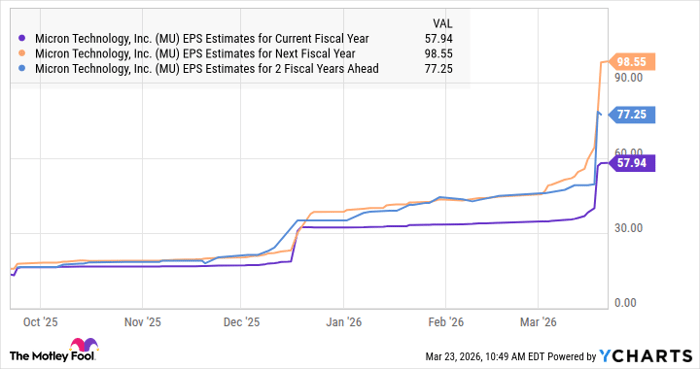
MU EPS Estimates for Current Fiscal Year data by YCharts
Assuming Micron's bottom line increases at a much more conservative 10% rate in fiscal years 2029 and 2030, its earnings could jump to $119 per share by the end of the decade. If this AI stock were trading at 21 times earnings at that time, in line with the S&P 500's forward earnings multiple, its price could reach $2,499 in 2030 (based on the $119 per share projected earnings).
That suggests potential gains of 490% from current levels, a feat that Micron can indeed achieve, considering the aggressive spending on AI data centers.
Should you buy stock in Micron Technology right now?
Before you buy stock in Micron Technology, consider this:
The Motley Fool Stock Advisor analyst team just identified what they believe are the 10 best stocks for investors to buy now… and Micron Technology wasn’t one of them. The 10 stocks that made the cut could produce monster returns in the coming years.
Consider when Netflix made this list on December 17, 2004... if you invested $1,000 at the time of our recommendation, you’d have $490,325!* Or when Nvidia made this list on April 15, 2005... if you invested $1,000 at the time of our recommendation, you’d have $1,074,070!*
Now, it’s worth noting Stock Advisor’s total average return is 900% — a market-crushing outperformance compared to 184% for the S&P 500. Don't miss the latest top 10 list, available with Stock Advisor, and join an investing community built by individual investors for individual investors.
See the 10 stocks »
*Stock Advisor returns as of March 25, 2026.
Harsh Chauhan has no position in any of the stocks mentioned. The Motley Fool has positions in and recommends Micron Technology. The Motley Fool recommends Gartner. The Motley Fool has a disclosure policy.
Recommended Articles


