




Nervous About the Oil Crisis? This Market-Crushing Stock is an Absolute No-Brainer Buy For You
Key Points
The spike in oil prices has driven volatility in the stock market and pressured most cyclical stocks.
Berkshire Hathaway has fallen since the war broke out, but it's well-prepared to weather a longer war.
Berkshire has large investments in energy stocks, and close to $400 billion to deploy if stock prices plunge.
- 10 stocks we like better than Berkshire Hathaway ›
Investors who spent the weekend biting their nails down to the quick got a reprieve this morning as President Trump said he would postpone an attack on Iranian power plants.
As a result, stocks soared on Monday, with major indexes up around 1.5% as of noon, and oil prices fell on hopes that tensions over the war would cool rose.
Will AI create the world's first trillionaire? Our team just released a report on the one little-known company, called an "Indispensable Monopoly" providing the critical technology Nvidia and Intel both need. Continue »
However, it's a mistake to assume the oil crisis resulting from the war and the closure of the Strait of Hormuz is fading, as the strait remains closed, and news from the region has been volatile since the war.
In other words, uncertainty is still elevated, and that's likely to continue until the war ends. The CBOE Volatility Index (VIX), also known as the fear gauge, is up by two-thirds from the start of the year, suggesting investors expect a volatile market.
Stocks are still down since the war broke out, and higher-risk stocks, like the tech sector, have been hit hard. However, there are some tickers that can provide refuge at a time like this.
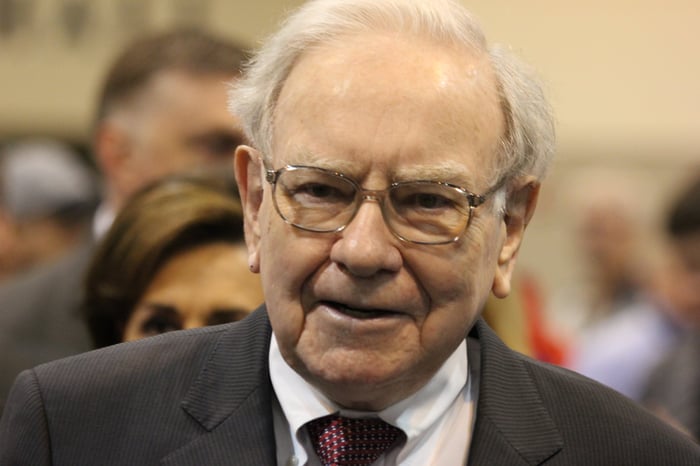
Image source: The Motley Fool.
An all-weather stock to beat the oil shock
One stock that has stood the test of time in both bull and bear markets and is well-suited to perform through the war in Iran is Berkshire Hathaway (NYSE: BRKA) (NYSE: BRKB).
While Warren Buffett is no longer running Berkshire on a day-to-day basis, having passed the reins to Greg Abel, his imprint will remain with the business, and he continues to oversee it as Chairman.
Buffett built a company designed to withstand economic shocks. It's diversified through its subsidiaries and stock market holdings across multiple stock market sectors, and, although Berkshire is exposed to cyclical forces, it has substantial energy holdings, meaning it could be a net beneficiary of the spike in oil prices.
Two of Berkshire's top ten holdings are oil companies. It closed the fourth quarter with Chevron (NYSE: CVX) as its fifth-biggest holding, at 130.1 million shares, now worth more than $26 billion after jumping 33.5% this year. Occidental Petroleum (NYSE: OXY), a Buffett favorite, was its seventh-biggest holding as of the end of 2025, with 265 million shares. Those shares are now worth roughly $16 billion, with Occidental up 46.1% this year.
Berkshire doesn't have any major oil-producing subsidiaries, though it holds a controlling stake in the Cove Point liquid natural gas (LNG) facility, a valuable asset at a time when LNG prices are soaring worldwide due to the destruction of natural gas infrastructure in the Middle East.
Berkshire's business model can deliver
Berkshire is diversified across sectors in a way that few other companies are, but it's more than diversification that makes the company special. The conglomerate is designed to generate cash in all kinds of environments as it counts on massive insurance businesses like GEICO to bring in cash, and it has large stakes in dividend stocks, including the two energy stocks above, to ensure that cash continues to flow into the company, enabling Berkshire to reinvest it as it sees fit.
Finally, Berkshire also has a massive cash hoard that it's ready to deploy should stocks fall far enough to enter value territory. Berkshire finished 2025 with nearly $370 billion in cash and T-bills, meaning the company has plenty of firepower to make acquisitions or buy more stock.
Berkshire has had a middling year so far, down about 5%, and it's fallen since the war started. However, the company has the kind of defensive model designed to thrive during challenging and unpredictable economic times. The longer the war in Iran drags on, the better Berkshire stock is likely to do.
Should you buy stock in Berkshire Hathaway right now?
Before you buy stock in Berkshire Hathaway, consider this:
The Motley Fool Stock Advisor analyst team just identified what they believe are the 10 best stocks for investors to buy now… and Berkshire Hathaway wasn’t one of them. The 10 stocks that made the cut could produce monster returns in the coming years.
Consider when Netflix made this list on December 17, 2004... if you invested $1,000 at the time of our recommendation, you’d have $495,179!* Or when Nvidia made this list on April 15, 2005... if you invested $1,000 at the time of our recommendation, you’d have $1,058,743!*
Now, it’s worth noting Stock Advisor’s total average return is 898% — a market-crushing outperformance compared to 183% for the S&P 500. Don't miss the latest top 10 list, available with Stock Advisor, and join an investing community built by individual investors for individual investors.
See the 10 stocks »
*Stock Advisor returns as of March 23, 2026.
Jeremy Bowman has no position in any of the stocks mentioned. The Motley Fool has positions in and recommends Berkshire Hathaway and Chevron. The Motley Fool recommends Occidental Petroleum. The Motley Fool has a disclosure policy.
Recommended Articles


