




Should Tesla Be Worried About Ford?
Key Points
Ford is investing heavily in producing low-cost electric vehicles while Tesla is focusing on developing its robotaxi business.
Tesla is already responding to the market moving toward lower-cost vehicles over the near-term, but the long-term playbook is autonomous driving.
- These 10 stocks could mint the next wave of millionaires ›
In many ways, the comparison between Ford Motor Company (NYSE: F) and Tesla (NASDAQ: TSLA) is emblematic of the challenges and opportunities in the automotive sector. The nature of their rivalry has changed over the years and is now gearing up for what could be a climactic battle that will change the face of the industry forever.
The Tesla narrative
There's been no end of discussion about Tesla's electric vehicle (EV) deliveries and automotive revenue declining over the last couple of years, and much has been made of the growing competition in the EV space from rivals, including Ford.
Will AI create the world's first trillionaire? Our team just released a report on the one little-known company, called an "Indispensable Monopoly" providing the critical technology Nvidia and Intel both need. Continue »
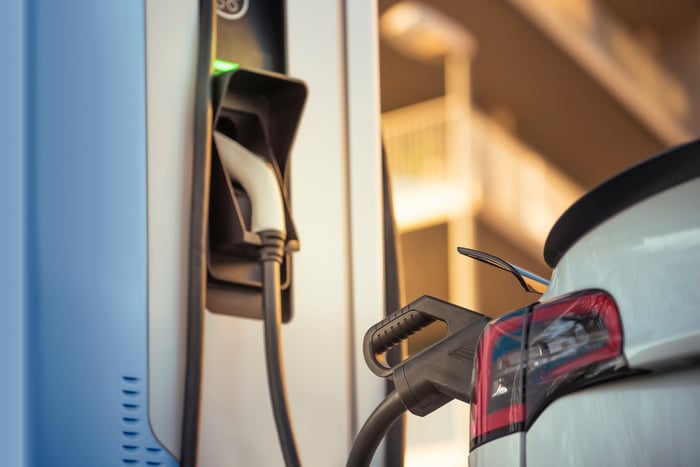
Image source: Getty Images.
But here's the thing. There's competition from rivals growing profits, and there's competition from rivals effectively subsidizing EV models by taking huge losses on them to establish market share.
The problem is the latter simply isn't sustainable, and Ford's difficulties in its Model e segment in recent years attest to that. As you can see below, the segment lost Ford over $14.5 billion over the last three years.
|
Ford segment-wise EBIT* |
2023 |
2024 |
2025 |
|---|---|---|---|
|
Ford Pro |
$7,222 million |
$9,007 million |
$6,843 million |
|
Ford Blue |
$7,462 million |
$5,269 million |
$3,024 million |
|
Ford Model e |
($4,701) million |
($5,105)million |
($4,806) million |
Data source: Ford presentations. *EBIT = Earnings Before Interest and Taxes.
Those kinds of losses aren't sustainable, and matters came to a head late 2025 when management took a $19.5 billion charge relating to its EV assets and announced a series of strategic changes aimed at turning the Model e segment profitable by 2029. These changes build on the previously announced $5 billion "bet" investment in a universal EV platform and system to try and produce affordable EVs starting with a midsize pickup truck selling for about $30,000 in 2027.
Will Ford's plans worry Tesla?
Any rival investing heavily to produce lower-cost EVs is obviously somewhat concerning, but there are two reasons why Tesla investors won't fear developments at Ford.
First, as noted above, it's one thing to sell cars; it's another to sell them profitably, and Ford isn't expecting to turn a profit in its EV segment until 2029. As such, the pressure is already on Ford to make a success of its $5 billion bet on EVs. Ford is aiming to produce vehicles with a "Lower cost of ownership over five years than a three-year-old used Tesla Model Y."
However, just as Ford is investing in lower-cost lithium-iron phosphate (LFP) batteries, Tesla is building an LFP factory in Nevada and a lithium refinery to support EV production. Meanwhile, Tesla already has lower-cost "standard" models on the market. In a sense, Tesla is already responding to the conventional EV market, shifting demand toward lower-cost models.
A fundamentally different vision of the EV market?
The second reason is arguably much more persuasive and pervasive. Simply put, Tesla CEO Elon Musk's vision for the future of transportation is that the vast majority of driving will be autonomous, with robotaxis playing a major role.
As such, the development of its autonomous full self-driving (FSD) and robotaxi businesses isn't a tactical move; it's the inevitable outcome of EV development.
If that doesn't make sense to Ford investors, then it certainly did to Ford CEO Jim Farley, who previously promised investors a Ford robotaxi network by 2021.
The reality is that the lower cost per mile advantage of EVs is best manifest when they are run more rather than being idle in a garage. A partial glimpse into the future can already be seen on the roads of the U.S., where the Tesla Model 3 is already one of the top 10 cars used as a taxi, despite having a substantially higher upfront cost than the other nine.
The cost-per-mile advantage is highly likely to be much greater when the driver is removed, as with Tesla's current robotaxis, and even greater still in Tesla's dedicated robotaxi, Cybercab.
Image source: Getty Images.
The future of transportation
Ford's track record of producing commercially viable EVs is not good. More importantly, if Tesla's vision of autonomous driving comes to fruition, then the value added by having a vehicle capable of autonomous driving, whether or not it's used as a robotaxi by its owner, is a major trump card over a low-cost Ford EV. Moreover, if Musk is right about Cybercab growth exploding, then it will make consumers think twice about the need to buy an EV, let alone a Ford EV.
All told, Tesla investors have little to fear from Ford if Tesla executes on its game plan.
Don’t miss this second chance at a potentially lucrative opportunity
Ever feel like you missed the boat in buying the most successful stocks? Then you’ll want to hear this.
On rare occasions, our expert team of analysts issues a “Double Down” stock recommendation for companies that they think are about to pop. If you’re worried you’ve already missed your chance to invest, now is the best time to buy before it’s too late. And the numbers speak for themselves:
- Nvidia: if you invested $1,000 when we doubled down in 2009, you’d have $447,961!*
- Apple: if you invested $1,000 when we doubled down in 2008, you’d have $47,222!*
- Netflix: if you invested $1,000 when we doubled down in 2004, you’d have $495,179!*
Right now, we’re issuing “Double Down” alerts for three incredible companies, available when you join Stock Advisor, and there may not be another chance like this anytime soon.
See the 3 stocks »
*Stock Advisor returns as of March 23, 2026.
Lee Samaha has no position in any of the stocks mentioned. The Motley Fool has positions in and recommends Tesla. The Motley Fool has a disclosure policy.
Recommended Articles


