




President Donald Trump Just Made a Huge Announcement About the Iran War: Here's Why it Could Be a Major Turning Point for the Stock Market
Key Points
President Donald Trump said the U.S. is 'very intent' on making a deal with Iran.
The stock market reversed significant losses in pre-market trading into significant gains on the news, although Iranian state media denied holding discussions with the U.S.
Still, Trump's openness to a deal is a new development that could mark an inflection point for the stock market.
- These 10 stocks could mint the next wave of millionaires ›
Several hours before the market opened today, stocks were poised to start the week with big losses. However, everything changed when President Donald Trump announced that the U.S. would suspend plans to conduct strikes on Iran's power plants and key infrastructure for five days, after holding 'productive' talks with officials in Iran.
Trump further told CNBC that "we are very intent on making a deal with Iran."
Will AI create the world's first trillionaire? Our team just released a report on the one little-known company, called an "Indispensable Monopoly" providing the critical technology Nvidia and Intel both need. Continue »
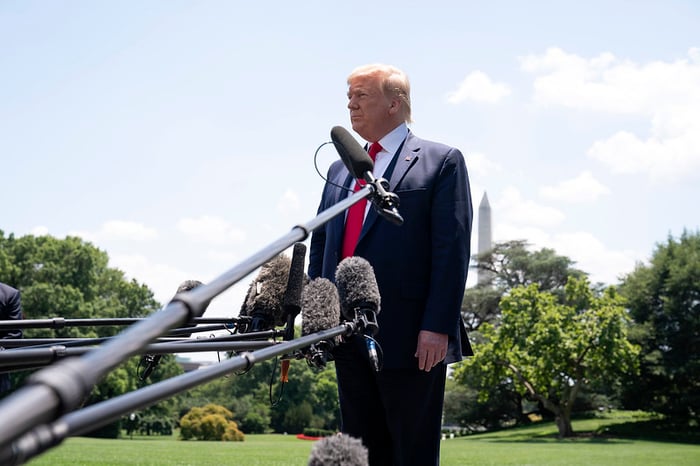
Official White House photo by Joyce N. Boghosian.
The Dow Jones traded 900 points higher, as of 10:32 a.m. ET today, although state media in Iran had denied holding talks with Trump, as of this writing.
Still, the market clearly views Trump's willingness to negotiate as a strong positive. It's certainly a major announcement by Trump and could be a major turning point for the stock market as well.
Ending the war would likely help quell concerns about stagflation
While the U.S. military has weakened Iran's military capabilities, the regime has still been able to wreak havoc in the Middle East.
Furthermore, the conflict has deterred oil tankers from traveling through the Strait of Hormuz, a key passage effectively controlled by Iran that sees one-fifth of the world's oil consumption flow through daily.
This has led oil prices to surge above $100 per barrel at times, stoking inflation concerns. In fact, investors over the past weekend began to price in the possibility that the Federal Reserve might actually raise interest rates later this year. Bond yields had surged. This was happening as the market grew increasingly concerned about signs of weakness in the labor market and economic growth.
Together, these suggested the possibility of stagflation, characterized by high inflation, high unemployment, and slow growth. Investors are fearful about stagflation because it makes it more difficult for the Fed to achieve its dual mandate of stable consumer prices and maximum employment. In this scenario, the Fed's rate moves may help achieve one of the Fed's mandates while potentially worsening the other.
If Trump can end the war sooner, rather than later, the U.S. economy can likely avoid a worst-case stagflation scenario, which is why markets are responding well.
While the issues with high oil prices wouldn't go away overnight, there would be a clearer path to seeing oil decline back to much lower levels in the coming months if the Strait of Hormuz is open and critical oil and energy infrastructure in the Middle East is believed to be safe.
While the stock market faced issues prior to the war in Iran, the major indexes had been performing decently, and the majority of market strategists still believed the broader market would deliver solid gains this year. An end to the war is likely to renew this mindset.
Where to invest $1,000 right now
When our analyst team has a stock tip, it can pay to listen. After all, Stock Advisor’s total average return is 898%* — a market-crushing outperformance compared to 183% for the S&P 500.
They just revealed what they believe are the 10 best stocks for investors to buy right now, available when you join Stock Advisor.
See the stocks »
*Stock Advisor returns as of March 23, 2026.
Bram Berkowitz has no position in any of the stocks mentioned. The Motley Fool has no position in any of the stocks mentioned. The Motley Fool has a disclosure policy.
Recommended Articles


