




What Happens to Your Investments If the Stock Market Crashes?
Key Points
Investors are becoming increasingly concerned about the market's future, new surveys show.
If the market crashes, there's a good chance your portfolio will lose value.
However, the market's long-term future remains promising.
- 10 stocks we like better than S&P 500 Index ›
More than half of U.S. investors feel pessimistic about the market's future, according to the most recent weekly survey from the American Association of Individual Investors, published on March 18, 2026. That figure is an increase from 46% last week and just 35% two weeks ago.
With Americans feeling increasingly concerned about potential volatility, it's wise to know what, exactly, might happen to your investments during a market crash or recession. For those with money invested, there's good and not-so-good news.
Will AI create the world's first trillionaire? Our team just released a report on the one little-known company, called an "Indispensable Monopoly" providing the critical technology Nvidia and Intel both need. Continue »
Image source: Getty Images.
The market's long-term future is still bright
Nobody knows what the market will do in the short term. However, if we face a bear market, crash, or recession, your investments will almost certainly lose value.
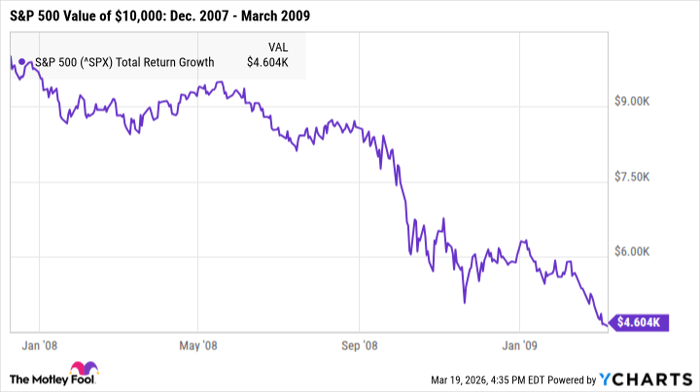
In some cases, that volatility can be severe. During the Great Recession, for example, the S&P 500 lost more than half of its value between 2007 and 2009.
In other words, if you'd had $10,000 invested in an S&P 500 ETF in December 2007, that investment would have been worth around $4,600 by March 2009.
^SPX data by YCharts
The good news, however, is that losing value is not necessarily the same as losing money. The only way to lose money in the stock market is to sell your investments for less than you paid for them.
In the previous example, if you'd bought your S&P 500 ETF shares for $10,000 and sold them for $4,600, you'd have locked in losses of more than $5,000. But if you'd simply held your investment until the market recovered, it would have regained all of its lost value without you losing anything.
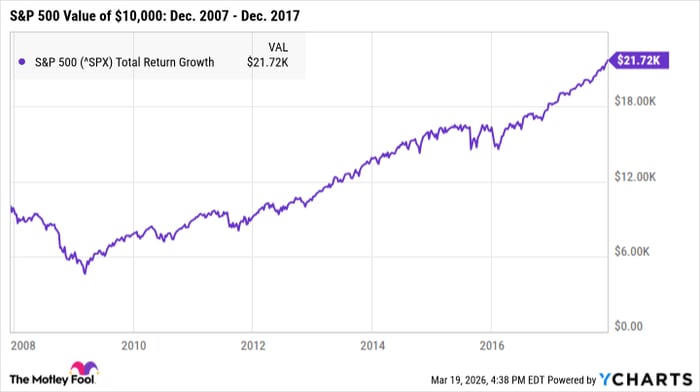
In fact, if you'd invested $10,000 in an S&P 500 ETF in December 2007 and held it for 10 years, you'd have more than doubled your money.
^SPX data by YCharts
A long-term outlook is your best friend when you're investing in the stock market. No matter how rough the short term may be (and it can be nauseating at times), the market as a whole is all but guaranteed to see positive total returns over a decade or two.
The key to ensuring your portfolio survives
The market itself has a flawless track record of recovering from crashes and recessions, but that doesn't mean that each individual stock will pull through. If you're investing in shaky companies that aren't strong enough to survive volatility, there is a good chance you'll lose money during a recession.
Stock price alone isn't necessarily indicative of a strong company. Even weak organizations can thrive when the market is soaring and investors are excited to buy, so underlying fundamentals are far more important.
Healthy organizations that are on solid financial footings and have clear advantages over their competitors are far more likely to bounce back. They might still lose value in the near term, but that's normal. If you hold these stocks for at least a few years, your portfolio has a much better chance of surviving even the worst market crash or recession.
Should you buy stock in S&P 500 Index right now?
Before you buy stock in S&P 500 Index, consider this:
The Motley Fool Stock Advisor analyst team just identified what they believe are the 10 best stocks for investors to buy now… and S&P 500 Index wasn’t one of them. The 10 stocks that made the cut could produce monster returns in the coming years.
Consider when Netflix made this list on December 17, 2004... if you invested $1,000 at the time of our recommendation, you’d have $495,179!* Or when Nvidia made this list on April 15, 2005... if you invested $1,000 at the time of our recommendation, you’d have $1,058,743!*
Now, it’s worth noting Stock Advisor’s total average return is 898% — a market-crushing outperformance compared to 183% for the S&P 500. Don't miss the latest top 10 list, available with Stock Advisor, and join an investing community built by individual investors for individual investors.
See the 10 stocks »
*Stock Advisor returns as of March 21, 2026.
Katie Brockman has no position in any of the stocks mentioned. The Motley Fool has no position in any of the stocks mentioned. The Motley Fool has a disclosure policy.
Recommended Articles


