




1 Artificial Intelligence (AI) Stock Down 25% That Could Roar Back in 2026
Key Points
Microsoft's stock has sold off for no good reason.
Microsoft is a clear winner from the AI build-out.
It has been a decade since the stock has consistently traded at this valuation range.
- 10 stocks we like better than Microsoft ›
Some of the most well-known and established artificial intelligence (AI) stocks are down significantly from their all-time high for no good reason. This opens up rare investment opportunities that hardly ever appear. One that I'm eyeing right now is Microsoft (NASDAQ: MSFT). Microsoft is down around 25% from its all-time high, something that isn't common.
The last time Microsoft was down 25% from its all-time high was during the late 2022, early 2023 marketwide sell-off when investors assumed we were headed straight for a recession, and market sentiment was extremely negative. While it's not all sunshine and rainbows in the world right now, there isn't a lot going on that will disrupt Microsoft's business. In fact, with all of the AI spending going on, Microsoft is expected to grow even more.
Will AI create the world's first trillionaire? Our team just released a report on the one little-known company, called an "Indispensable Monopoly" providing the critical technology Nvidia and Intel both need. Continue »
I think this sell-off is a no-brainer buying opportunity, and Microsoft could easily roar back by the end of 2026 to establish a new all-time high.

Image source: Getty Images.
Microsoft is benefiting big-time from the AI build-out
Just because Microsoft's stock is down 25% doesn't mean it needs to gain 25% to reach a new all-time high. It actually requires a 33% gain, which is an impressive return for any stock for just a year's investment. But what will Microsoft have to do to return to those levels?
I think it just needs to maintain its course.
Microsoft is taking a bit of a hands-off approach in the AI arms race. Instead of directly competing by building its own generative AI model, Microsoft is choosing to stay neutral. While it owns 27% of OpenAI, the makers of ChatGPT, Microsoft also hosts all sorts of other generative AI models, such as Grok from xAI, Anthropic's Claude, and DeepSeek R1, among others. Microsoft is positioning itself as the place where you can gain access to nearly any generative AI model you could want, and by not forcing a model on the user, it gives them greater flexibility.
Microsoft is recognizing this revenue through its cloud computing platform, Azure. Azure has been the highlight of Microsoft's business over the past decade and has consistently grown at least 20% or greater during that time frame. However, cloud computing is seeing unprecedented growth thanks to the AI build-out.
During the second quarter of fiscal year 2026 (ended Dec. 31), Azure's revenue increased an impressive 39% year over year. However, that figure could have been higher if Microsoft had used some of its newly installed computing equipment for external use rather than for internal use. It also has a $625 billion backlog, showcasing that there's a ton of contracted usage still to come.
Overall, in Q2, Microsoft's revenue rose 17% year over year and beat expectations laid out in Q1. There isn't really anything to nitpick, because all of Microsoft's hefty AI spending is already showing a significant return on investment through its cloud computing growth.
As a result, Microsoft is about as much of a no-brainer of a buy as it gets. But just how cheap is this price?
Microsoft has always traded at a premium valuation
Despite Microsoft's 25% sell-off, it still trades at a premium valuation to the market. At 25.6 times trailing earnings and 24.5 times forward earnings, it's still more expensive than the S&P 500, which trades for 24.6 times trailing earnings and 21.7 times forward earnings. This shouldn't come as a surprise, as Microsoft has always traded at a premium and has earned that status through consistent execution. However, the earnings ratio can be skewed by one-time effects and gains on investments (like OpenAI). As a result, I think using the operating price-to-earnings ratio is a better way to assess Microsoft's valuation from a historical standpoint.
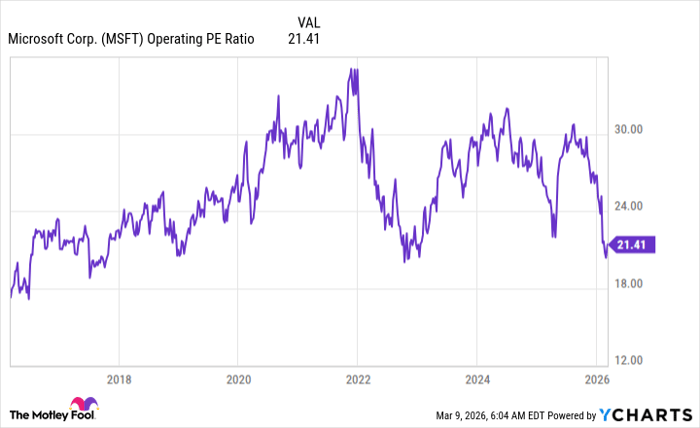
MSFT Operating PE Ratio data by YCharts
Microsoft's stock is near decade lows on this valuation measure, and you need to rewind to 2019 to find a time when it consistently traded this cheaply, outside of one-time dips. I think Microsoft's stock will rally throughout the year and return to normal valuation levels, resulting in impressive stock returns.
Should you buy stock in Microsoft right now?
Before you buy stock in Microsoft, consider this:
The Motley Fool Stock Advisor analyst team just identified what they believe are the 10 best stocks for investors to buy now… and Microsoft wasn’t one of them. The 10 stocks that made the cut could produce monster returns in the coming years.
Consider when Netflix made this list on December 17, 2004... if you invested $1,000 at the time of our recommendation, you’d have $514,000!* Or when Nvidia made this list on April 15, 2005... if you invested $1,000 at the time of our recommendation, you’d have $1,105,029!*
Now, it’s worth noting Stock Advisor’s total average return is 930% — a market-crushing outperformance compared to 187% for the S&P 500. Don't miss the latest top 10 list, available with Stock Advisor, and join an investing community built by individual investors for individual investors.
See the 10 stocks »
*Stock Advisor returns as of March 16, 2026.
Keithen Drury has positions in Microsoft. The Motley Fool has positions in and recommends Microsoft. The Motley Fool has a disclosure policy.
Recommended Articles


