




It's Starting to Look Like 1973 All Over Again. Here's What That Could Mean for Stocks.
Key Points
Current dynamics are similar to those in 1973, including a Middle East oil crisis and rising inflation.
These factors create a dismal environment for the stock market.
The smartest approach, both in 1973 and now, is to think long-term.
- These 10 stocks could mint the next wave of millionaires ›
"History doesn't repeat itself, but it often rhymes."
There's a debate over the exact wording of this quote and who said it first. However, the adage's premise is spot on. While current events are never completely similar to those in the past, they can be eerily similar.
Will AI create the world's first trillionaire? Our team just released a report on the one little-known company, called an "Indispensable Monopoly" providing the critical technology Nvidia and Intel both need. Continue »
I think we're seeing this firsthand right now. It's starting to look like 1973 all over again.

Image source: Getty Images.
Déjà vu
A full-fledged crisis has erupted in the Middle East. Oil prices are soaring. Higher inflation combined with low economic growth has led to stagflation. The Federal Reserve faces a dilemma about how to set interest rates.
That describes the situation in 1973. Following a war between several Middle Eastern countries and Israel, where the U.S. provided supplies to the Israeli military, Arab members of the Organization of Petroleum Exporting Countries (OPEC) imposed an oil embargo against the U.S. The price of oil skyrocketed as a result.
Core inflation had improved to roughly 3.3% the year before. However, the oil embargo sparked a surge in the prices of goods and services, leading to a rapid rise in inflation. U.S. GDP plunged as the economy entered a recession. The Federal Reserve, which has a dual mandate of promoting stable prices and maximum employment, was conflicted.
Students of history could be (and, arguably, should be) experiencing déjà vu. No country has placed an oil embargo on the U.S. However, Iran's blockage of the Strait of Hormuz, through which roughly 20% of the world's oil supply is transported, has caused the price of a barrel of oil to spike more than 40%. The average price of gasoline in the U.S. has jumped by $0.50 per gallon. If the crisis is prolonged, the prices of other products will almost certainly rise dramatically as well.
Meanwhile, fourth-quarter GDP growth was revised down to just 0.7% -- much slower than expected. The combination of this weak growth and the specter of higher inflation is exactly what the Fed doesn't want to see.
A dismal scenario for the stock market
The dynamics in 1973 led to one of the worst stock market crashes in history. The S&P 500 (SNPINDEX: ^GSPC) plunged more than 40% by mid-1974. Making matters worse, the index was dominated by the "Nifty Fifty," a group of large-cap stocks trading at sky-high valuations.
Unfortunately, the rebound from the brutal bear market wasn't a quick one. It took around seven and a half years for the S&P 500 to regain its level from early 1973. High inflation also eroded the buying power of any dividends paid by stocks during this period.
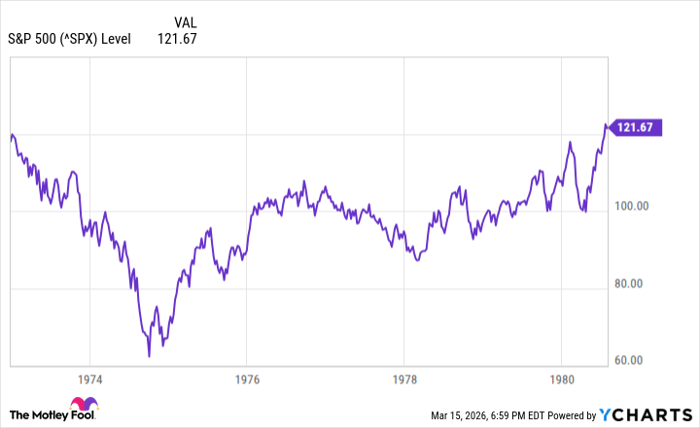
^SPX data by YCharts
Fast-forward to today. Fifty large-cap stocks don't dominate the S&P 500. Now, the so-called "Magnificent Seven" stocks make up one-third of the index. Like the "Nifty Fifty" from over five decades ago, these stocks are also priced at a premium compared to historical valuation levels.
Could investors face a "lost decade" like the 1970s? All of the necessary ingredients appear to be in place.
What should investors do?
If history indeed rhymes, investors might want to consider buying commodities (especially gold). For those seeking opportunities in the stock market, energy stocks and gold stocks could be the biggest winners. Keeping more money in U.S. Treasuries could also be a smart strategy. That's what Warren Buffett was already doing before he stepped down as CEO of Berkshire Hathaway (NYSE: BRKA) (NYSE: BRKB).
However, 2026 is unquestionably different from 1973. The promise of artificial intelligence (AI) could prevent a steep market sell-off. The showdown with Iran over the Strait of Hormuz could end relatively quickly. Investors shouldn't assume that the stock market will repeat its performance from years ago.
The smartest approach, both in 1973 and now, is to think long-term. Buy shares of companies that are well-positioned to deliver strong growth over the next 20 years. Even after the malaise of the 1970s, the S&P 500 was up almost 260% two decades after the 1973 decline. I suspect history will rhyme over the next two decades regardless of what happens over the near term.
Where to invest $1,000 right now
When our analyst team has a stock tip, it can pay to listen. After all, Stock Advisor’s total average return is 930%* — a market-crushing outperformance compared to 187% for the S&P 500.
They just revealed what they believe are the 10 best stocks for investors to buy right now, available when you join Stock Advisor.
See the stocks »
*Stock Advisor returns as of March 16, 2026.
Keith Speights has positions in Berkshire Hathaway. The Motley Fool has positions in and recommends Berkshire Hathaway. The Motley Fool has a disclosure policy.
Recommended Articles


