




Prediction: Rigetti Computing Stock Is Going to Plummet in 2026
Key Points
Quantum computing is a promising technology that could transform areas like science and cryptography, but it's a long way from mass commercialization.
Rigetti Computing is a leader in the quantum industry, having built some of the most accurate systems to date.
However, Rigetti is still generating a minuscule amount of revenue, which opens the door to significant downside in its richly valued stock.
- 10 stocks we like better than Rigetti Computing ›
Quantum computing holds a lot of promise in areas like scientific research and cryptography. It uses a concept called superposition to simulate several different solutions to a given problem at once, making it perfect for data-intensive workloads. Even the best classical computers can only perform a limited number of operations at once, which is why running complex technologies like artificial intelligence (AI) requires data centers the size of football fields, with thousands of individual chips.
However, most quantum computers available today still produce very high error rates, so they aren't very useful in the real world. Rigetti Computing (NASDAQ: RGTI) is one of the companies pushing the quantum industry forward, but even its best hardware is still a long way from mass commercialization.
Will AI create the world's first trillionaire? Our team just released a report on the one little-known company, called an "Indispensable Monopoly" providing the critical technology Nvidia and Intel both need. Continue »
Rigetti stock has already lost two-thirds of its value from last year's all-time high, but it's still extremely expensive, which could open the door to more downside. Here's why I predict the stock could end 2026 with significant further losses.

Image source: Getty Images.
The long journey toward commercialization
Rigetti was founded in 2013, and it has since built an entire supply chain for its quantum computing business. It manufactures chips in its own fabrication facility, designed its own quantum programming language called Quil, and built a cloud platform where it leases quantum computing capacity to customers for a fee.
By owning the supply chain, Rigetti can bring updates to market much faster and more cost-effectively than its competitors. It currently has the industry's largest multi-chip quantum computer called Cepheus-1-36Q, which boasts a gate fidelity of 99.5%. Gate fidelity measures the accuracy of each quantum operation, and a higher reading means fewer errors.
To explain further, classical computers use bits, which are always in a state of either 0 or 1. But quantum computers use qubits, which can assume the state of either 0 or 1 simultaneously (the concept known as superposition), allowing them to run simulations from large data sets much faster than classical computers. A gate fidelity of 99.5% implies one error per 200 operations, which is half the error rate of Rigetti's previous Ankaa-3 system, but it's still impractical for solving most real-world problems.
The good news is Rigetti recently achieved a gate fidelity of 99.9% in testing, but it will still be roughly three years before the same results can be replicated in commercial settings. This coming December, the company plans to start selling a new system with a reliable gate fidelity of around 99.7%.
But even at 99.9%, a quantum computer would still make one error per 1,000 operations, so it won't be ideal for every real-world problem. That speaks to how far these systems are from widespread deployment.
Minimal revenue and substantial losses
Unfortunately, there isn't a lot of money in selling computers that aren't very useful in the real world. As a result, Rigetti generated just $7.1 million in revenue during 2025, which was a 34% drop from the previous year. That is a tiny amount of money for a company valued at almost $6 billion.
Building quantum systems isn't cheap. Rigetti had $86.7 million in total operating expenses last year, with $61.3 million going toward research and development alone. With all of that money going out and hardly any money coming in, the company produced an operating loss of $84.6 million and a generally accepted accounting principles (GAAP) net loss of $216.2 million after factoring in non-operating liabilities.
Even if we exclude one-off and noncash expenses like stock-based compensation, Rigetti still lost $50.5 million on an adjusted (non-GAAP) basis during 2025.
Fortunately, the company had $443.5 million in cash, equivalents, and marketable securities on its balance sheet as of Dec. 31, so it can sustain losses of this magnitude for the foreseeable future. But with minimal revenue coming in, management will be faced with some tough decisions in the future, like drastically cutting costs or raising more money by diluting existing shareholders.
Rigetti's sky-high valuation sets the stage for downside
Rigetti's stock is already down 25% in 2026, and as I mentioned, it's down by a total of 62% from last year's peak. However, its price-to-sales (P/S) ratio remains at a sky-high level of 779, which simply isn't sustainable.
For some perspective, Palantir Technologies -- which is widely regarded as one of the most expensive large-cap stocks in the market -- trades at a P/S ratio of 89. And Nvidia, which is the leading supplier of AI data center chips and components, trades at a P/S ratio of just 20.
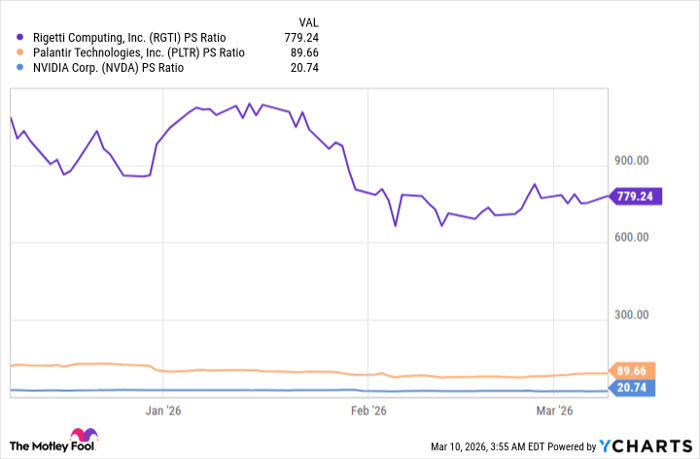
RGTI PS Ratio data by YCharts
Rigetti stock would have to plunge by 88% from its current price just to trade in line with Palantir's valuation, and I would still consider it expensive at that point. Plus, if the company's revenue continues to shrink, its P/S ratio will actually climb from here even without a rise in its stock, which could fuel arguments for even more potential downside.
Should you buy stock in Rigetti Computing right now?
Before you buy stock in Rigetti Computing, consider this:
The Motley Fool Stock Advisor analyst team just identified what they believe are the 10 best stocks for investors to buy now… and Rigetti Computing wasn’t one of them. The 10 stocks that made the cut could produce monster returns in the coming years.
Consider when Netflix made this list on December 17, 2004... if you invested $1,000 at the time of our recommendation, you’d have $511,735!* Or when Nvidia made this list on April 15, 2005... if you invested $1,000 at the time of our recommendation, you’d have $1,140,464!*
Now, it’s worth noting Stock Advisor’s total average return is 946% — a market-crushing outperformance compared to 191% for the S&P 500. Don't miss the latest top 10 list, available with Stock Advisor, and join an investing community built by individual investors for individual investors.
See the 10 stocks »
*Stock Advisor returns as of March 13, 2026.
Anthony Di Pizio has no position in any of the stocks mentioned. The Motley Fool has positions in and recommends Nvidia and Palantir Technologies. The Motley Fool has a disclosure policy.
Recommended Articles


