




Can Nvidia's Stock Reach a $10 Trillion Market Cap by 2030?
Key Points
Nvidia's growth rate has been slowing down in recent quarters, but it remains outstanding.
The stock would need to rise by around 130% to get to a $1 trillion market cap.
Economic uncertainty and a possible slowdown in tech spending, however, could weigh on its share price.
- 10 stocks we like better than Nvidia ›
Nvidia (NASDAQ: NVDA) is the most valuable company in the world, and there's little wonder why that is when you see its financials. Demand for its artificial intelligence (AI) chips is through the roof, and those chips are expensive, enabling the company to grow its business at a high rate while also generating fantastic profit margins along the way.
According to analysts at Grand View Research, the AI market will continue to grow at a compounded annual growth rate of 30.6% until 2033, as businesses continue to invest heavily into all things AI-related. It puts Nvidia in an excellent position to continue growing at a fast rate.
Will AI create the world's first trillionaire? Our team just released a report on the one little-known company, called an "Indispensable Monopoly" providing the critical technology Nvidia and Intel both need. Continue »
Nvidia already became the first company to reach a $5 trillion valuation when it did so last year. Could it also be the first one to reach $10 trillion, perhaps, by the end of the decade?

Image source: Getty Images.
Nvidia still has much more growth ahead
A big reason to stay bullish on Nvidia is that the growth opportunities in AI remain plentiful. And as long as that's the case, the need for cutting-edge chips will be significant, inevitably leading customers back to Nvidia and to purchasing its top-end chips.
What's remarkable about the business is that since its business took off due to the emergence of ChatGPT a few years ago and the ramp-up in AI spending, its lowest quarterly growth rate has been just under 56%.
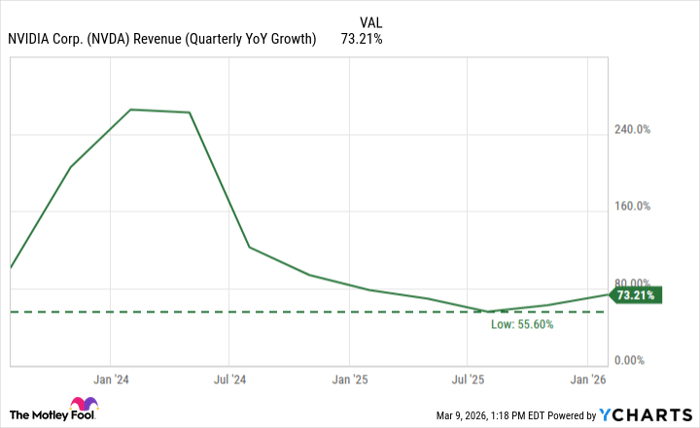
NVDA Revenue (Quarterly YoY Growth) data by YCharts
While most companies would be thrilled with growth of around 50%, for Nvidia, it could send investors into panic mode.
Is a $10 trillion valuation realistic for Nvidia?
Nvidia's valuation sits at around $4.4 trillion, which means that if it were to get to $10 trillion, it would need to more than double, and rise by close to 130%. To get there by around 2030, or four years from now, that would mean the stock would need to rise by an average of nearly 23% per year.
I think that's a tall task given the market conditions, uncertainty, plus the fact that Nvidia already trades at 37 times its trailing earnings. It may not be egregiously expensive, but it's not a dirt cheap stock, either. There's also the possibility that there's a pullback in AI spending in the coming years if economic conditions deteriorate.
Nvidia may very well reach a $10 trillion valuation due to the opportunities in AI, but I don't think it'll happen within the next four years. It's still a good stock to own for the long term, but investors shouldn't set their expectations too high given how far it has already risen in recent years and the challenges ahead.
Should you buy stock in Nvidia right now?
Before you buy stock in Nvidia, consider this:
The Motley Fool Stock Advisor analyst team just identified what they believe are the 10 best stocks for investors to buy now… and Nvidia wasn’t one of them. The 10 stocks that made the cut could produce monster returns in the coming years.
Consider when Netflix made this list on December 17, 2004... if you invested $1,000 at the time of our recommendation, you’d have $522,791!* Or when Nvidia made this list on April 15, 2005... if you invested $1,000 at the time of our recommendation, you’d have $1,132,678!*
Now, it’s worth noting Stock Advisor’s total average return is 952% — a market-crushing outperformance compared to 191% for the S&P 500. Don't miss the latest top 10 list, available with Stock Advisor, and join an investing community built by individual investors for individual investors.
See the 10 stocks »
*Stock Advisor returns as of March 11, 2026.
David Jagielski, CPA has no position in any of the stocks mentioned. The Motley Fool has positions in and recommends Nvidia. The Motley Fool has a disclosure policy.
Recommended Articles


