




Is Oracle Stock a Millionaire Maker?
Key Points
In a matter of months, Oracle has given investors epic highs and painful lows.
Oracle Cloud Infrastructure (OCI) has competitive advantages over rival solutions.
OCI's expansion is becoming increasingly risky as Oracle's free cash flow plummets and debt soars.
- 10 stocks we like better than Oracle ›
There are few stocks that encapsulate the highs and lows of growth stock investing quite like Oracle (NYSE: ORCL).
Will AI create the world's first trillionaire? Our team just released a report on the one little-known company, called an "Indispensable Monopoly" providing the critical technology Nvidia and Intel both need. Continue »
Over the last year, Oracle has gone from a legacy software company turned Wall Street darling, to the poster child of high-risk, debt-fueled artificial intelligence (AI) spending.
Oracle is now down a staggering 54.9% from its all-time high (achieved last September). Here's why Oracle could still be a millionaire maker, and some risks to consider before buying the tech stock.

Image source: Getty Images.
Oracle's potential is undeniable
An essential quality of a long-term investor is patience, which allows an investment thesis to play out. But too much patience can teeter on complacency when dealing with a debt-heavy company like Oracle.
Oracle's database and data management software segment is high-margin and generates tons of free cash flow (FCF), but it's not big enough to fund Oracle's cloud infrastructure ambitions.
Oracle wants to expand the big three cloud players -- Amazon, Microsoft, Alphabet -- into the big four, with Oracle Cloud Infrastructure (OCI) being the premier cloud for high-performance computing and AI applications.
Oracle stock hit an all-time high last September after the company outlined an aggressive road map to grow OCI revenue from $18 billion in fiscal 2026 to $144 billion in fiscal 2030.
For context, Amazon Web Services -- which is the largest cloud infrastructure player in the world -- generated $128.7 billion in 2025 revenue. Meaning Oracle is projecting its cloud revenue less than five years from now to be larger than present-day AWS.
That's the millionaire-maker investment thesis for Oracle, in a nutshell. If that forecast is even remotely close to being true, and OCI generates similar margins to AWS (35.6% in 2025) -- then Oracle stock will likely produce massive returns for investors over the next five years, and potentially compound several-fold over the ultra long term. But the forecast is riddled with uncertainties.
A race against the clock
Oracle's OCI projections are based on remaining performance obligations (RPO) -- which is basically another term for a backlog. Oracle reported $523 billion in RPO in its earnings results for the second quarter of fiscal year 2026, ended Nov. 30, 2025, but $300 billion of that is tied to OpenAI.
In the meantime, it is raising more money through a variety of debt and equity instruments -- further straining its balance sheet.
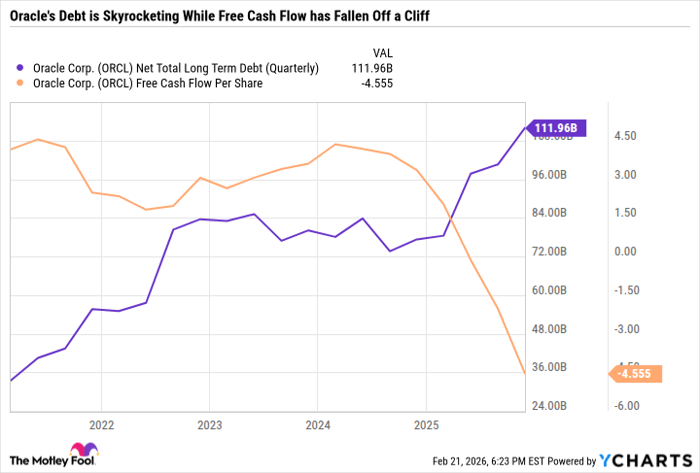
ORCL Net Total Long Term Debt (Quarterly) data by YCharts
Oracle is only a buy for risk-tolerant investors
Oracle is spending a fortune building data centers as quickly as possible to convert its backlog into realized revenue.
Investors looking for a safer way to bet big on cloud computing and AI should consider Microsoft or Amazon. Oracle's aggressive bet could play out and take significant market share from the current leaders, but it depends on a lot going right.
Because the company has so much debt, investors can't just sit idly by and hope that the gamble pays off.
Oracle will report third-quarter fiscal 2026 earnings in the coming weeks. A larger RPO number is unlikely to impress Wall Street, so investors should instead focus on Oracle's spending road map, FCF burn rate, and timeline for improving its balance sheet.
Should you buy stock in Oracle right now?
Before you buy stock in Oracle, consider this:
The Motley Fool Stock Advisor analyst team just identified what they believe are the 10 best stocks for investors to buy now… and Oracle wasn’t one of them. The 10 stocks that made the cut could produce monster returns in the coming years.
Consider when Netflix made this list on December 17, 2004... if you invested $1,000 at the time of our recommendation, you’d have $409,970!* Or when Nvidia made this list on April 15, 2005... if you invested $1,000 at the time of our recommendation, you’d have $1,174,241!*
Now, it’s worth noting Stock Advisor’s total average return is 889% — a market-crushing outperformance compared to 192% for the S&P 500. Don't miss the latest top 10 list, available with Stock Advisor, and join an investing community built by individual investors for individual investors.
See the 10 stocks »
*Stock Advisor returns as of February 25, 2026.
Daniel Foelber has positions in Oracle and has the following options: short March 2026 $240 calls on Oracle. The Motley Fool has positions in and recommends Alphabet, Amazon, Microsoft, and Oracle. The Motley Fool has a disclosure policy.
Recommended Articles


