




Down 25%, Should You Buy the Dip on Bristol Myers Squibb?
Key Points
Multiple core drugs are losing patent protection over the coming years, carving an eventual crater in revenue.
Newer, growing drugs should help fill that hole, and Cobenfy is a wild card with huge potential.
At its current valuation, Bristol Myers Squibb stock seems worthy of your attention.
- 10 stocks we like better than Bristol Myers Squibb ›
Pharmaceutical companies spend a ton of money on developing new drugs. Most fail, but those that win regulatory approval and reach the market can generate billions of dollars in sales, all while patents bar competitors from copying them. Patents last for years, but they eventually expire.
At that point, a drug's sales plummet once generic copies become available to patients. This is often called the "patent cliff." It's why innovation is so essential for pharmaceutical stocks: Their companies must continually develop and bring new products to market to survive, let alone grow.
Will AI create the world's first trillionaire? Our team just released a report on the one little-known company, called an "Indispensable Monopoly" providing the critical technology Nvidia and Intel both need. Continue »
Bristol Myers Squibb (NYSE: BMY) is trading more than 25% off its high due to a steep patent cliff the company faces. Should you buy the dip?
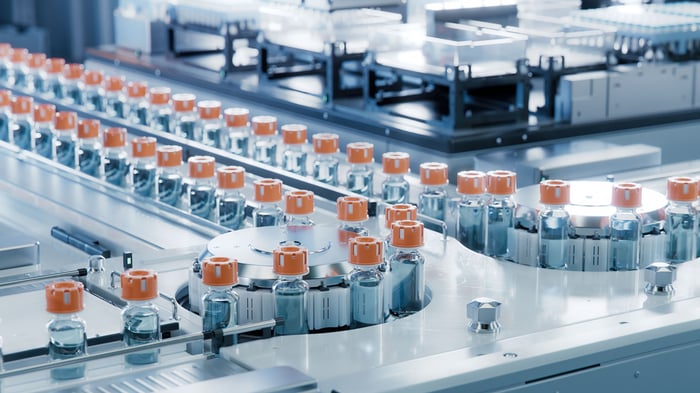
Image source: Getty Images.
Investors face a real cliff-hanger, but there's hope
Patent cliffs are typical of the industry, but Bristol Myers Squibb faces an abnormally steep one. Generic competition caused Revlimid sales to decline by 48.9% to $2.9 billion in 2025, while Sprycel sales dipped 61.7% to $493 million. More pressing is the looming patent expiration of top sellers Eliquis and Opdivo, which combined for $24.4 billion in sales in 2025, roughly half of total revenue. Those drugs will lose U.S. patent protection between 2027 and 2029, paving the way for generics shortly thereafter.
Bristol Myers Squibb has a growth portfolio of rising drugs, which, excluding Opdivo, grew sales roughly 23% to $16.3 billion in 2025. Cobenfy is a groundbreaking antipsychotic drug for schizophrenia that launched in late 2024. It's now in a phase 3 study for treating psychosis related to Alzheimer's disease. Results are due in 2026, and if ultimately approved, the drug would be the first of its kind. Analysts estimate that Cobenfy could hit annual sales of $3.4 billion by 2030 if it wins approval from the Food and Drug Administration (FDA).
Why buying the dip could work out well
For now, the patent cliff is a slow slide, not a plunge. Analysts' estimates call for sales to decline from $48.2 billion in 2025 to $45.2 billion by the end of 2027. Analysts believe earnings will be flat in 2026.
Yet there's much to like here. Bristol Myers Squibb will pay you a nice dividend, currently 4.2%. The dividend costs less than half of earnings, so it's pretty safe and can endure even a sizable contraction in the business. Also, Wall Street is already very aware of the patent cliff; the stock trades at less than 10 times this year's earnings estimates. There are still risks, such as the possibility that Cobenfy fails its phase 3 study. But from a valuation standpoint, the stock definitely reflects reality.
If Bristol Myers Squibb succeeds with Cobenfy for Alzheimer's, there could be enough growth to replace the eventual lost sales from Eliquis and Opdivo, and perhaps even continue growing the business. The stock's valuation would likely rise along the way on positive sentiment, and investors would still be cashing those dividend checks.
If you're looking to swing big over a five-year time frame, consider buying the dip on Bristol Myers Squibb.
Should you buy stock in Bristol Myers Squibb right now?
Before you buy stock in Bristol Myers Squibb, consider this:
The Motley Fool Stock Advisor analyst team just identified what they believe are the 10 best stocks for investors to buy now… and Bristol Myers Squibb wasn’t one of them. The 10 stocks that made the cut could produce monster returns in the coming years.
Consider when Netflix made this list on December 17, 2004... if you invested $1,000 at the time of our recommendation, you’d have $424,262!* Or when Nvidia made this list on April 15, 2005... if you invested $1,000 at the time of our recommendation, you’d have $1,163,635!*
Now, it’s worth noting Stock Advisor’s total average return is 904% — a market-crushing outperformance compared to 194% for the S&P 500. Don't miss the latest top 10 list, available with Stock Advisor, and join an investing community built by individual investors for individual investors.
See the 10 stocks »
*Stock Advisor returns as of February 21, 2026.
Justin Pope has no position in any of the stocks mentioned. The Motley Fool has positions in and recommends Bristol Myers Squibb. The Motley Fool has a disclosure policy.
Recommended Articles


