




This Artificial Intelligence Stock Could Bounce Back in 2026
Key Points
AWS continues to be a bright spot for the business.
The stock hasn't been this cheap in a long time.
- 10 stocks we like better than Amazon ›
Some artificial intelligence (AI) stocks just haven't had as good a run as others. While the overall AI investment sector has done well, others have been left behind. One that has performed poorly over the past year is Amazon (NASDAQ: AMZN). While some may hesitate to call Amazon an AI stock, it's one of the most important companies in this sector thanks to Amazon Web Services (AWS).
I think Amazon can bounce back this year and deliver strong returns along the way.
Will AI create the world's first trillionaire? Our team just released a report on the one little-known company, called an "Indispensable Monopoly" providing the critical technology Nvidia and Intel both need. Continue »

Image source: Getty Images.
Amazon plays a huge role in AI
Since 2025, Amazon's stock has declined by around 7%. However, its revenue and earnings are up significantly from that time.
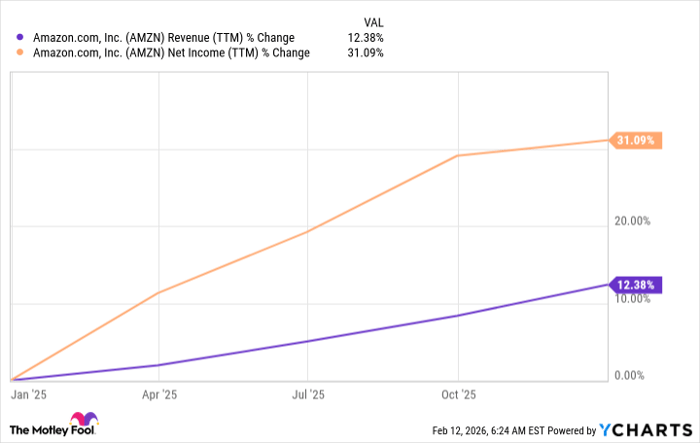
AMZN Revenue (TTM) data by YCharts.
The poor showing of Amazon's stock despite strong growth points to Amazon's valuation declining. That's exactly what has happened, as the market is unwilling to pay the premium that it used to pay to own Amazon's stock.
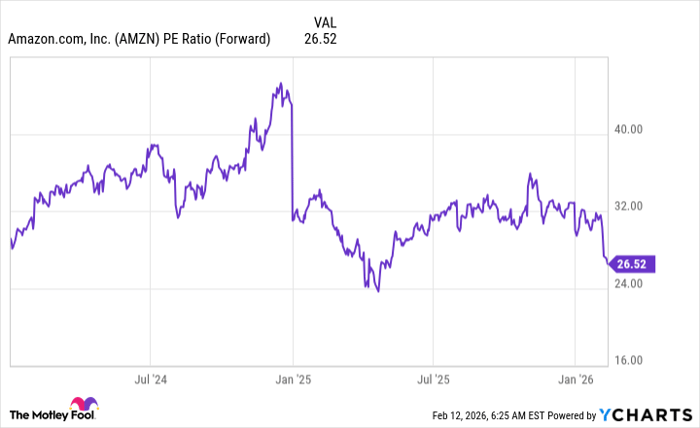
AMZN PE Ratio (Forward) data by YCharts.
At 26.5 times forward earnings, Amazon is now trading in the range that most big tech stocks do. This pullback was likely warranted, as the 30-plus times forward earnings investors used to have to pay for it were a little much considering the results.
However, I think right now is a reasonable price to pay for the stock, and any future gains will be caused by its underlying business improving.
During the fourth quarter (Q4), Amazon crushed it. Overall sales rose 14% year over year, compared with 12% growth during last year's Q4. Powering that acceleration was AWS, Amazon's cloud computing platform. Cloud computing plays an important role in AI because it gives developers access to the computing power needed to create and run AI models. Without cloud computing, the generative AI landscape would look far different from what it does today.
AWS grew at a 24% pace during Q4, the fastest rate in 13 quarters. That rewinds the clock to 2022, the year before AI really took center stage. This is a big deal for Amazon, as it shows that AWS is starting to become a top option to build AI models on. If it can contain this growth rate throughout 2026, I have no doubt that Amazon's stock will bounce back throughout the year.
The only holdup I have is its spending. Amazon informed investors that it plans to spend $200 billion on capital expenditures during 2026, with most of that going to data centers. This will eat into Amazon's cash flows, which many investors don't appreciate. However, if the demand for AI computing is there, then building out the computing footprint makes sense. I'm going to give the benefit of the doubt to management, as they probably know more about the situation than the average investor.
I think that Amazon is a great buy today and should bounce back throughout 2026.
Should you buy stock in Amazon right now?
Before you buy stock in Amazon, consider this:
The Motley Fool Stock Advisor analyst team just identified what they believe are the 10 best stocks for investors to buy now… and Amazon wasn’t one of them. The 10 stocks that made the cut could produce monster returns in the coming years.
Consider when Netflix made this list on December 17, 2004... if you invested $1,000 at the time of our recommendation, you’d have $414,554!* Or when Nvidia made this list on April 15, 2005... if you invested $1,000 at the time of our recommendation, you’d have $1,120,663!*
Now, it’s worth noting Stock Advisor’s total average return is 884% — a market-crushing outperformance compared to 193% for the S&P 500. Don't miss the latest top 10 list, available with Stock Advisor, and join an investing community built by individual investors for individual investors.
See the 10 stocks »
*Stock Advisor returns as of February 15, 2026.
Keithen Drury has positions in Amazon. The Motley Fool has positions in and recommends Amazon. The Motley Fool has a disclosure policy.
Recommended Articles


