




If I Had to Bet on 1 Vanguard ETF Outperforming the Market in 2026, This Would Be It
Key Points
The Vanguard Growth ETF has outperformed the S&P 500 in 15 of its 22 years.
The "Magnificent Seven" stocks account for close to 58% of the fund.
Growth in cloud computing, digital advertising, and artificial intelligence (AI) infrastructure buildouts could fuel more gains for the ETF.
- 10 stocks we like better than Vanguard Index Funds - Vanguard Growth ETF ›
The S&P 500 (SNPINDEX: ^GSPC) tracks abiout 500 of the largest U.S. public companies, and is widely considered the most important index in the stock market. That's why its performance is often used to gauge if a stock or exchange-traded fund (ETF) had a good year.
We can't predict how a stock or ETF will perform, but there's one Vanguard ETF that has consistently outperformed the S&P 500 that's poised to keep it going: the Vanguard Growth ETF (NYSEMKT: VUG). In 2025, the fund rose 18.9%, outperforming the S&P 500's 16.4% gain.
Where to invest $1,000 right now? Our analyst team just revealed what they believe are the 10 best stocks to buy right now. Continue »

Image source: Getty Images.
Focusing on growth stocks
The Vanguard fund mirrors the CRSP US Large Cap Growth Index, which tracks the companies that account for 85% of the U.S. stock market's value and selects those with faster-growing sales and profits than their industry average. It currently holds 151 companies.
Since the ETF is weighted by market cap, larger companies make up a greater share than smaller ones. This has made the fund tech-heavy (65.8% of the ETF), but those have been the best-performing growth stocks on the market during the past decade.
In that time, the Vanguard Growth fund has gained 390%, compared to the S&P 500's 265%.
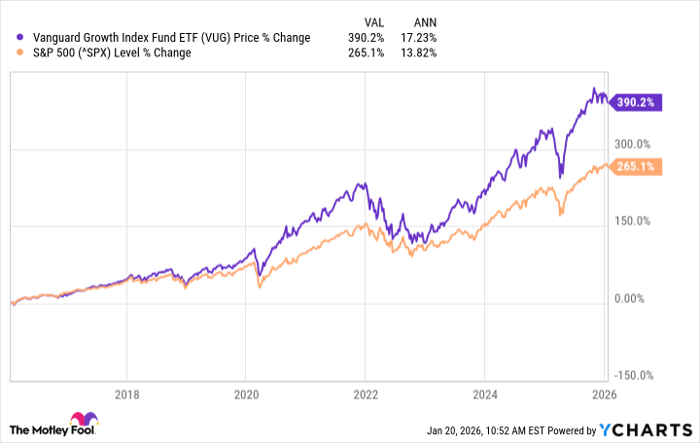
VUG data by YCharts
A lot is riding on the "Magnificent Seven" stocks
The "Magnificent Seven" stocks account for close to 58% of the fund, so whether it outperforms depends heavily on how they perform as a group. Below is a list of their weighting in the fund:
- Nvidia: 12.7%
- Apple: 11.9%
- Microsoft: 10.6%
- Alphabet (Class A): 5.4%
- Amazon: 4.6%
- Alphabet (Class C): 4.3%
- Meta Platforms (Class A): 4.3%
- Tesla: 3.8%
There's real concern that Magnificent Seven stocks are overvalued, and the risk of a correction is high. However, there are tech tailwinds happening that could drive them to a better 2026. In 2025, only Nvidia and Alphabet outperformed the S&P 500, rising 39% and 65%, respectively.
If investors begin seeing revenue growth and tangible returns from increased artificial intelligence (AI) spending, the Magnificent Seven is in good shape. If investors get impatient (which they tend to do), we could see them struggle.
Par for the course
The Vanguard Growth fund has outperformed the S&P 500 in 15 of its 22 years on the market. That doesn't mean it will this year, but in the seven years it underperformed, there was one common theme: Investors preferred value stocks to riskier growth stocks.
With the expected growth of AI infrastructure, cloud computing services, digital advertising, and potential cuts in interest rates, this fund is positioned to continue its outperformance streak.
Should you buy stock in Vanguard Index Funds - Vanguard Growth ETF right now?
Before you buy stock in Vanguard Index Funds - Vanguard Growth ETF, consider this:
The Motley Fool Stock Advisor analyst team just identified what they believe are the 10 best stocks for investors to buy now… and Vanguard Index Funds - Vanguard Growth ETF wasn’t one of them. The 10 stocks that made the cut could produce monster returns in the coming years.
Consider when Netflix made this list on December 17, 2004... if you invested $1,000 at the time of our recommendation, you’d have $450,525!* Or when Nvidia made this list on April 15, 2005... if you invested $1,000 at the time of our recommendation, you’d have $1,133,107!*
Now, it’s worth noting Stock Advisor’s total average return is 937% — a market-crushing outperformance compared to 195% for the S&P 500. Don't miss the latest top 10 list, available with Stock Advisor, and join an investing community built by individual investors for individual investors.
See the 10 stocks »
*Stock Advisor returns as of January 24, 2026.
Stefon Walters has positions in Apple and Microsoft. The Motley Fool has positions in and recommends Alphabet, Amazon, Apple, Meta Platforms, Microsoft, Nvidia, Tesla, and Vanguard Index Funds - Vanguard Growth ETF. The Motley Fool recommends the following options: long January 2026 $395 calls on Microsoft and short January 2026 $405 calls on Microsoft. The Motley Fool has a disclosure policy.
Recommended Articles


