




Water War Escalates: Kuwait Desalination Plant Attacked, Oil Prices Break 100 and New Market Logic
TradingKey - On the evening of March 29, 2026, a power and desalination facility in Kuwait was directly hit by Iranian missiles, resulting in casualties. Kuwaiti officials explicitly characterized the event as an 'attack' rather than an accidental strike. Almost simultaneously, the Kuwaiti military reported attacks on military bases and damage to several power transmission lines.
On March 30, Donald Trump warned on social media that if Iran does not reopen the Strait of Hormuz, the U.S. could strike targets including power facilities, oil infrastructure, and even desalination plants. This statement directly exacerbated tensions; by explicitly listing desalination facilities as potential targets, the U.S. has escalated its threat to potentially cutting off the essential water supply for tens of millions of people.
Capital markets moved quickly to price in the news on March 30: WTI crude jumped 3.3% to $102.88 per barrel, marking its first close above $100 since July 2022; Brent crude was quoted at $112.78 per barrel.
However, more noteworthy than oil prices is the target of the attacks itself—water, which is becoming a more lethal 'soft target' than oil.
I. Why Desalination Plants?
Gulf nations' drinking water is heavily dependent on desalination, a well-known vulnerability.
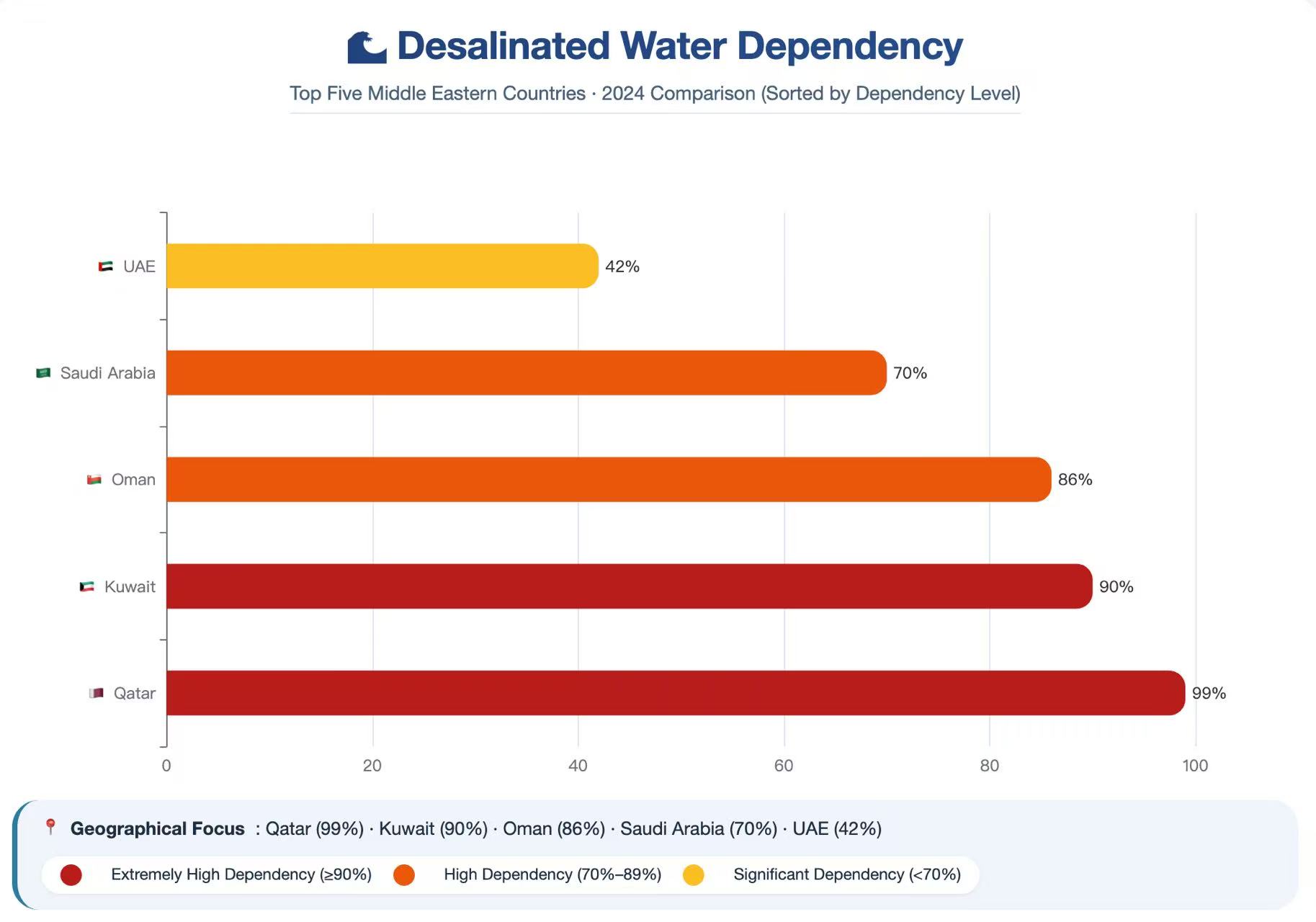
Source: Al Jazeera (Metric: percentage of national drinking water supply derived from desalination)
For Gulf states, water is more precious—and more vulnerable—than oil. In Kuwait, as much as 90% of drinking water comes from desalination. Major plants include Shuaiba North, Shuaiba South, Az-Zour, Shuwaikh, Doha East, Doha West, and Subiya, with a combined daily capacity exceeding 2.2 million cubic meters. Should these centralized, large-scale facilities be compromised, alternatives would be nearly impossible to find; the region lacks rivers and lakes, groundwater is already severely over-extracted, and rainfall is exceptionally rare.
Ii. Why Has Water Become The "New Target"?
Iran's recent attacks on Gulf infrastructure demonstrate a clear escalation across three patterns:
1. Expanding The Battlefield And Increasing The Cost Of Alliance
By targeting water resources, the risk of war is brought directly to every household's tap, making it impossible for Gulf nations to remain on the sidelines.
2. Attacking Civilian "Soft Targets" To Circumvent All-Out War
While desalination plants are civilian facilities, their strategic importance is on par with military bases. Such attacks can incite panic without directly triggering a full-scale escalation into war.
3. Exploiting The "Symbiotic Vulnerability" Of Power And Water
Most desalination plants utilize a cogeneration model, where power plants provide the heat and electricity required for desalination. Attacking the power system can indirectly paralyze the water supply, delivering a dual strike.
The Kuwait incident is not an isolated case. Over the past month, desalination facilities in several countries across the region have been attacked or impacted:
- March 1: Facilities near Jebel Ali Port in the UAE caught fire due to missile debris, leading to a suspension of port operations.
- March 7: The U.S. was accused of attacking a desalination plant on Iran's Qeshm Island, affecting the water supply for 30 villages.
- March 8: Bahrain claimed that Iranian drones attacked a desalination plant within its territory.
- March 29: Kuwait's Doha West Power and Distillation Plant was attacked, impacting approximately 38.5% of the country's fresh water supply.
III. Market Reaction: Oil Prices Surge Toward $100, Asset Pricing Logic Rewritten
Crude Oil: From 'Transportation Bottlenecks' to 'Capacity Destruction'
Attacks coupled with Trump's hawkish rhetoric have caused market panic over supply disruptions to escalate sharply.
- March 30: WTI closed at $102.88, while Brent settled at $112.78.
- Early hours of March 31: The Kuwaiti oil tanker 'Al-Salmi' was hit by a drone attack at the Port of Dubai, resulting in hull damage and a fire. WTI surged as much as 3.7% to $106.70, its highest level since July 2022.
Unlike reversible transportation bottlenecks, direct strikes on energy infrastructure could lead to permanent capacity losses, with repairs taking months or even years. Furthermore, following the Houthis' first attack on Israel, the market fears a blockade of the Bab-el-Mandeb Strait, creating a 'double chokepoint' crisis.
IV. Trump’s “Aggressive Warnings” and Reversal of Stance
On March 30, Trump issued an aggressive warning on social media: if Iran does not reopen the Strait of Hormuz, the U.S. will "completely destroy all of Iran's power plants, oil wells, and Kharg Island, potentially even including desalination plants."
Explicitly listing "desalination facilities" as potential targets implies that the U.S. is threatening to cut off not just the energy lifeline, but the vital water source for tens of millions—an extreme form of deterrence that pushes the conflict toward "mutually assured destruction of livelihoods."
However, just one day later during intraday trading on March 31, Trump told aides he was "willing to end the war even without the Strait of Hormuz reopening." Markets immediately staged a V-shaped reversal: Nasdaq futures jumped 1%, the Nikkei turned positive, and oil prices fell more than 1%, erasing most of the gains accumulated following the tanker attacks.
This dramatic reversal reveals a core characteristic of the current market: geopolitical headlines—particularly Trump's personal rhetoric—have become the central variable driving short-term volatility in oil prices and stock markets, with an influence that even outweighs the Federal Reserve's monetary policy signals.
V. How to Price Water Infrastructure Risk?
The attack on desalination plants reveals the escalation of conflict from energy assets to critical lifeline infrastructure. In the Gulf region, numerous desalination plants backed by international giants (ACWA Power, Engie, Veolia, etc.)—once viewed as stable cash-flow assets—now face significant geopolitical risk exposure.
Structural opportunities may emerge in the following sectors:
- Distributed Desalination Systems: Replacing centralized facilities to mitigate single-point-of-failure risks
- Reverse Osmosis (RO) Membrane Technology: High efficiency and modularity, suitable for decentralized deployment
- Water Utility Security and Defense: Physical security, anti-drone defense, and cybersecurity
- Water Asset Financing Premiums: Geopolitical risks will drive up financing costs; projects with built-in security redundancies will likely command valuation premiums
Water security is shifting from an ESG concern to a national security imperative, potentially impacting sovereign credit ratings, risk assessments for multinational corporations, and the long-term valuation logic of water assets.
Water Resource Red Line
The oil market can withstand price volatility, global supply chains can adjust trade routes, and even flight cancellations and travel disruptions can be absorbed, but water is the exception. In the 45°C heat of a Persian Gulf summer, without water, cities cannot function, hospitals cannot operate, and order will collapse within days. International humanitarian law—the Geneva Conventions—explicitly prohibits attacks on civilians and civilian infrastructure, but whether these provisions can restrain off-course missiles in the heat of war remains an unknown.
The attack on the Kuwaiti desalination plant may be just the tip of the iceberg. It reveals a disturbing trend: when war crosses the red line of water, the entire region enters an unpredictable phase of vulnerability. For capital markets, the next 'price discovery' frontier in the Middle East conflict is water. Every desalination plant is a new risk variable that global investors must learn to price.
Recommended Articles


