




How US Midterm Elections Impact the Crypto Market: Will Bitcoin Price Surge or Crash?
What Are the US Midterm Elections?
TradingKey - U.S. midterm elections refer to periodic nationwide elections held at the exact midpoint of a U.S. president's four-year term (Year 2). U.S. midterm elections primarily focus on elections across three levels: the House of Representatives, the Senate, and local public offices, as detailed below:
House of Representatives | Senate | Governors and Local Public Offices | |
Total Seats | 435 seats (all up for election) | 100 seats (divided into three rotating classes) | 50 state governors and local legislatures |
Scope of Midterm Election | 100% up for election (435 seats) | About 1/3 of seats up for election (typically 33–35 seats) | Gubernatorial elections in 36 states, along with state legislators, judges, etc. |
Term Length | 2 years | 6 years (1/3 up for election every 2 years) | 4 years for most governors (2 years in a few states) |
Constitutional and Legislative Powers | Responsible for drafting budget bills, power of appropriations, and authority to initiate impeachments of public officials | Responsible for confirmation of federal officials/judges, ratification of international treaties, and impeachment trials | Responsible for state laws, police powers, state budgets, and redistricting |
As can be seen, U.S. midterm elections do not elect the president, but they completely reshuffle the power landscape of the U.S. Congress (the Senate and the House of Representatives) and determine executive and local governance powers in most states. Therefore, they are widely recognized as the core 'midterm exam' and vote of confidence regarding satisfaction with the incumbent president and their ruling party.
Three Midterm Elections Experienced by the Crypto Market
As the earliest cryptocurrency, Bitcoin has experienced three midterm elections since acquiring sufficient market liquidity, namely in 2014, 2018, and 2022, and Bitcoin prices experienced dramatic volatility before and after these three elections.
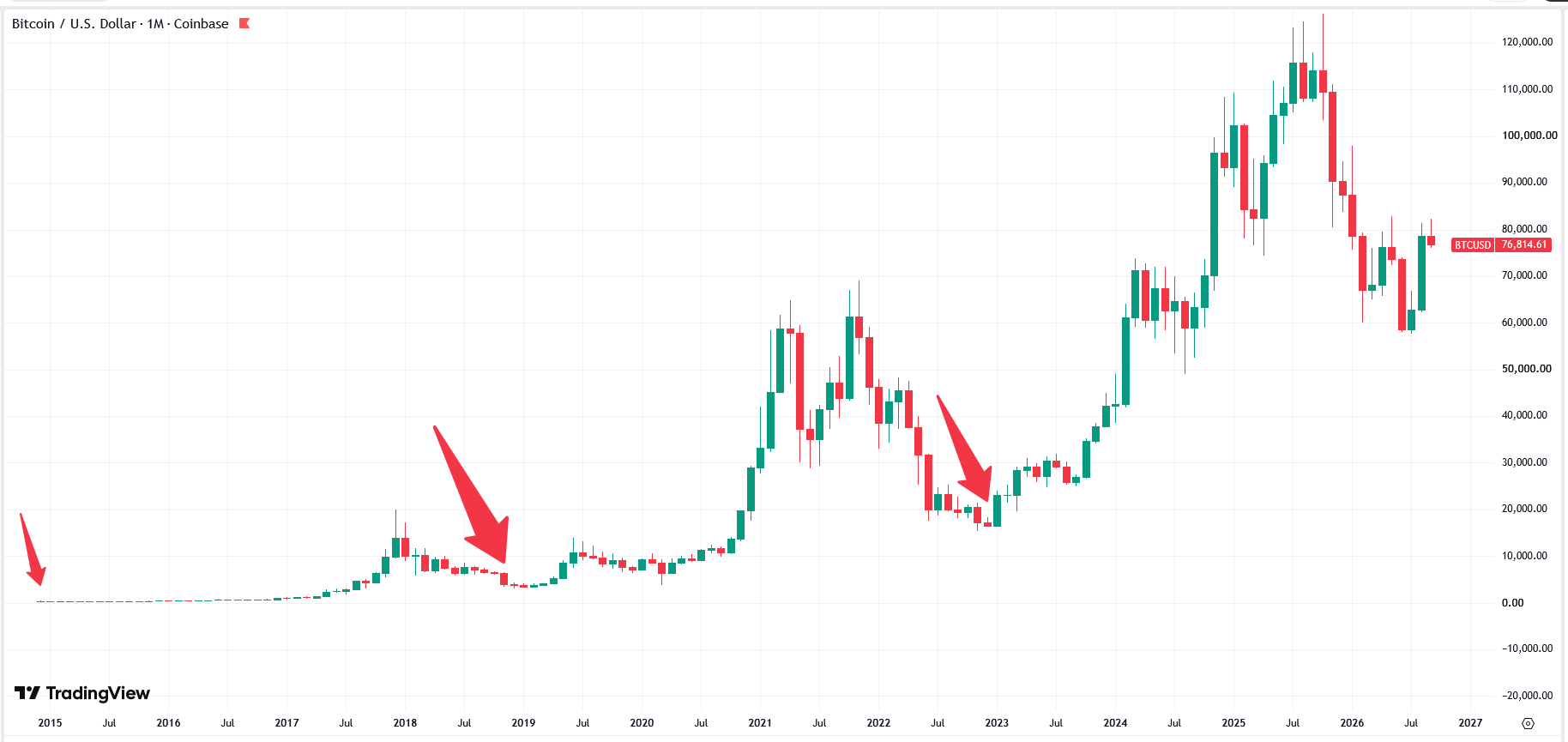 Bitcoin price chart, source: TradingView
Based on historical data analysis, U.S. midterm election years usually coincide with Bitcoin's cycle bottom, presenting a very distinct and consistent cyclical pattern of falling first and then rising, as detailed below:
Midterm Election Year | Pre-Election/Mid-Year Performance | 12-Month Post-Election Performance |
2014 | -56% | Significant rebound and bottoming |
2018 | -73% | Surged > 50% |
2022 | -64% | Rallied > 50% |
Why Bitcoin Prices Always Fall Before Rising?
Bitcoin prices dropped sharply prior to the midterm elections, primarily because policy uncertainty triggered a liquidity contraction. On the eve of elections (typically August to October), the fierce battle between the two parties for control of Congress leaves regulatory bills and future tax rate policies filled with variables. For institutional investors, policy unknowns are more unsettling than known negative factors; therefore, they deleverage in advance, lock in profits, and move into cash for safe-haven protection, causing market liquidity to dry up.
However, as election uncertainty clears and policy certainty emerges at the margin, these conditions improve. Historical data shows that regardless of which party ultimately controls the Senate and the House of Representatives, once the election results are settled, the largest political tail risk is eliminated. Post-election, with congressional seats determined, regulatory policy paths and legislative priorities for both parties become predictable, prompting previously sidelined capital and quantitative funds to quickly re-enter the market and build positions.
In addition, to pave the way for the presidential election two years later, the administration and the new Congress often turn to economic stimulus, fiscal appropriations, or tax incentives. This post-election tendency toward fiscal easing injects liquidity into risk assets. Another non-negligible factor is that U.S. midterm elections (such as in 2014, 2018, and 2022) happen to fall at the end of the bear market or the bottoming-out phase of Bitcoin's four-year bull-bear cycle, after which the market gradually enters the quadrennial halving cycle.
2026 Midterm Elections: Will Bitcoin Price Repeat 'Fall First, Then Rise'?
The 2026 midterm elections (November 3) remain highly likely to repeat the structural pattern of pre-election volatility and pullback shakeouts, followed by a renewed rally once post-election uncertainty clears. This is because the run-up to midterm elections is typically the most vulnerable period for financial markets, when short-term pullbacks in U.S. tech stocks tend to directly spill over into Bitcoin. In addition, the Clarity Act is currently stalled, triggering short-term risk-averse selling pressure.
After the election, once the composition of the new Congress is finalized, regulatory certainty—regardless of which party gains the upper hand—will allow institutional risk-management models to be re-established, driving sidelined capital back into the market. Furthermore, with Super PACs contributing hundreds of millions of dollars in political donations, both Republicans and Democrats have turned increasingly friendly toward cryptocurrencies.
Although the rhythm is similar, the market foundation in 2026 is fundamentally different from the past, making a recurrence of historic pre-election surges or crashes of over 50% unlikely. This is because spot ETFs and accumulated traditional institutional capital provide Bitcoin with strong upper and lower bounds, while industry maturity has further improved.
Conclusion
U.S. midterm elections are held at the midpoint of a president's four-year term to elect members of Congress and local officials. Historical data shows that Bitcoin often declines ahead of elections due to regulatory uncertainty and institutional risk aversion, but rebounds strongly after the elections as policies take effect and headwinds fade. In 2026, supported by spot ETFs and Super PACs, the market foundation is more solid, and the market is expected to repeat the pattern of 'falling first, then rising,' though a crash of historic proportions is extremely unlikely.
Recommended Articles


