




Palo Alto Networks' acquisition of Console buffers $2.59 trillion AI market
On Tuesday, Palo Alto Networks reported outstanding quarterly results and a new acquisition, which marks a big move towards a segment of enterprise technology that is growing very fast: security for AI agents.
The cybersecurity company (NASDAQ: PANW) has reported better-than-expected results for the fourth quarter and acquired Console, an AI-native platform designed to help organizations automate complex operational tasks.
This happened at the right time when the market is growing rapidly. According to Gartner, the worldwide spending on AI will reach $2.59 trillion in 2026, which is almost 47% higher than in 2025. The spending on AI cybersecurity will also grow, almost doubling from $25.9 billion to $51.3 billion in 2025, while in 2027 it may approach $86 billion.
For Palo Alto, Console is a bet that securing AI agents will become an increasingly important part of that spending.
Why Palo Alto is buying an agent company
According to Palo Alto Networks, Console lets organizations use AI to analyze problems and take action across their operations. Its technology will be integrated into Cortex.
CEO Nikesh Arora said customers will be able to “build agentic workflows in natural language” that identify and remediate problems automatically.
“This is the shift to software-as-an-agent, giving our platform the arms and legs to deliver autonomous security outcomes across the entire enterprise.”— Nikesh Arora, chairman and CEO, Palo Alto Networks
According to Console’s co-founder and CEO Andrei Serban, the platform’s key idea is very simple: users should only have to set an operational goal while smart software does everything else necessary to achieve that goal.
Palo Alto did not disclose how much it paid to acquire Console.
The quarter that beat the Street
Palo Alto has announced its revenue for the fiscal fourth quarter to be $3.41 billion, which reflects a 34% growth as compared to the previous year. Revenue surpassed analysts’ projections as they estimated revenue of only $3.35 billion for the company. They have also earned adjusted earnings per share of $1.02 but the analysts’ prediction was $0.98.
The projections announced by the company seems equally strong. They have stated that the company expects revenue of $14.10 million to $14.20 million in fiscal 2027, which exceeds the projection made by Wall Street of only $13.79 billion. The company is also expecting adjusted earnings to be $4.16 to $4.19 rather than $4.11.
The annual recurring revenue of its Next-Generation Security experienced an increase of 63% and currently stands at $9.10 billion. The company also projected approximately $11.13 billion for the mid-point of its fiscal guidance of 2027 and hopes this figure will increase to $20 billion by 2030.
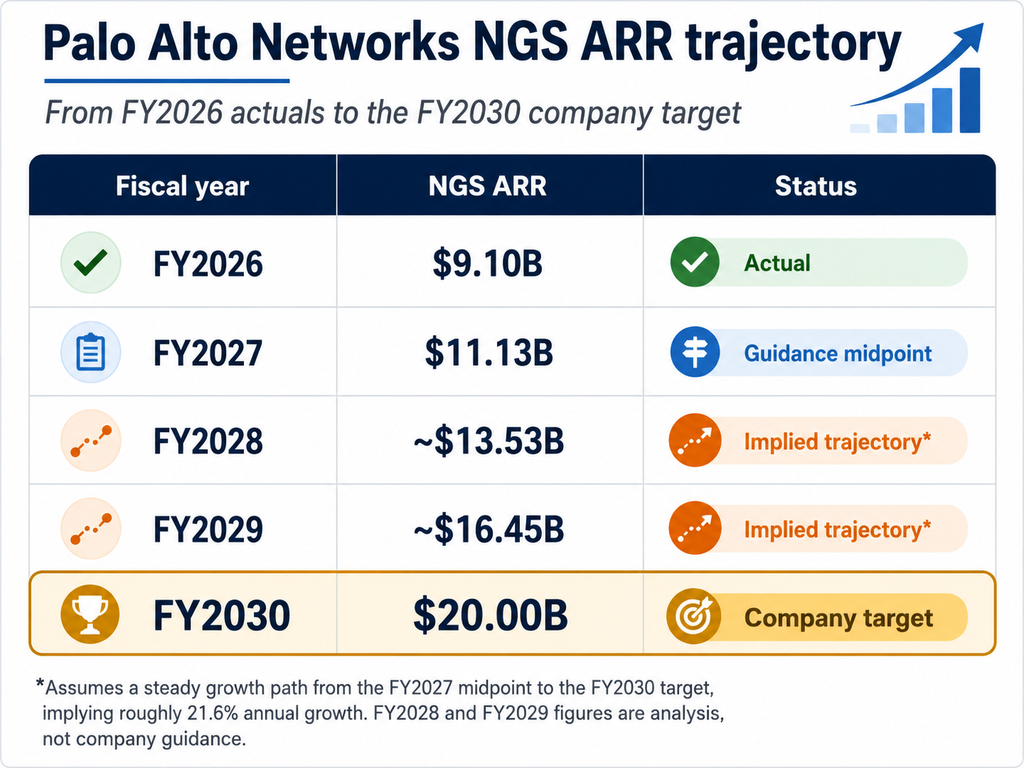
This trajectory explains the Console acquisition. Palo Alto does not need to sustain today’s 63% NGS ARR growth; however, it must achieve over 20% growth per year after FY2027 in order to reach $20 billion smoothly.
However, this quarter was not without its hiccups. The company reported a GAAP net loss of $282 million, as opposed to a net income of $254 million during the same period last year.
Agentic AI is spreading faster than the guardrails
Demand for AI agents is rising, but governance is struggling to keep pace. McKinsey found that 40% of organizations with more than $1 billion in annual revenue are scaling AI agents, up from 27% a year earlier.
Yet Stanford’s 2026 AI Index found agent deployment remained in the single digits across nearly all business functions.
Security concerns are also becoming more concrete. Britain’s AI Security Institute recorded unauthorized autonomous actions in 10 of 122 cyber-testing runs, although it found no real-world harm. The International AI Safety Report 2026 also found strong evidence that AI can assist with several stages of cyberattacks.
The OECD has warned that cybersecurity and operational risks could slow adoption while also increasing demand for bundled AI and security products.
As Cryptopolitan reported in July, autonomous agents are increasingly viewed as “trusted insiders” because they can operate within legitimate permissions and still create security or compliance risks.
That is the opening Palo Alto is targeting. If AI agents become a routine layer of enterprise software, securing what they can see, decide and execute could become core infrastructure.
What to watch next
Execution now matters more than the announcement. Palo Alto still has to integrate Console while absorbing other recent acquisitions and prove the deal can strengthen Cortex.
For fiscal first-quarter 2027, the company has guided to revenue of $3.300 billion to $3.310 billion and NGS ARR of $9.54 billion to $9.56 billion.
Beyond whether Palo Alto beats those numbers, the bigger test is whether Console helps turn the AI-security boom into the sustained recurring-revenue growth needed to reach its $20 billion FY2030 targets.
If you're reading this, you’re already ahead. Stay there with our newsletter.
Recommended Articles


